

Escaping eyeballs
A new arrival at the National Gallery in London.

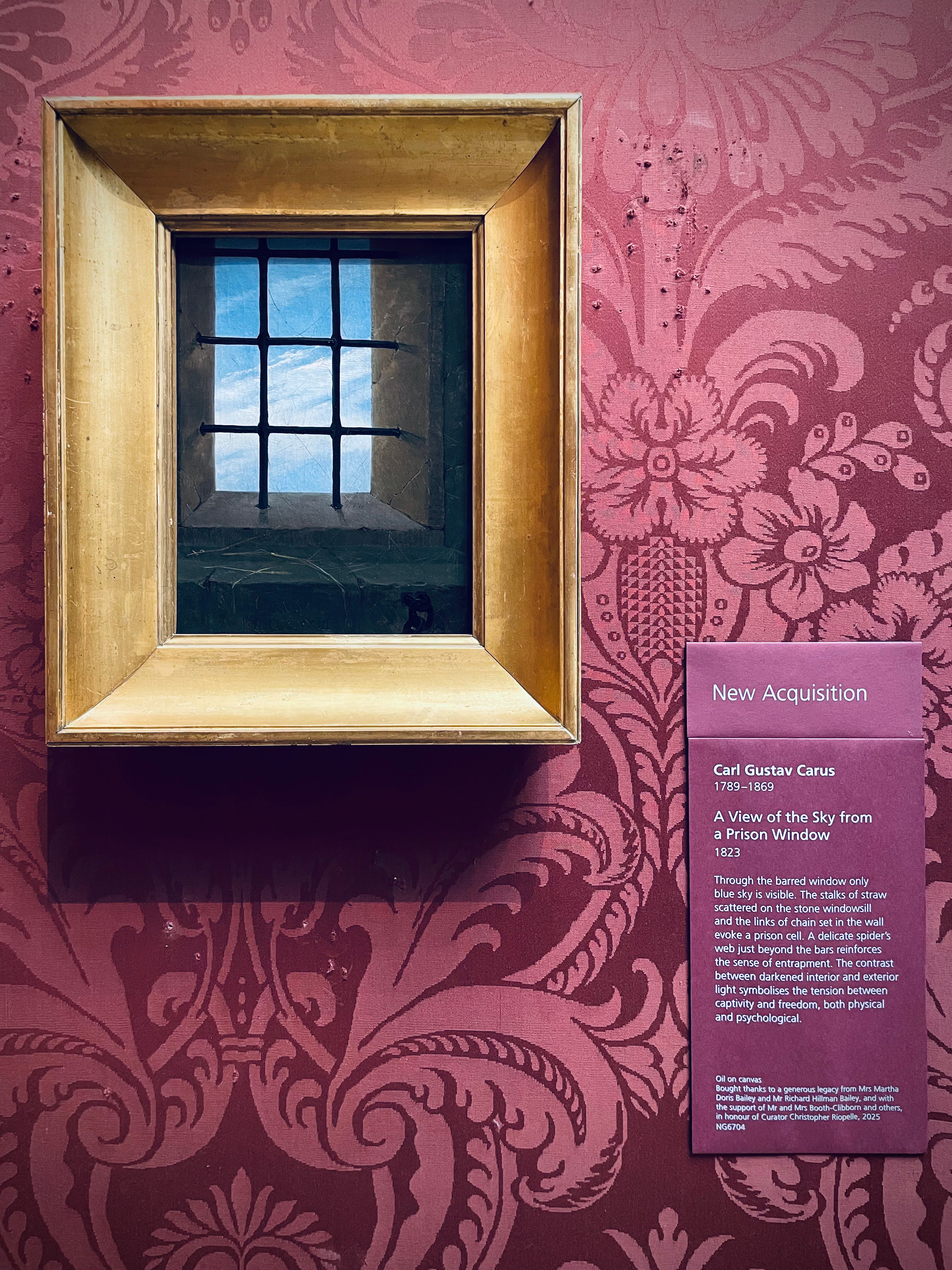
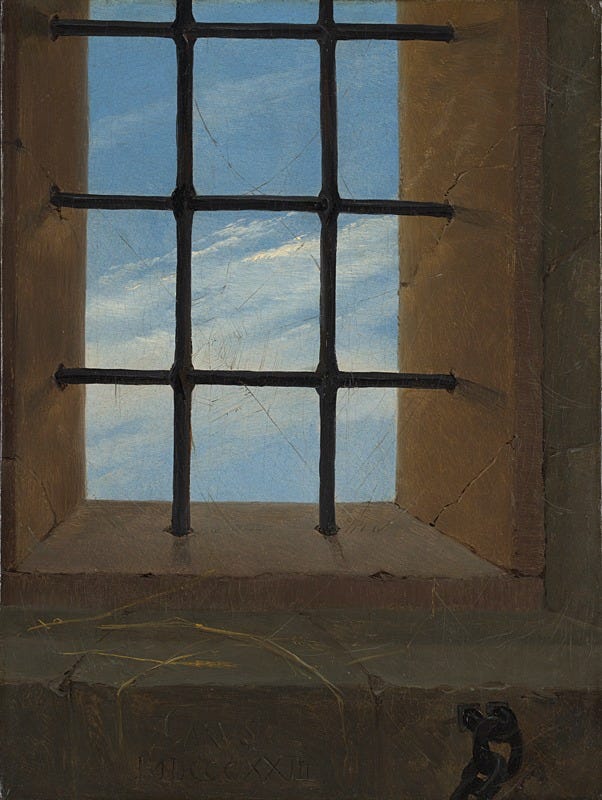
I’VE WRITTEN for the London Review of Books about a small painting recently acquired by the National Gallery: A View of the Sky from a Prison Window, painted in 1823 by the German artist Carl Gustav Carus.
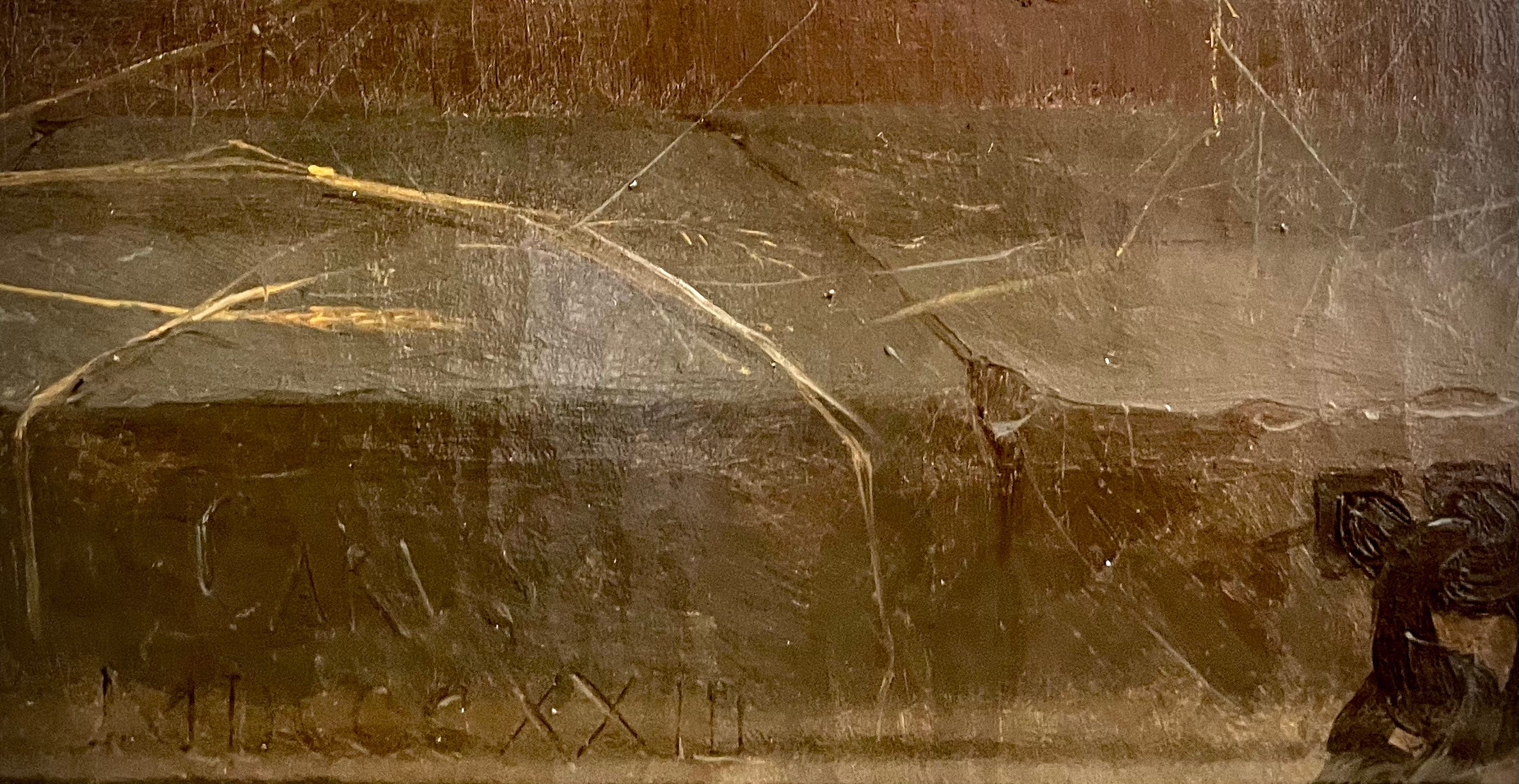
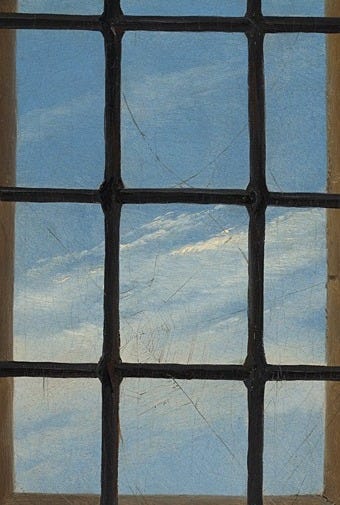
It shows a barred stone window looking onto a patch of blue sky and wispy clouds. Fine strands of cobweb criss-cross the window bars, and a few stalks of straw lie on the cracked window ledge. Carus’s signature and the date, MDCCCXXIII, are just about legible next to the top three links of an iron chain set in the wall:
It is hardly the sort of painting to leap out from the gallery walls, and on first sight might appear a little disappointing, a little empty.
At the National Gallery it hangs on a side wall, half-hidden behind a black marble column; a newcomer waiting to take its place in the collection. You might easily miss it.
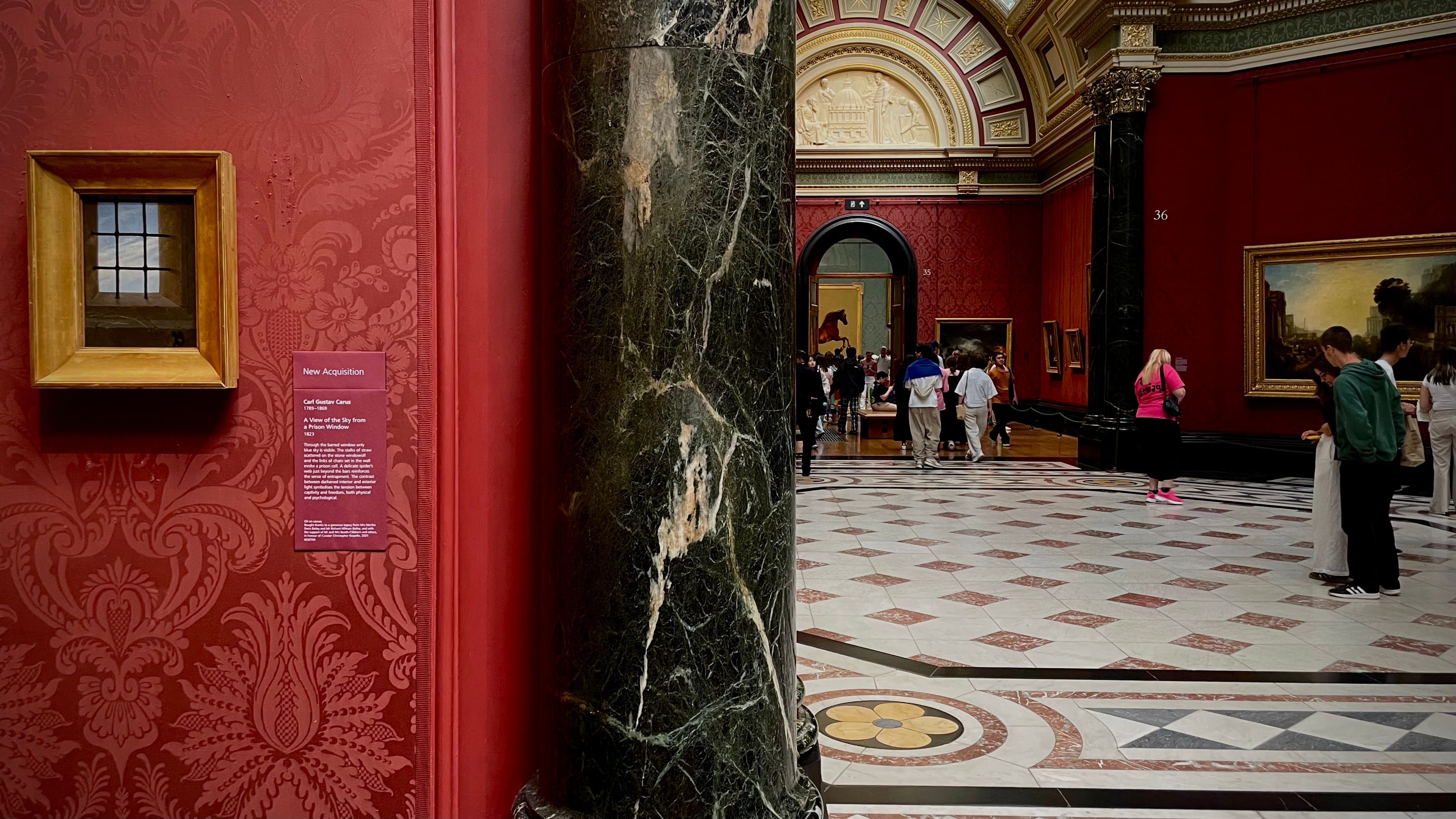
Despite its reticence, there is a good deal to say about it, not least because Carus, pretty well unknown in Britain (this is the first painting by him to enter a public collection) is such an intriguing figure.
He was by profession a scientist: a pioneering gynaecologist (a word he invented); a psychologist who discovered the unconscious before Freud (according to Jung); and an antomist who made some pioneering discoveries (basically, the structure of the vertebrae) that laid the ground for Darwin’s theory of evolution. He was also awarded a prize for his study of the circulatory systems of insects. He wrote incessantly, and at great length, and much of what he wrote seems to have been published without a great deal of editing.
In short, he was a man of the nineteenth-century, at a time when the boundaries between amateurism and specialisation were less rigid, and when you didn’t have to fill in funding proposals and worry about the competition quite so much.
In his spare time Carus was an amateur painter, but a good one, especially when he was not trying to paint like his great friend Caspar David Friedrich. He had an eye for desuetude, bareness, decrepitude, a romanticism shot through with a premonition of modernity.
Many of his paintings are landscapes in the style of Friedrich, misty romantic scenes, graveyards and mountains, but as things progressed a more matter-of-fact type of imagery appears (which to my mind is far more interesting).
Here is totally unassuming An Overgrown Mineshaft, painted on paper in 1824, and in the collection of the Metropolitan Museum in New York.
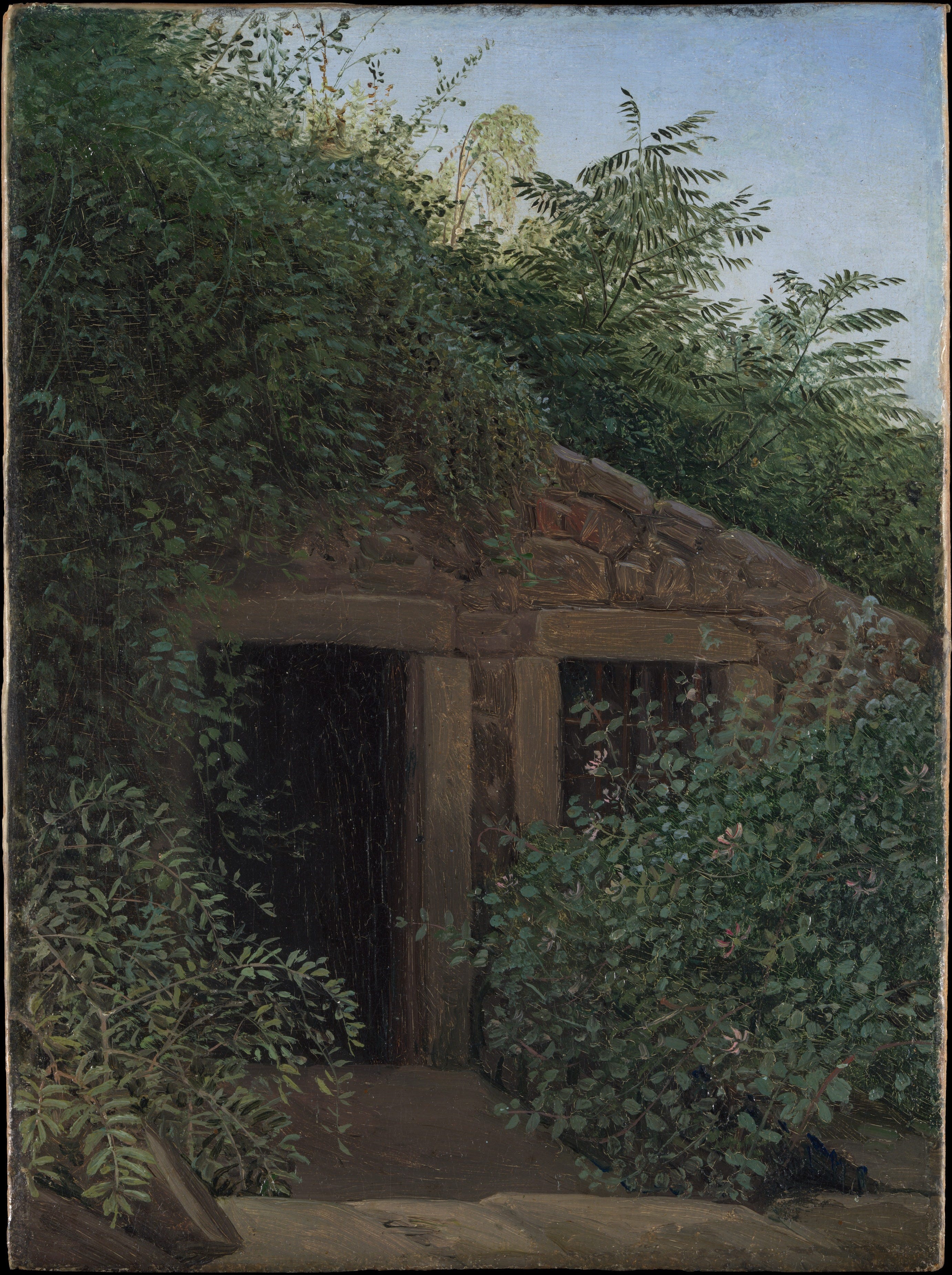
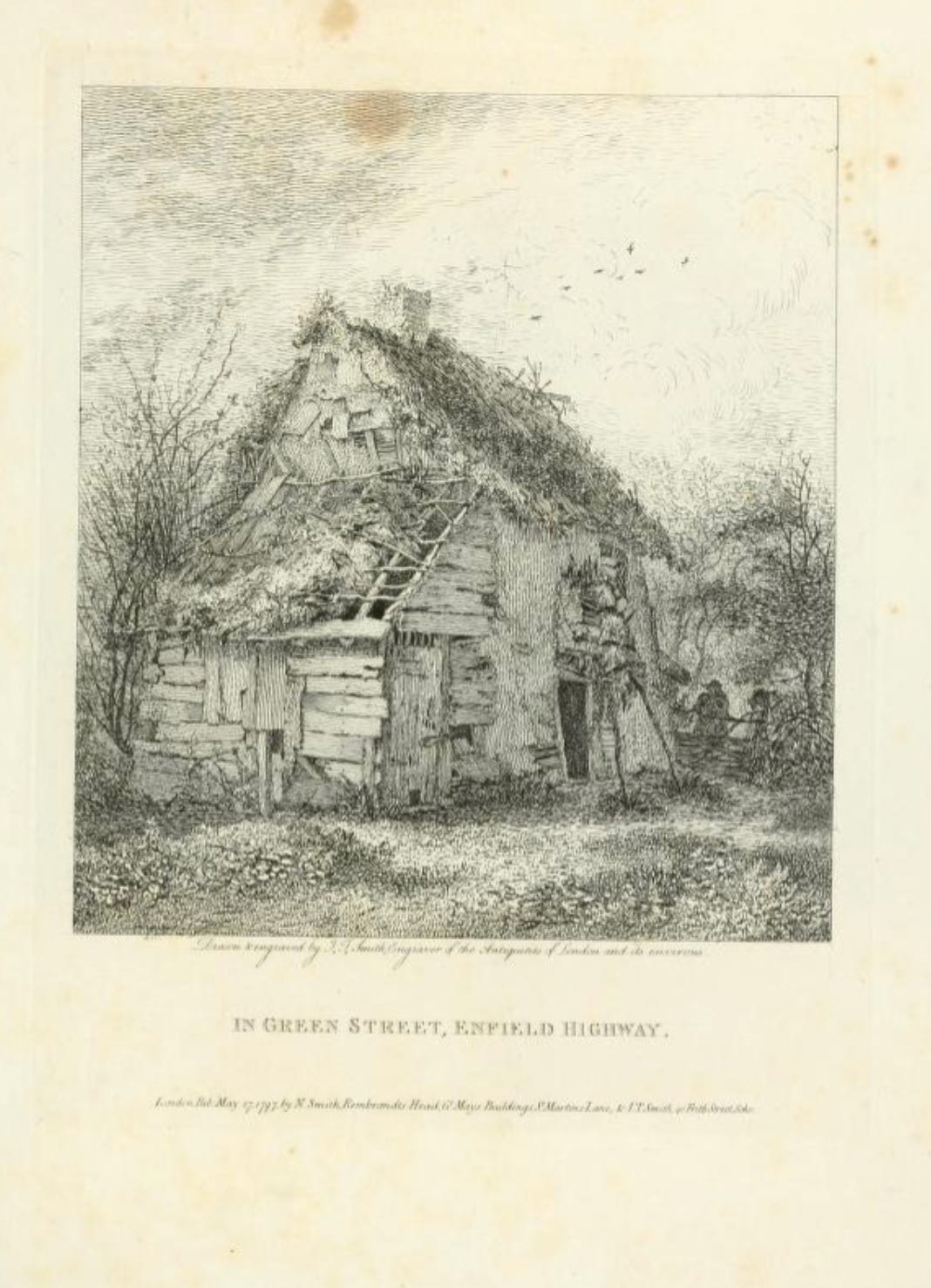
It reminds me of the wonderful and largely unknown etchings by the English antiquarian and artist John Thomas Smith of tumbledown cottages in his Remarks on Rural Scenery, which I have been looking at while writing lectures on John Constable (there are lots of these sorts of evocative structures still to be seen in Suffolk):
The other connection between Carus and Constable is the interest both had in the recent discovery of the classification of clouds, by the English meteorologist Luke Howard, published in his 1803 Essay on the Modification of Clouds.

Strangely, where Carus wrote about Luke Howard’s classification, and was enthusiastic about Goethe’s poem on the subject, he never seemed too bothered to paint actual clouds, from a scientific perspective.
The clouds in A View from the Sky are vaguely cirrus-like painterly scumbles of lead white rather than meteorologically accurate depictions.
Constable, on the other hand, painted clouds almost compulsively, and with great accuracy, but nowhere refers to Luke Howard’s pioneering system of classification. The difference, perhaps, between a scientist interested in art, and an artist interested in science.
Where Constable was intent on accurate images of his native landscape, Carus’s paintings seem like metaphors for mental states — two different views of nature, but with a common progressive goal.
Carus summed this up in his great concept ‘Erdlebenkunst’, or ‘Earth-life painting’, which he brilliantly proposed as a replacement for the dull term ‘landscape’ painting (nobody took the slightest bit of notice for over a hundred years, until it was picked up by Joseph Beuys). Constable, for his part, made a different sort of proposition in the painting themselves, in the ‘deconstructed’ surfaces of his full-size sketches.
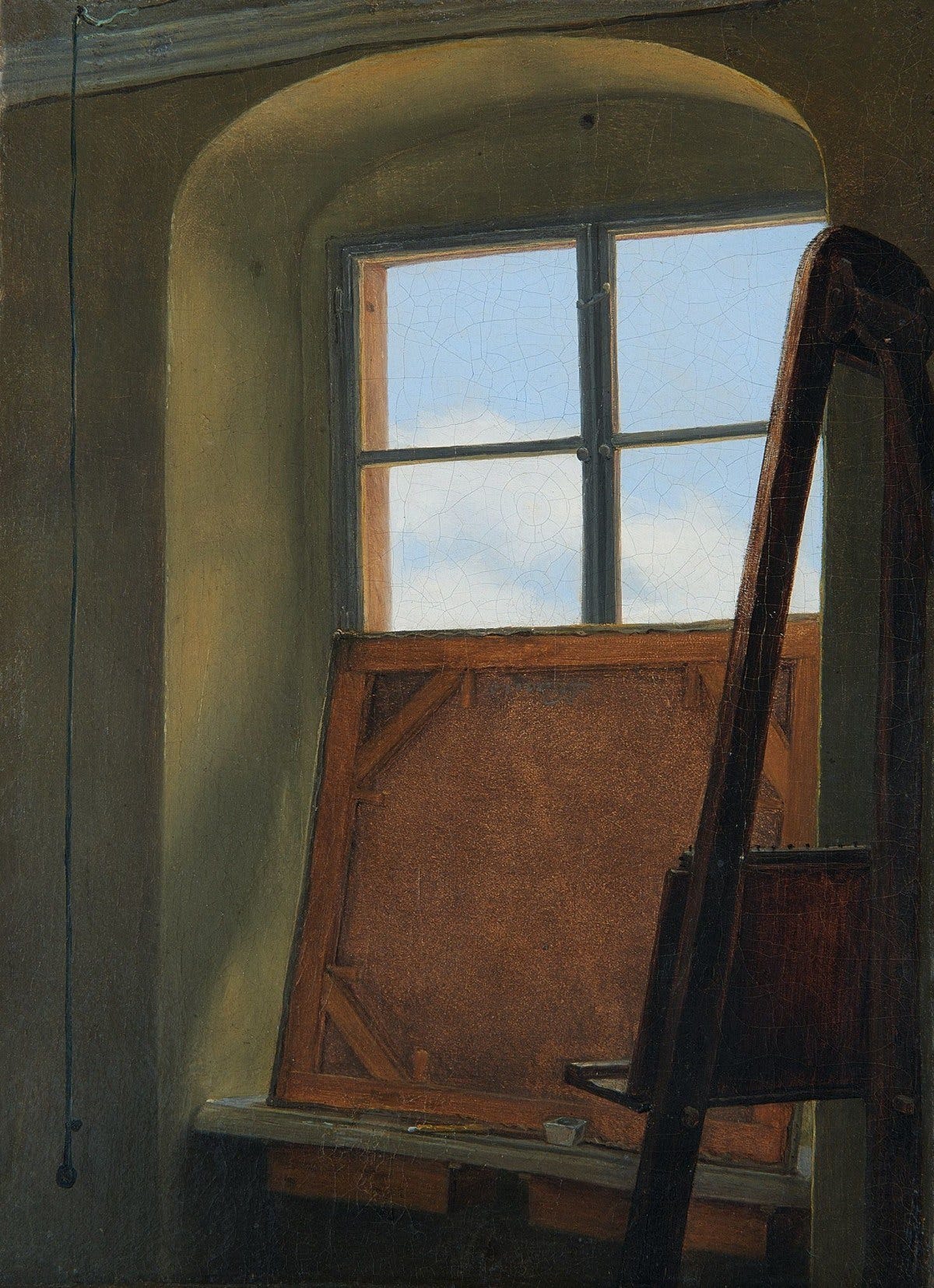
Another small painting by Carus shows a corner of the studio he kept in the maternity hospital where he worked in Dresden.
The window and the clouds beyond are blocked by a canvas turned to face the world it represents. A small canvas rests on the easel (perhaps it is A View of the Sky from a Prison Window). Perhaps Carus saw working life as imprisoning, and longed to devoted himself to his art.
There is no indication of the location shown in A View of the Sky from a Prison Window, and it seems most likely to be a fantasy based on sketches down of a ruined church. Carus lived through the Napoleonic wars, and the great movement of democratic liberation in Europe, but there is no evidence that he was particularly political, and is highly unlikely to have spent any time in jail.
A View of the Sky from a Prison Window seems less an image of captivity, and rather a painting about the freedom of an enquiring mind.
The remarkable quality of the painting is the subtlety of the perspective, and the fact that if you look closely at the iron window bars, they curve around, implying a viewing position much closer than would be expected, as though, the viewer is a single eyeball, drifting slowly towards freedom.
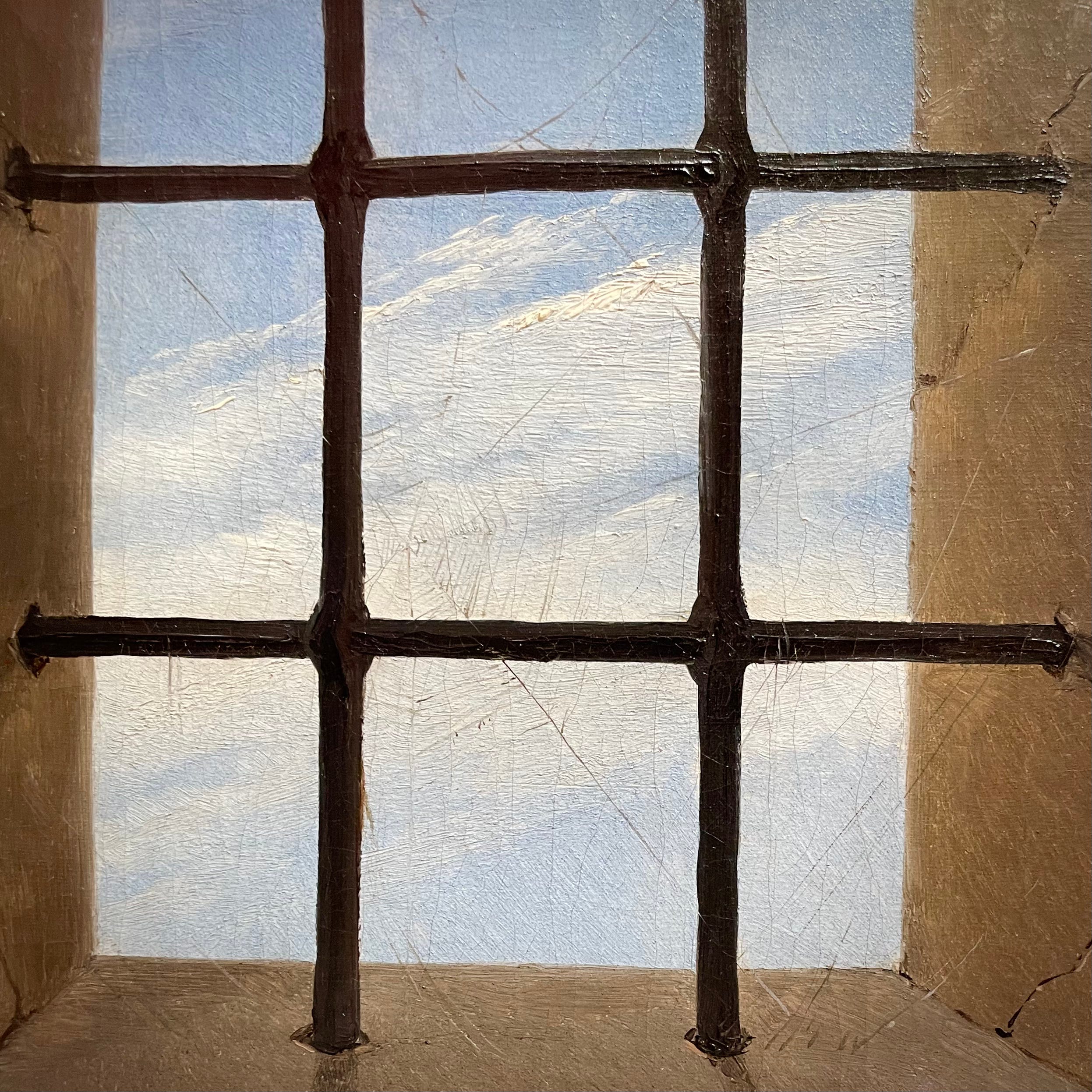
As a painter and psychologist, Carus might have been interested too in the flashing white lights that the eye creates (as in a Mondrian) at the junctions of the prison bars.
Many professional painters lack the narrative power of this amateur. The chain places the viewer in the captive's position. Dried reeds underscore the emptiness of the cell. And I love that eloquent spider web across the view of the sky. Thank you for this discovery.