

Goodbye David Hockney!
1937-2026

GOODBYE DAVID HOCKNEY! Few artists have meant more to so many people over the past seven decades in Britain and abroad. His work has been part of life, part of the way we see the world. He was the cause both of happiness and enlightenment. He made us happy by opening our eyes.
Like all great artists Hockney was also a prophet, and what he prophesied in his images was the changing spaces, the changing shapes of the times in which we live. We know the world better for him. He was always one step ahead.
Here is the text of my review of an exhibition at the Tate Gallery, published in the Times Literary Supplement on the 24th February 2017, which says some of the things about Hockney that meant the most, at least for me.
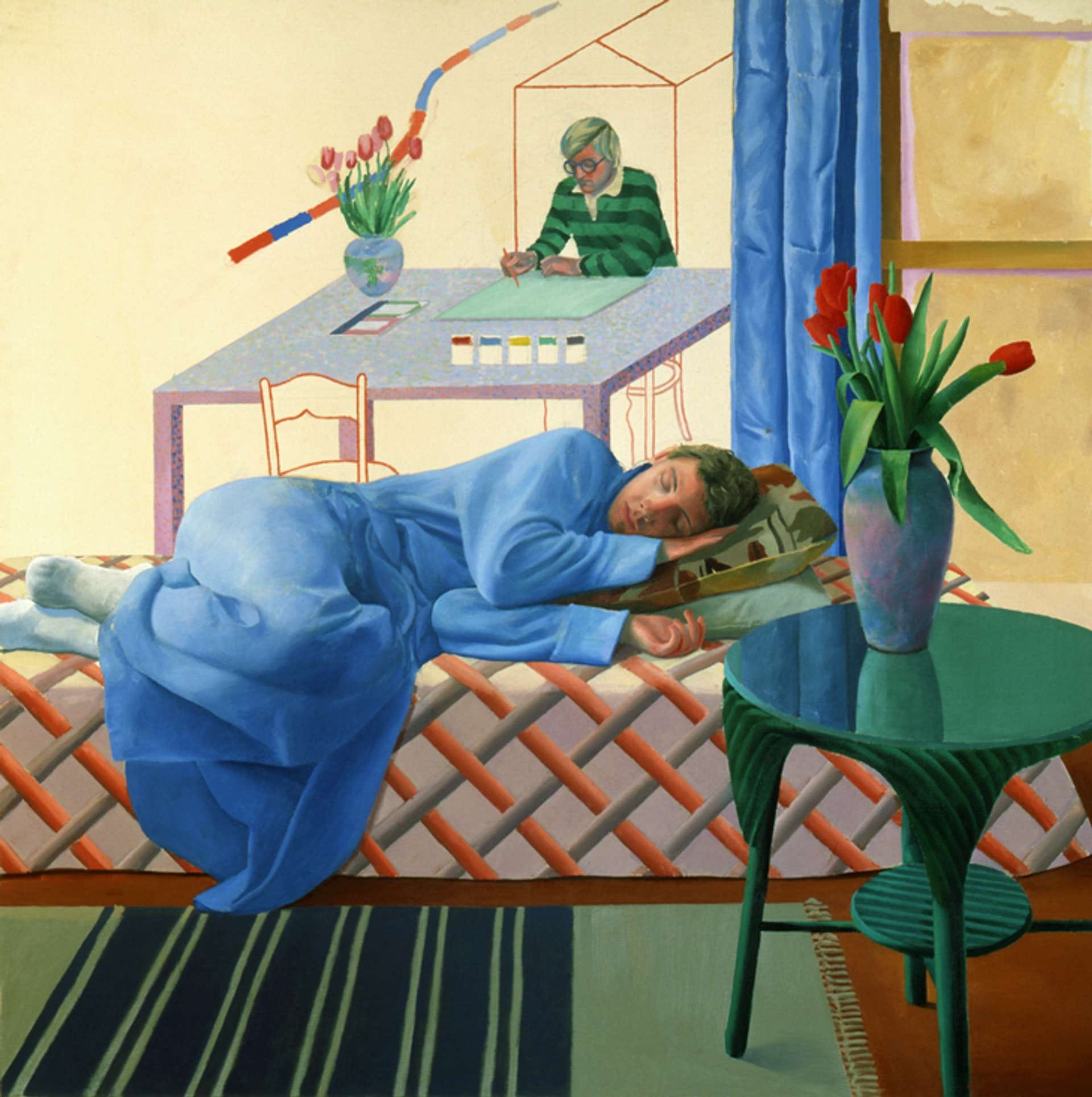
DAVID HOCKNEY AT TATE BRITAIN is a masterpiece of an exhibition, brilliantly selected and immaculately displayed. Covering six decades of work, mostly painting, it shows just how far and wide Hockney’s obstinate pursuit of freedom in picture-making has taken him. The overarching theme is one so rare in art: happiness. It comes across in images of open sexual desire, in portraits of friends and lovers as well as family, as much as in his intense, upbeat colour and endless interrogation of what it is to make a picture of the world.
Wit, energy and charm run through Hockney’s work from the 1960s, from student works at the Royal College of Art to paintings made after first visiting America in 1964. Hockney had too much to say to be an abstract artist, introducing images and words to put his message across: “propaganda”, as he described it, for homosexuality at a time when it was still illegal. The message is hardly coded. The Most Beautiful Boy in the World, painted in 1961, shows a naked figure, a valentine heart by his head, the title of the painting scrawled down his back and other inscriptions, including an unambiguous “69”. The influences at this time are clear — the blurred figures are from Francis Bacon, the abstract fields are from Alan Davie, the jazzy shapes are from Roger Hilton, but Hockney makes everything his own.
Hockney’s confidence in composing a painting, knowing just where everything should go, beams from these early works. His inventiveness is prodigious — for him the blank canvas holds no fear or doubt. In The Hypnotist (1963) the figures may be crudely painted, like fairground mannequins, but the scene, showing a suited figure firing a mesmirising bolt at a young blond man, is a perfectly designed evocation of cheap stage magic. In Rocky Mountains and Tired Indians (1965), the whole painting seems tired, in need of a rest, provided by the artist in the form of an incongruous blue chair placed behind the rudimentary figures of the Indians.
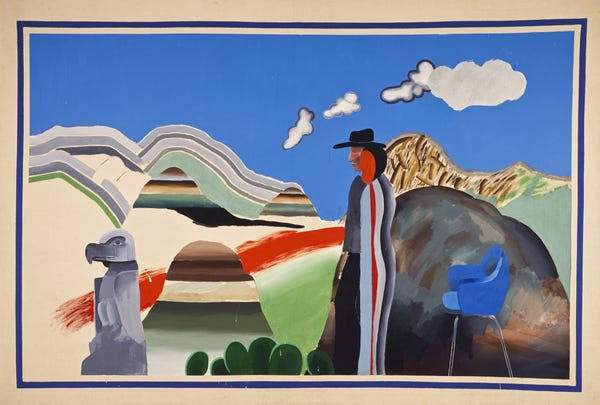
The boldness and wit in these works sometimes borders on being all-too sassy. Hockney was sometimes too good, you might say, at being Hockney, at creating a personalised world and inhabiting it. As one of the curators of the exhibition, Chris Stephens, points out in the catalogue, writing about Hockney’s work has been dominated by the voice of the artist; the same might be said (perhaps obviously) of the work itself. It was not that it was too dominant, it was that it was too good, too fluent. How to let the world in?
Hockney’s solution was an increasingly refined naturalism, and a new subject matter, California, where he first travelled in 1964. His account of his first time in Los Angeles (in a book of conversations with Nikos Stangos, David Hockney by David Hockney) is hilarious. He doesn’t drive, so rents a bicycle, cycling 18 miles to a club for the ‘sleazy sexy hot night-life’ he had read about in John Rechy’s City of Night (1963), only to arrive there too late and find it deserted. He buys a car anyway, meets Christopher Isherwood and Don Bachardy, and soon adjusts to the West Coast lifestyle. It was his relationship with Peter Schlesinger, whom he met while teaching at UCLA in 1966, that seems to have triggered the important shift in his painting. The Room, Tarzana (1967) is based on an advertisement in the San Francisco Sunday Chronicle and a photograph of Schlesinger lying face down on a table (transposed to a bed in the painting), naked apart from t-shirt and socks, looking back, pink-faced and wary.
Natural light and shadows, or something approximating them, appear for the first time in Hockney’s painting — the pale lime edge of the white door, the lilac shadow beneath the table, the white-hatched tufts on the rug — you can feel the artist settling himself in this new world of transient illumination, trying to get it exactly right. Ink drawings made around this time also show Hockney stepping outside himself, drawing sitters in their own worlds, rather than his: W.H. Auden sits lifeworn, eyes closed, smoking, indifferent to the scratch of Hockney’s pen. Portraits of Kasmin, his friend and gallerist, and his mother, have a hard, mineral reality quite different from the aestheticized coloured crayon drawings hanging alongside at Tate Britain, technically impressive as they are.
Hockney’s naturalism found its greatest expression in the series of double portraits he began at the end of the 1960s, including the portrait of Celia Birtwell and Ossie Clark, Mr and Mrs Clark and Percy (1970-71), and the art dealer Henry Geldzahler and his assistant Christopher Scott (1969). The chief brilliance of these paintings is their composition.
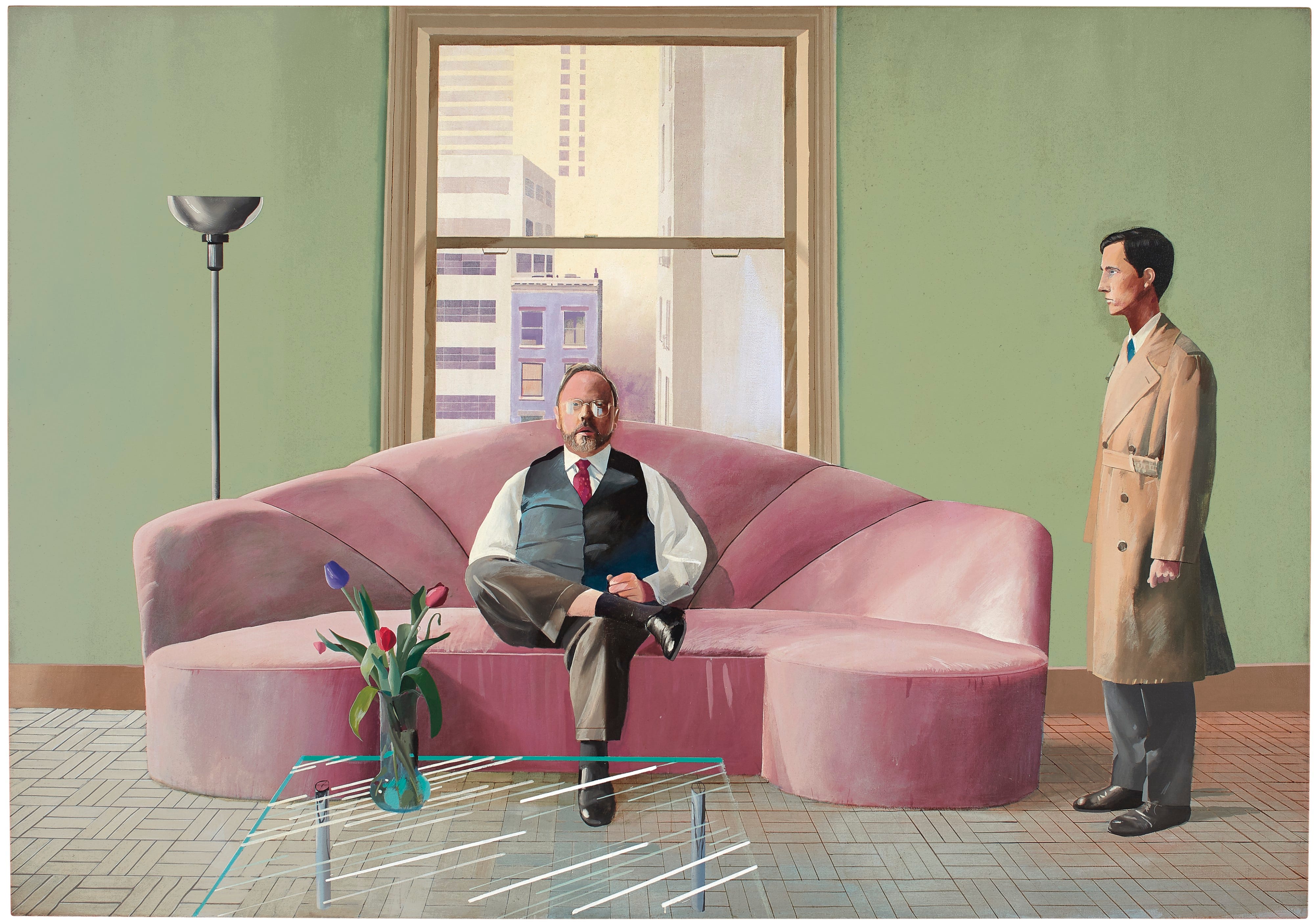
Figures are perfectly placed, spaces are perfectly judged. Christopher Scott’s head is isolated against a lime green expanse of wall — move it an inch either way and the whole painting would fall apart. A little closer up the paintings can feel laborious, illustrational — Hockney talks of his labours painting and repainting Celia Birtwell’s face, and it shows. These are distance-viewing pictures, public images. Only with the image of his mother in My Parents (1977) does Hockney convey inner life through the light in the eyes.
With Portrait of an Artist (Pool with Two Figures) 1971-72, Hockney transcends his own genre and creates what is certainly (but rarely described as) his greatest painting. Much bigger, it might be said, than the Bigger Splash.
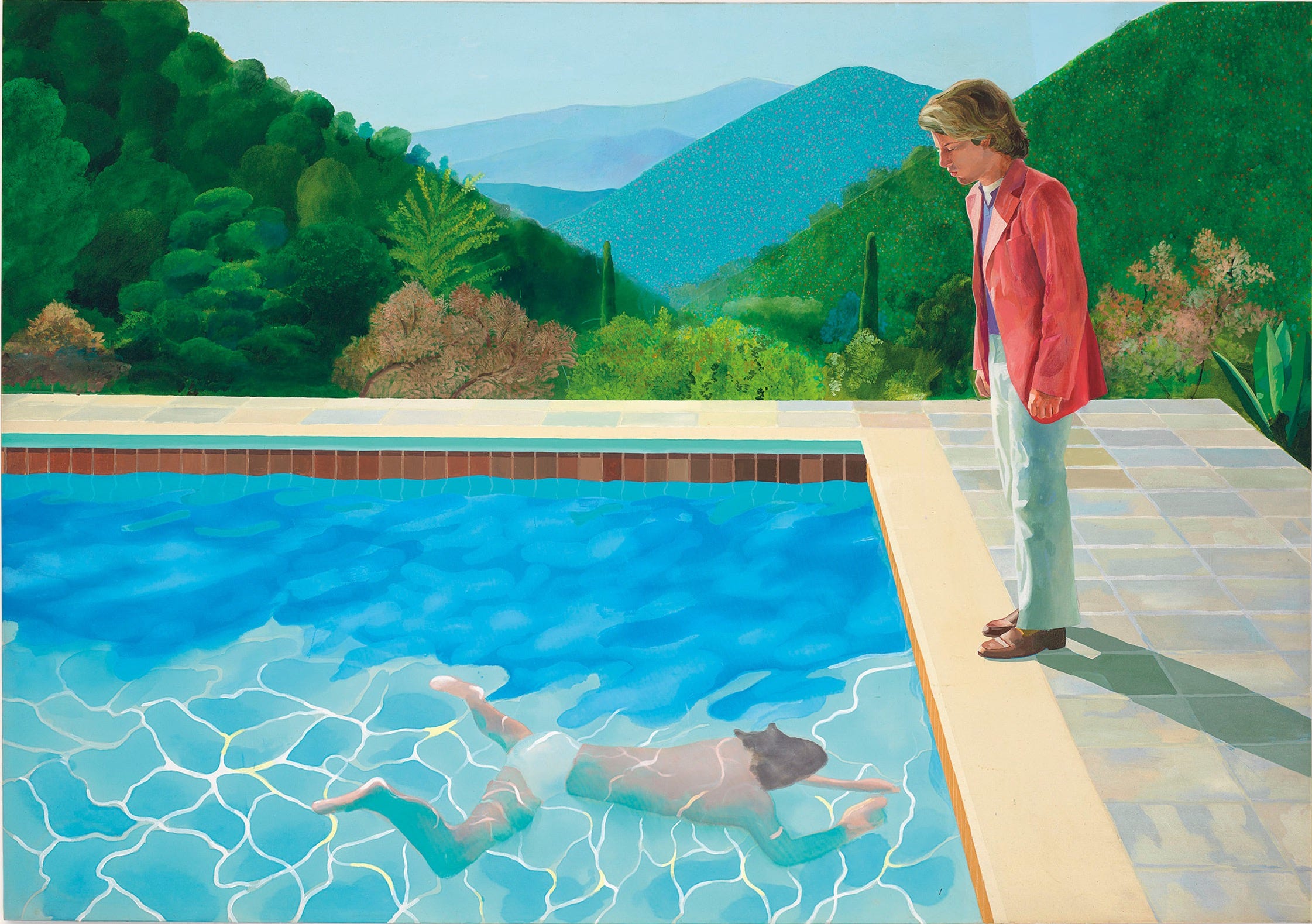
It is an outdoor setting — unusual for Hockney’s figure paintings — showing Peter Schlesinger in a pink jacket looking down at an unidentified figure in a swimming pool. Hockney painted it after breaking up with Schlesinger, labouring on a first version for months before rapidly painting the second version in a fortnight, in time for an exhibition in New York. It is a marvellous contrivance, taken from photographs of Hockney’s friend the artist Mo McDermott and the photographer John St Clair in a swimming pool in the South of France (to get the light), and of Schlesinger taken later in a London park, to complete the portrait. The swimming body, bent and fluttered out of shape by the water, becomes a dream image; the neat figure of Schlesinger a symbol of the loneliness of love figured as obsessive desire. It is the painting in which Hockney seems to lose himself most fully, both in the figures and the landscape background, which leads, quite literally, to the subject that was to dominate his later work.
Hockney’s attitude to naturalism was complex. If at first it signalled artistic freedom, a way of escaping from oneself into the world of appearances, but the late 1970s it had become a roadblock, a matter of pictorial convention that distanced the works from the viewer. Hockney sharpened his pencils, polished his lenses, and embarked on a mission, which has defined his work ever since, of capturing the world in a way that somehow circumvents traditional conventions of showing things, and gets much closer to the reality of perception.
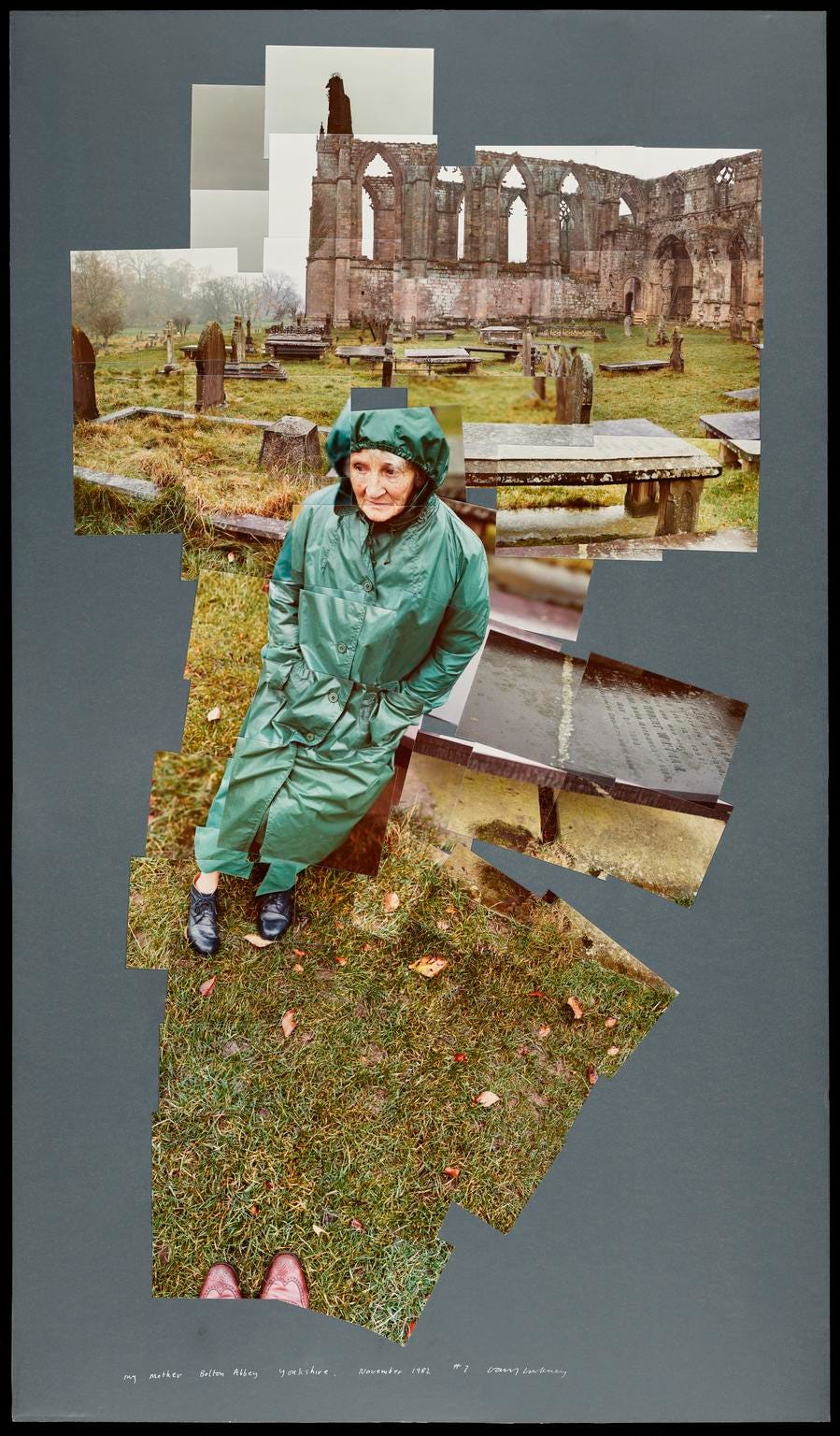
This mission has certainly kept the flame of freedom burning in his work. The photo-collages, or ‘joiners’, as Hockney terms them, were the first attempt to create multi-perspectival images, some more successful than others. The best is the composite portrait of his mother at Bolton Abbey, which conveys the feeling of being close to a lived experience of space.
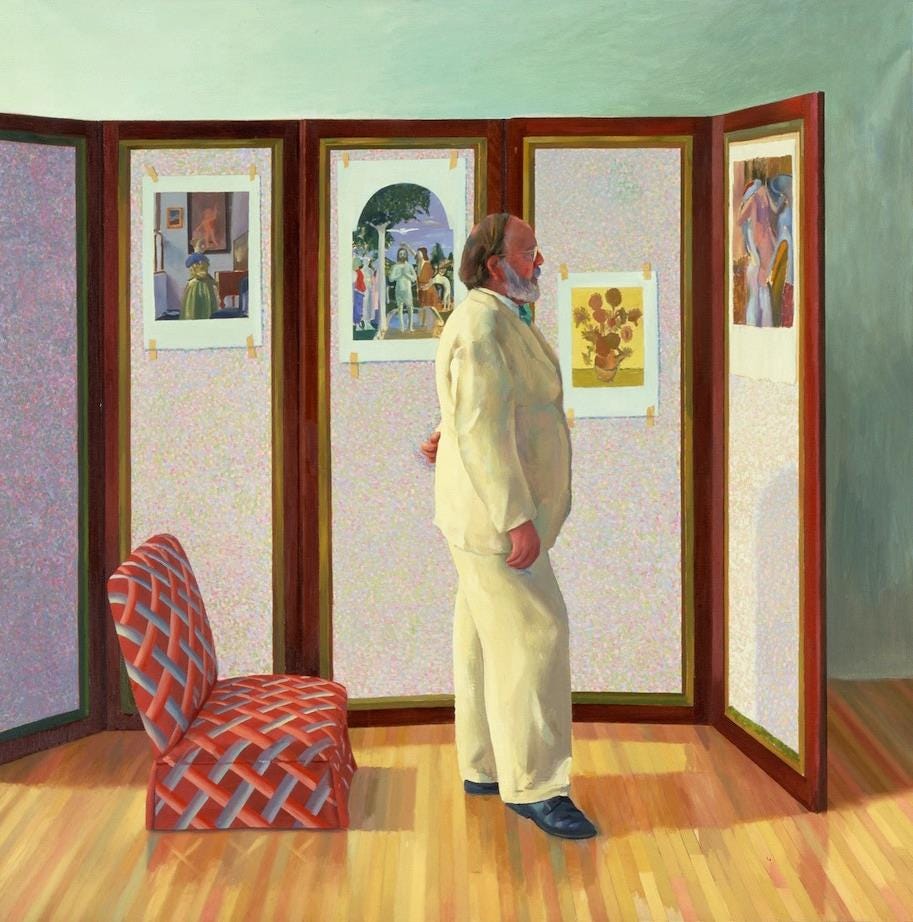
The ‘joiners’ laid the ground for the landscape painting that followed, a bold attempt to forge a new type of painting, wrestling with the limitations of perspectival construction. It was the sort of abrupt change in styles that drives art dealers made: from Looking at Pictures on a Screen, of 1977, a naturalistic portrait of Geldzahler…
to the intensely chromatic alla prima (brushed straight on) style of Nichols Canyon…
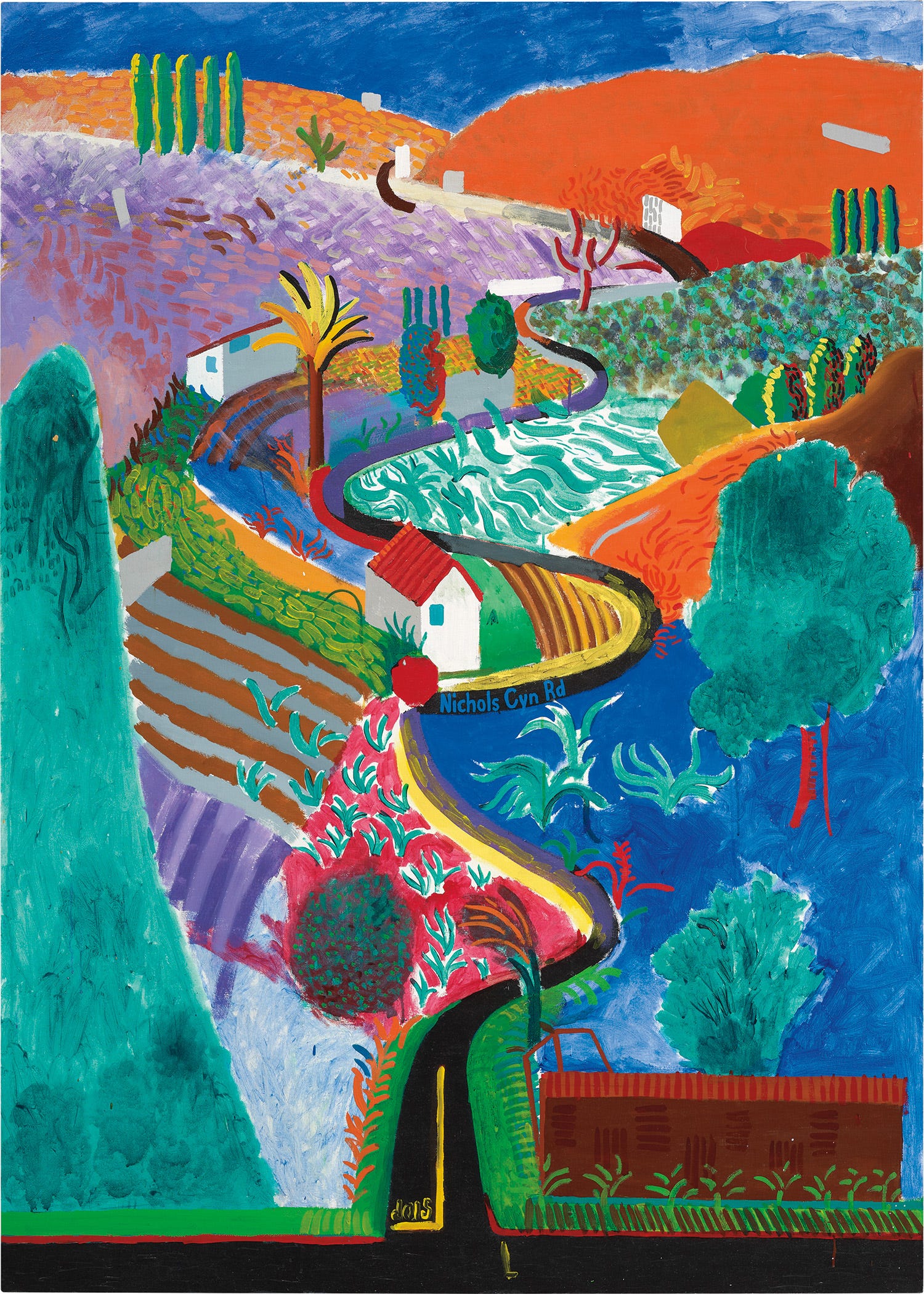
… Hockney travelled further in three years than most artists do in a lifetime.
To compare the Grand Canyon series to Turner, or the Yorkshire paintings of more recent years to Van Gogh, as writers have done, is to avoid the question of what makes these paintings so new in appearance. The saturated colours, the bright reds and yellows of the Grand Canyon, with its deep purple shadows, show a light so filtered that it looks more like the glowing colours on an LED screen. The Very New paintings, made in 1992, capture Hockney’s old inventiveness in an enclosed, theatrical space, reflecting his prodigious work as a set designer (another topic entirely), alongside his posters for theatrical productions, among the best produced anywhere since the days of Toulouse-Lautrec.
Today the Very New paintings appears as prophecies of the phantasmagoric world of digital images just around the corner. In Hockney’s work they also look forward to the vivid drawings made with the brushes app on an iPad, which regularly elicit groans from fellow artists, but which remain captivating.
More recent paintings of the East Yorkshire landscape are similarly inventive, sometimes to the point of being hard to accept. The brushwork seems too loose, the colour too optimistic, the general feeling of cheerfulness at odds with the reality of nature, brute and indifferent.
Yet as The Arrival of Spring, a series of drawings made in 2013 shows, Hockney is far from indifferent to the changing moods of nature. These drawings are intensely moving, with a quietness of scale and directness of observation, and heavy with an emotion that brings back to mind Portrait of an Artist, the Schlesinger pool painting, a terribly sad feeling of happiness past.
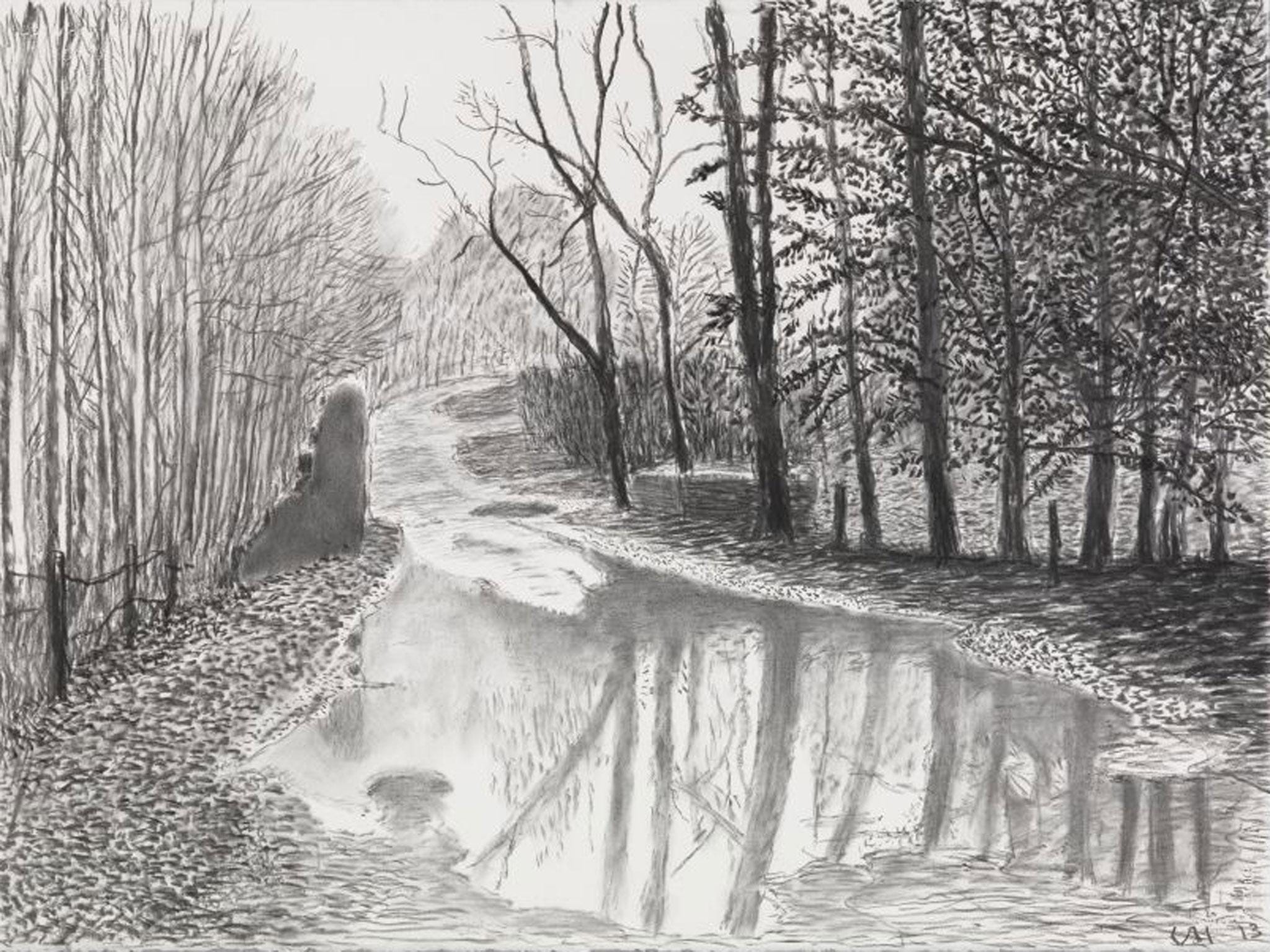
They bring us closer to nature than paintings such as A Closer Winter Tunnel, February—March (2006), or even than the otherwise spectacular installation The Four Seasons, Woldgate Woods (2010-11), documenting in film a slow journey down a wooded lane through the seasons.
Hockney may not be interested in the conflicts between nature and technology, but he remains open to both in his quest to create new ways of imagining and representing the world. After travelling with Hockney to gather material for China Diary (1982), Stephen Spender wrote about Hockney’s lack of interest in politics, and absorption in the task of making art. “He looks at life, he says, from the point of view of the imagination. The imagination is to him a kind of ultimate force directing — or which should direct — everything”. It is the confidence in the imagination and its ability to make us happy that, despite the often strange and difficult nature of his painting, makes David Hockney such a vital artist still.
Rest in Peace, David Hockney! I love your work!
This is a wonderful essay that captures so well this artist whose name and art are so well-known. This morning's appreciation in the Guardian is beautifully written, too. The landscapes without color, like the last image in your essay, appeal to me very much, though I also like his signature pool paintings.
The Guardian article mentions there are two shows at Tate Britain and Tate Modern next year that are planned to go on. Pace Gallery in New York currently has installed the iPad paintings "The Moon Room"; a photo of it is her: https://www.pacegallery.com/exhibitions/david-hockney-the-moon-room/