

How to draw a wildfire

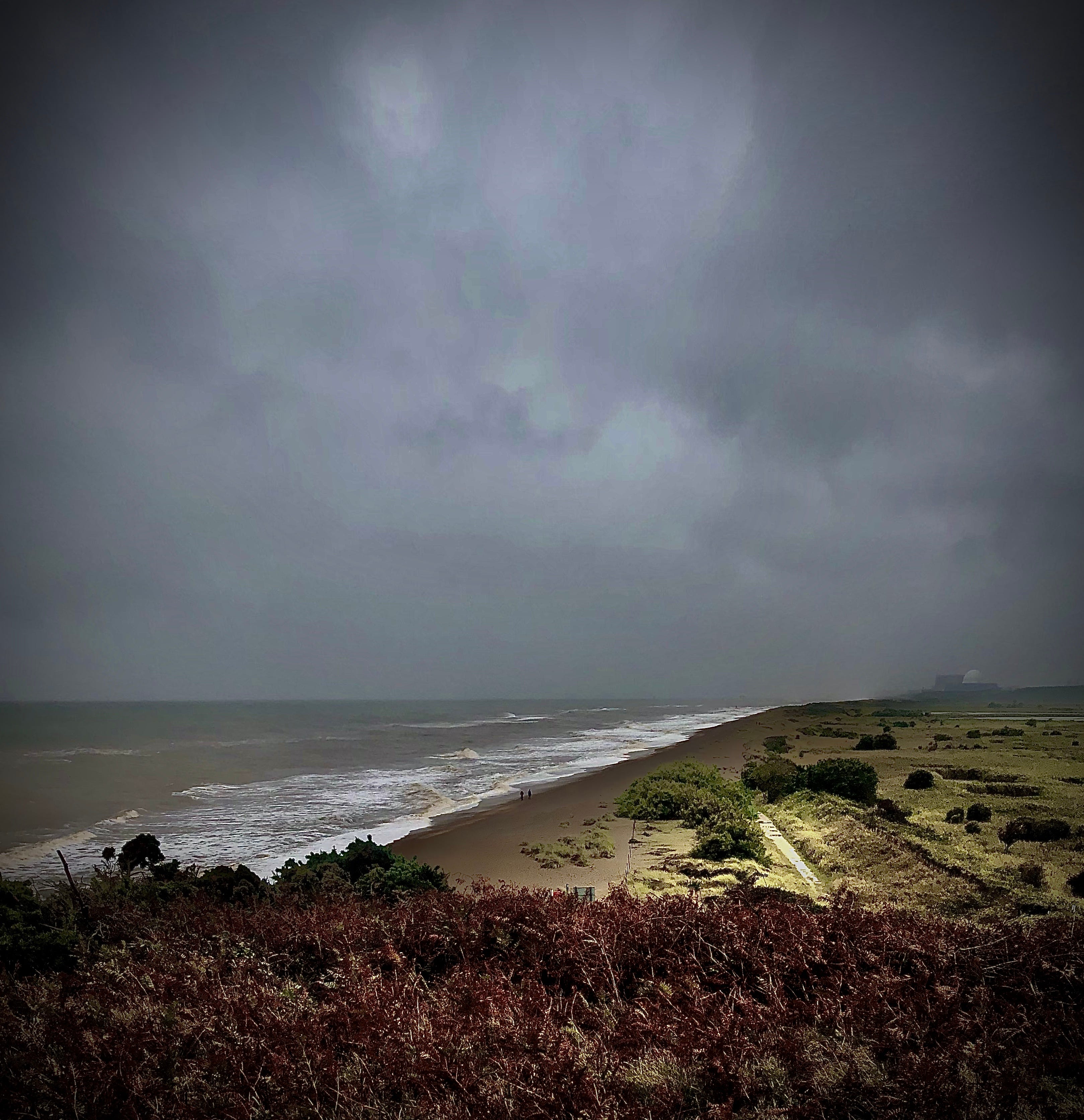
THE DUNWICH HEATH WILDFIRE seems to have inaugurated a new era of climate-change wildfires in Britain. Perhaps we will look back to 2026 as the year in which something tipped, a new feeling and awareness entering human consciousness.
We could see the thick blue smoke on the horizon from Hog Hill, ten miles inland, shortly after it started on Wednesday afternoon. Then through nights and days, hearing the fire engines — ‘machines’, as they are know in the trade — coming up from London, hurtling cross-country along narrow parched lanes. Looking anxiously east to the coast, following the fire on the national, and by Friday the international news. It seemed to spread around the world, as it ravaged the heathland overlooking the sea.
What does a wildfire look like? I think of images from the history of art, and none seems really adequate. Perhaps only Franz Marc’s painting The Fate of the Animals, painted in 1913, which shows creatures caught in some great forest conflagration. The painting itself was burned during the First World War, and restored by Paul Klee. My memory is of dynamic force lines, darkened jewel-like colours, the barely discerned forms of animals making their cries, fleeing, or frozen in panic. An image of heat and confusion, darker still where it suffered its own holocaust.
But it is not Dunwich. The world has changed. We cannot really find anchors in art history for this new human moment. I do not want to show images of wildfires in painting as if it were somehow the theme of the day. As soon as it was confirmed as wildfire, on the news around nine o’clock on Wednesday evening, I remember W.G. Sebald’s description of walking on Dunwich Heath in a state of confusion, his thoughts turning to great fires, a chapter that goes on to describe a dream in which Dunwich Heath itself is the scene of destruction. I retrieve The Rings of Saturn from upstairs and re-read the chapter. It is disappointing. The sentences are too long, and the fire, after all, is still burning.
But what else have we got to make sense of this unimaginable new world?
Increasingly you see calls (funding, residencies, prizes, that sort of thing) for art ‘about’ climate change. I can’t help shaking my head - no, no! Climate change cannot simply be another subject for art. It is like making art ‘about’ Nazism and Hitler in Germany in 1935. As if any work of art made in Germany at that time could escape being shaped by the horrors of the day. All art nowadays is ‘about’ climate change, whether it likes it or not. Climate change is the matrix, the ineluctable condition.
This goes also for the audience — for our response to art. At what point will every play, every concert, take on the atmosphere of wartime, when every word, every note, every silence is a drawing together, an act of defiance or resilience, or simply of collapsed despair? Don’t you know there’s a climate war on?
And then, on one of the hottest days of the year (every successive day this summer seems to take this accolade), the moon drifts over the sun, and all of Europe stops to witness the spectacle.
Perhaps the sun is trying to tell us something.
Solar witness, soleil noir. You cannot look at me, but you cannot do without me. Take better care, worse times are coming, but all is not lost. This is what it looks like, a world gone silent, the world with the lights dimmed, where light and shadow stand on a knife edge.
We lurch increasingly between fire and flood, between summer and winter with nothing between, no respite. Works of art have become our new autumns, our new springs, the interstices in which we can reflect and gather strength, begin to make sense of things.
How to represent this — how to look at this changed world? The wildfire races at fifty metres a minute across heathland, driving out that animals it does not kill. The silver-studded blue butterfly, plebejus argus, found mainly on Dunwich Heath, has just completed its annual egg-laying in the area now burnt to ash. Walls of flame twenty metres, forty metres high, delving down into the roots, reaching into the canopies of tall trees, waves of fire mimicking the ocean waves so tantalisingly close. Nightjars buzz in the air above the fire, as if playing the phoenix, their urgent whirring call, like the sound of a nearby substation, coming from untouched heathland just a little way off. A helicopter was brought down from Bedford and deployed to quell one wave with another, scooping ocean waves to throw into the flames, as if in demonstration of the interference theory of classical physics.
We live in a wildfire age. Relentless acceleration and spread is the primary virtue, the primary goal. Wildfires are in truth not wild at all, just as the coronavirus pandemic was not a wild-disease. Even a discarded shard of glass was thrown down by human hand. At Dunwich great bulldozers and flailing machines were driven up from Ipswich, the earth thrown and scraped to create wide breaks, the branches of trees chewed and splintered, great trunks felled to stop the spread of the fire. Social distancing for fire-infected nature. The destruction, as everyone swiftly realised, was an ironic repetition (on a smaller scale), like a misreading, of the fields being bulldozed and cut by new roads, and the tens of thousands of trees felled for the construction of the new nuclear power station at Sizewell. The fearful tabloids, seeking some sensation from the fire, whipped up fear of fire reaching the nuclear reactors, as the wind blew it in the opposite direction.
We cannot look at the thing itself, we can only contemplate its effect. The image of the wildfire is the aftermath of the fire, the black and white of ash and dust. Fire drains colour from the world. Like a charcoal drawing of once-lush scenery, formerly rendered in deep-coloured pigment, the yellow of gorse, the bruised and blushing blues and pinks, and colours without name, of lowland flowers. Earth gouged across a field, a tree become like the charred ribcage of a beached sea monster, escaped from the warming ocean into another deadly conflagration on the shore.
You cannot paint a pandemic. Only the intensity of drawing can suggest the fire that lingers beneath the earth. Rabbit burrows, badger dens, the roots of trees, places the fire sought to escape its own destruction, and where temperatures hot enough to fire ceramics are recorded by firefighters and farmers barricading the soil. A solitary fireman calls for a shovel and whacks at a burning log, using the tool to cut and flail, the thick dirty smoke causing him to turn away and curse.
While the fire rages there is a certainty of burning. What could be more unequivocal than fire? And yet soon this certainty becomes something else. Wind and humidity are closely monitored, local knowledge sought. Fluctuating weather conditions, the efficacy of water dousing and of cutting back and clearance. In the charred landscape flames flicker up randomly, as if the fire had gone into hiding. Underground resistance. Anything could or might happen. An unexploded hand grenade. A new friendship in the village hall. Only days later green shoots appear on a path. The landscape itself becomes a theatre of uncertainty, unrecognisably transformed, readying, waiting. Nobody quite knows what is next, where the gorse and heather will revive, which birds will return, in which places the roots and seed bank were passed over by the racing flames, how the scorched earth will reconfigure itself. Nobody knows how we will feel when we begin to walk newly-unchartered paths once again. And this, for the time being, is the image that counts: the image of uncertainty.
As others note, you do capture the moment in poignant ways. I'm not sure whether art needs to reflect climate change but not sure whether it shouldn't either. But it certainly provides a way for us to get out of our own heads and into the lives of artists from the past, which is a great privilege and joy.
I can think of some contemporary photographs that captured the haunting aftermath of wildfires from Sally Mann (her Blackwater series), but would have to mull over paintings...
Thank you for this piece which offers much to ponder as we enter this age more fully, become aware of where we are. I both resist and am struck by your observation that art cannot capture the fire(s) and the floods we are in the midst of. I appreciate, too, your conclusion about uncertainty being our norm now. There is, however, a post WWII painting that comes to mind - now to find the details of it.