

Long Bodies
On the sculptor Wilhelm Lehmbruck


Sie hatten vier Jahre Zeit: ‘They had four years’ time’. So ran the inscription on the wall in the final room of the 1937 exhibition Entartete Kunst.
‘They’ were the artists in Hitler’s Germany, who had not toed the line. On coming to power in 1933, Hitler had declared that Germans had four years to adjust to the new ‘normal’ of Nazi Germany.
This included all artists, who were required to support the new national government and cease making ‘degenerate art’ — an art of distorted bodies, abstraction, of politically subversive dadaism.
As I write in my new book The Worst Exhibition in the World, there was never any strict definition of what ‘degenerate’ art might be. But any Nazi worth their salts knew it when they saw it.
The inscription was therefore a sort of weary Nazi sigh. We gave these artists four years to change, but they fluffed it. They could have made Nazi art (and how hard can it be just to copy a photograph?). But instead they kept on making this — the work of cretins, madmen, Jews and Bolshevists.
The claim was acutely ironic, especially in this final gallery. On the walls were paintings by Franz Marc (1880-1916) and Lovis Corinth (1858-1925), surrounding a great sculpture by Wilhelm Lehmbruck (1881-1919). All were long dead by the time Hitler gave the cultural world its deadly deadline.
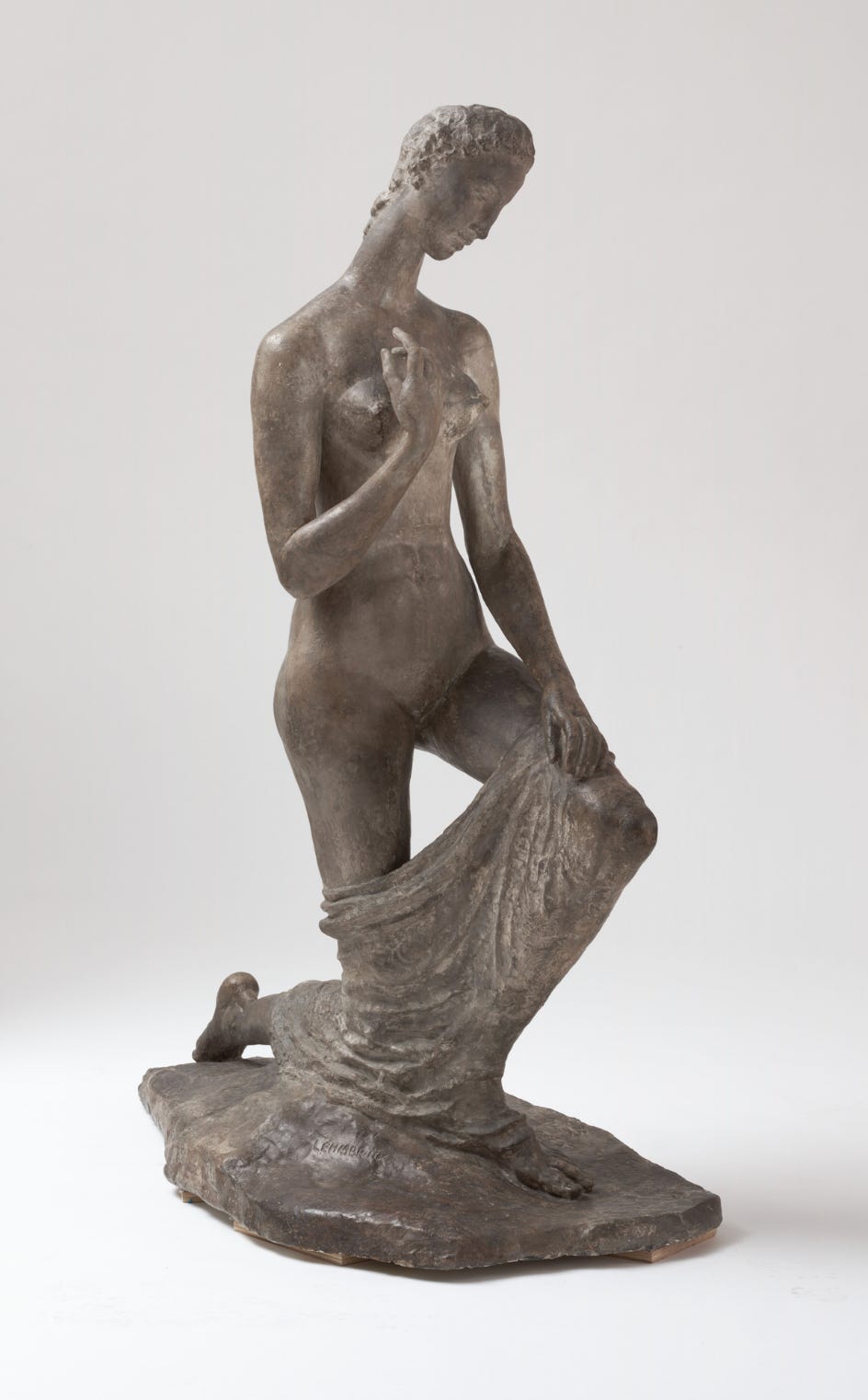
Lehmbruck’s sculpture Große Kniende, or ‘Large Kneeling Woman’ dominated the gallery space. It was the climax of an exhibition mounted to denigrate modern art, but in which at every turn the works seem to take revenge on the curatorial intentions. Nowhere moreso than in the pathos and sublime power of Lehmbruck’s elegant, elongated figure of a woman, not kneeling in submission to Goebbels et.al., but genuflecting in devotion at the human spirit all around.
Like many sculptors of his generation, Lehmbruck had begun in an academic style shaped by Auguste Rodin, the great sculptor of the age, the years around 1900. But he was infinitely sensitive to new ideas of form. In his mid-twenties he followed the path of hundreds, if not thousands of artists, and in 1910 moved to Paris. In a short space of time he developed a highly expressive type of sculpture, more refined, delicate, otherworldy.
The Large Kneeling Woman was the first, and greatest statement of this new Lehmbruckian figure style.
The best historical reference, not lost on critics of the time or since, was Mannerism. It was in part an early voyage to Italy in 1905, and sight of the sculpture of Michelangelo and his progeny, that set Lehmbruck on his new course.
'Mannerism' means, from one perspective, long bodies: the elongated, elegant, artificial bodies depicted by artists such as Parmigianino, Rosso, Primaticcio, and Hendrick Goltzius, working in the wake of the High Renaissance style of Michelangelo, and after the death of Raphael in 1520.
The art historian John Shearman described Mannerism as the 'stylish style', one that was characterised by 'poise, refinement and sophistication'. These are words that fit Lehmbruck’s new figure style of the Kneeling Woman perfectly.1
The sculpture became famous, shown at large and well-attended exhibitions in Cologne and Berlin in 1912, and the next year, at the epochal Armory Show exhibition in New York (Lehmbruck was the only German artist included). At these large pre-war exhibitions the forms of modern art were being brokered and aired for the first time in public, the shape of things to come made visible for anybody with eyes and mind to see them.
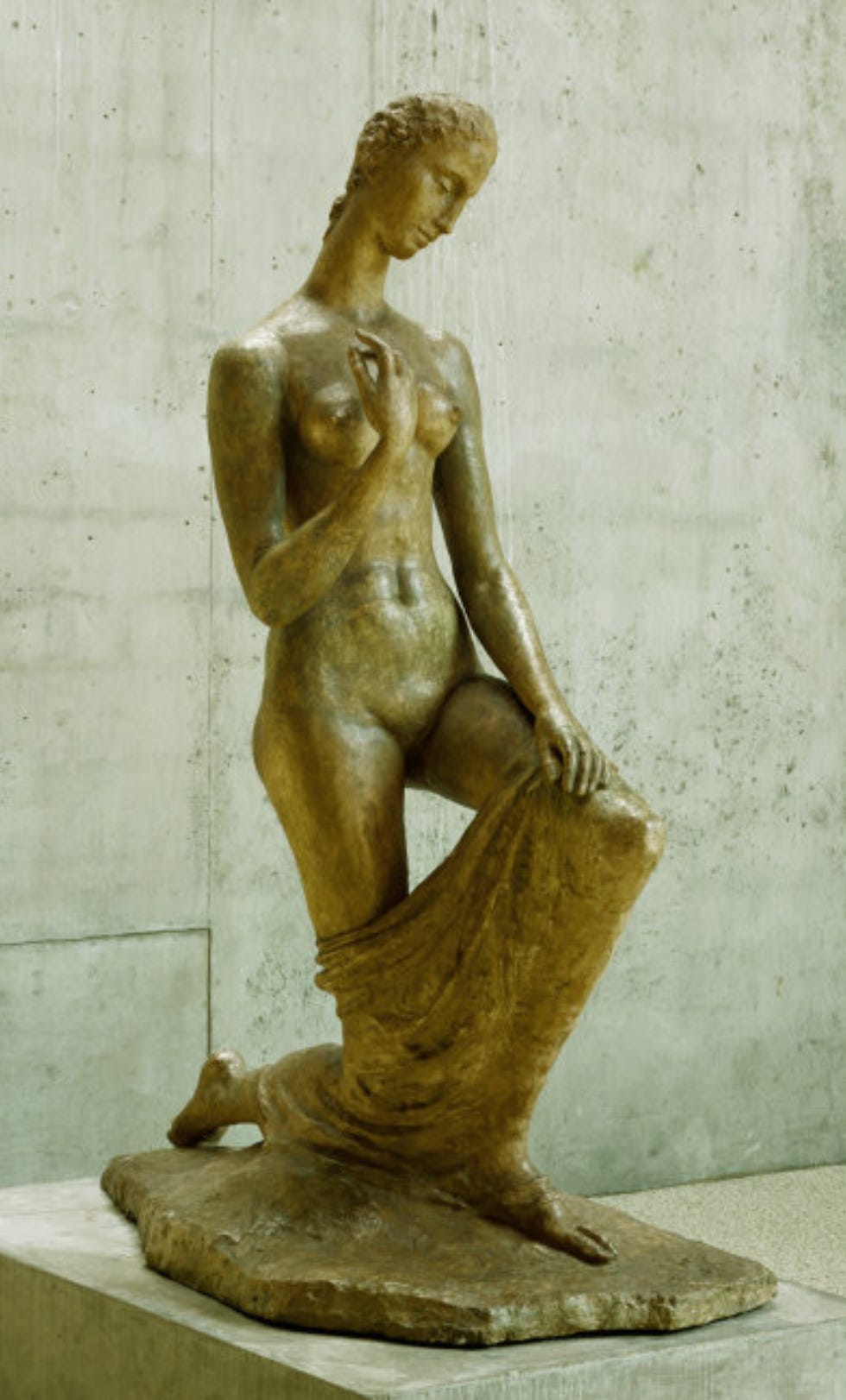
To our eyes, however, the Kneeling Woman might hardly look like a radical work of art. The woman seems formed according to quite traditional ideas of beauty, and is on the whole naturalistic. Her gesture of modesty of self-containment might make us think of a classical tradition stretching back through centuries of mediterranean sculpture.
Only her extended neck, elongated body and the inscrutable, severe inward-expression, like a Bhodisattva from the Rhine, seems to signal something new.
At the time she provoked a memorable response from the critic Julius Meier-Graefe, writing about a visit to Lehmbruck’s studio:
One day all portrait busts, all torsos retaining a reminiscence of the Greek spirit had been moved aside, and in the center of the atelier there stood a huge female creature, half-kneeling, appearing to have no end to her. At first glance, she looked most like an awkward giant marionette. Here was an artist with the unheard-of luck of capturing the composure of antique sculpture, and he gave it up for a single original notion, for a leap into the blue.... . This slitlike phantom cut through the air like a steep reef and forced the viewer to either kneel down or to flee. I chose the latter.... Naturally, I soon came back.2
The poet Theodor Däubler memorably described Kneeling Woman as 'ethical verticality', writing that 'we no longer find prayer but rather devotion, a faith in the verticality to come...'.3
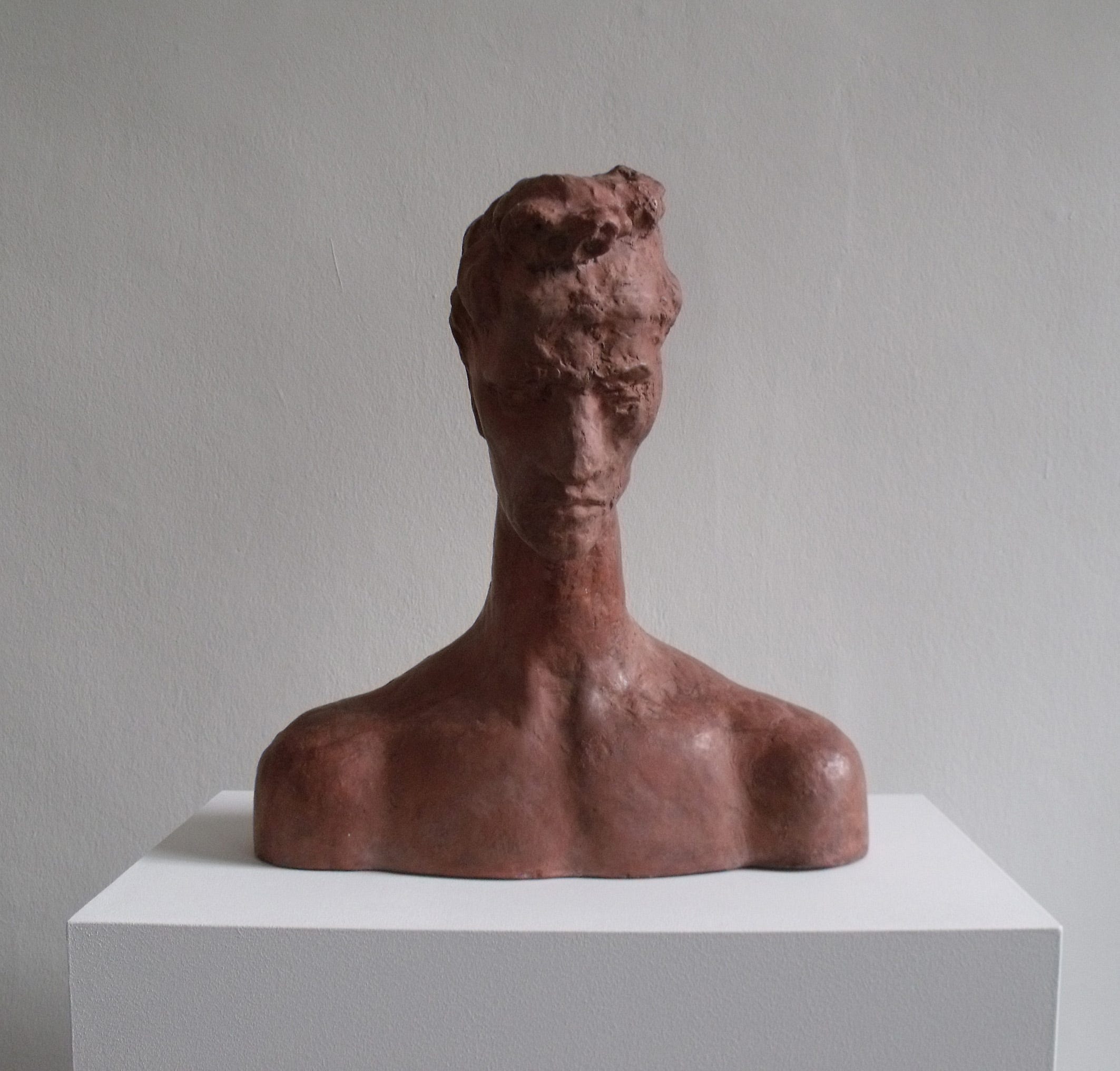
This verticality was almost like architecture, Däubler wrote, when it came to the dramatic bust Lehmbruck made a couple of years later, the Büste des emporsteigenden Jünglings (‘Head of a Rising Youth’), which seems to contain all the tense resolution and anxiety of a generation throwing themselves into a spiritually cleansing war.
Paris was an arcadia for Lehmbruck, a cosmopolitan artists’ colony in which he had found the perfect conditions to create his spiritualised sculpture, alongside the likes of Constantin Brancusi and Amedeo Modigliani.
With the outbreak of war, however, he was obliged to return to Berlin, and was assigned (for what seems quite a short time) to the Hospital Corps as a medical orderly.
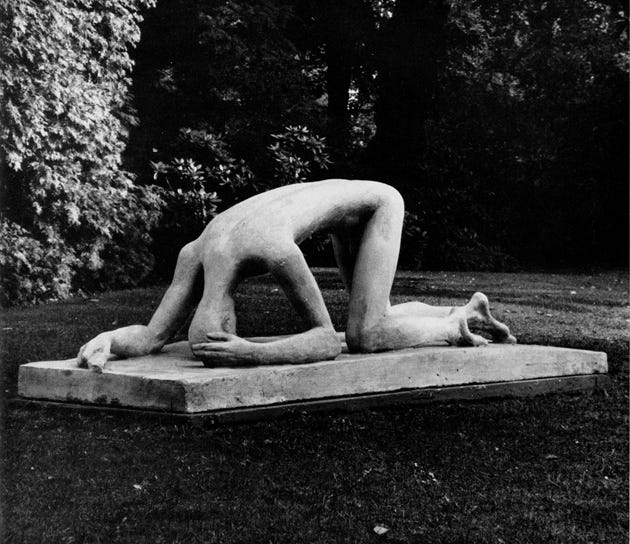
The experience of war broke him, and and produced (somehow, in the confusion and upheaval of war), his Gestürtzter (‘Fallen Man’), of 1916, an image of defeat, a warrior figure holding a broken sword, painfully horizontal and sinking into the earth. This was a remarkable sculptural conception for the time – the sort of work that many would have said was simply not sculpture, simply not ‘art’.
It seems from our view a premonition not only of the downfall of the German nation and empire, but also of Lehmbruck’s own tragic end.
In early 1919 Lehmbruck wrote to his wife of his renewed will to live and create, and promise that the future would be better. Shortly after however, on the 25th March, he committed suicide in his Berlin studio.
Perhaps it was a failed love affair, perhaps despair at the plight of humanity. We will never know. But it was as if all the optimism, and the wild imagination of the first decade or so of art of the twentieth century, and of Lehmbruck’s four golden years in Paris, had been extinguished.
Had he lived Lehmbruck would have surely become the German Brancusi, just as Franz Marc would have become the German Matisse, if such comparisons shed any light. The death of both artists was a tragedy for German modernism.
Lehmbruck’s works were among the first to be confiscated from German museums as part of the Nazi Entartete Kunst campaign, when in 1930 the Thuringian State Museum in Weimar was subject to the first of these ‘cleansing’ acts.
Although there was some ambiguity in the Nazi view of Lehmbruck — he was after all a creator of classical, heroic figures — it was his Mannerism (one of the Nazi slurs against modern art), his long bodies, and association with the world of Expressionism that condemned him as ‘degenerate’.
The Kneeling Woman included in Entartete Kunst had been confiscated from the Staatsgalerie in Munich, and was damaged in transit: ironically, considering the short distance across the town it had been moved. We might imagine it roughly roped to a handcart, falling off as the hapless art-movers made the short journey to the Hofgarten arcade.
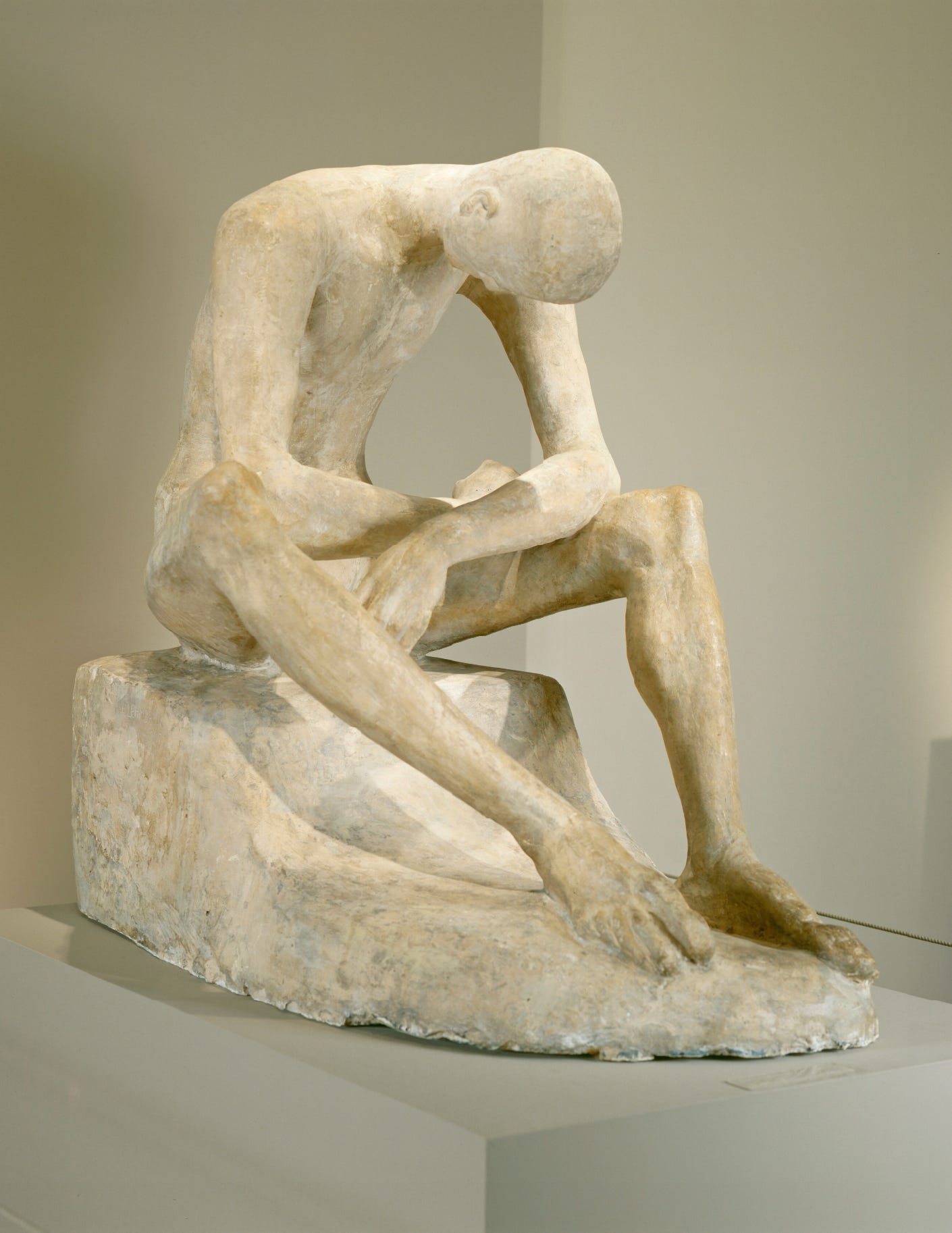
It was shown at Entartete Kunst for only a short time, before being replaced by another work by Lehmbruck, Der Denker (‘The Thinker’), which had been confiscated from the Kunsthalle in Mannheim. This second sculpture found its way to the National Gallery of Art in Washington DC, where it can be seen to this day.
What happened to the plaster version of the Kneeling Woman that was on display in Entartete Kunst, nobody knows. Perhaps it was loaded back on the handcart, and left somewhere to crumble into the earth. Perhaps it finally met its end under the Allied bombardment that destroyed large parts of Munich on the 24th April 1944.
In 1939 the Museum of Modern Art in New York had bought a stone cast version of the Kneeling Woman. This version had been confiscated from the Kunsthalle in Mannheim two years earlier, and consigned to Karl Buchholz, one of the four art dealers involved in selling (or saving, depending on your view), works of ‘degenerate’ art.
The last time I visited MoMA it was still on display, and was an unmistakeable symbol of resistance and freedom. It has been in storage for the past few years. The Kneeling Woman is one of those great anti-fascist works, not made as such, but which contain within themselves the spirit of individual imaginative freedom of modern art.
J. Shearman, Mannerism, London, 1967, p.19
Cited in: Reinhold Heller, The Art of Wilhelm Lehmbruck (exh cat, Washington National Gallery of Art, 1972), 24.
T. Däubler, Der neue Standpunkt, Dresden 1916.
An interesting essay! I found Däubler's Der neue Standpunkt (Dresden: Hellerauer Verlag, 1916) on Archive.org and took a stab at the passage mentioned in the footnotes. My translation, from pp. 187-188:
"His [Wilhelm Lehmbruck's] kneeling figure is the prelude to Expressionism in sculpture. It is no longer a prayer, but a devotion, a belief in the vertical that must come to pass. If this woman were to rise, this kneeling figure, she would be a grotesque wraith: yet she will rise one day, sweeping us along with her. Or leaving us behind. But our dreams, which she has stirred up, will continue to haunt us. For the time being, the Kneeling Woman is our folded vertical line."
Thanks for this nice essay; I was not yet familiar with Lehmbruck. Would you put August Macke on the same list as Franz Marc in terms of what he might have been, had he not been killed in the war? Both were big losses, but we are lucky to have many of their works still in museums.