

Dunghill Theory
And the greatest painting in the world.

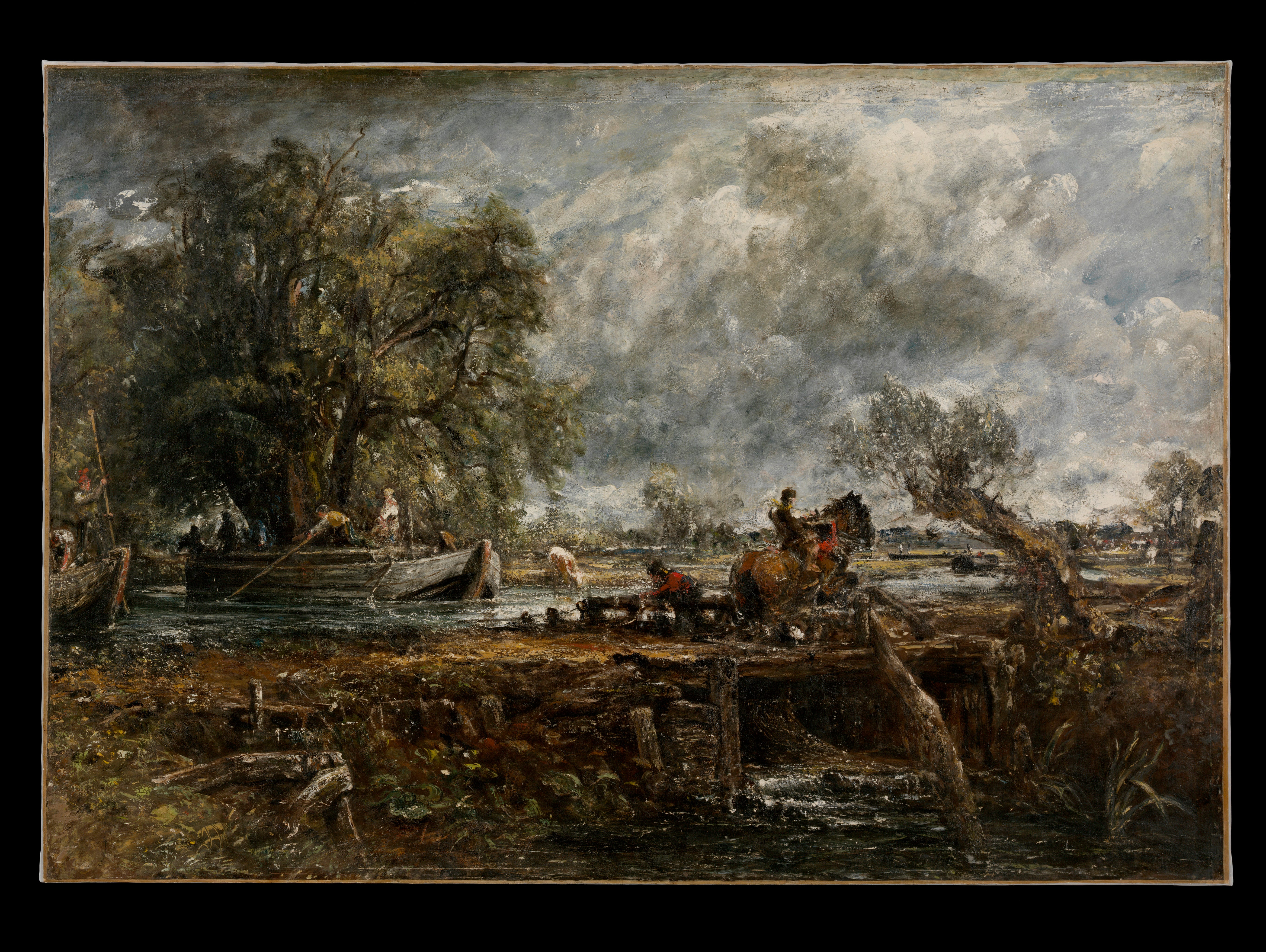
LUCIAN FREUD CALLED IT the greatest painting in the world. We don’t have to agree with everything Freud said, but he had a point.
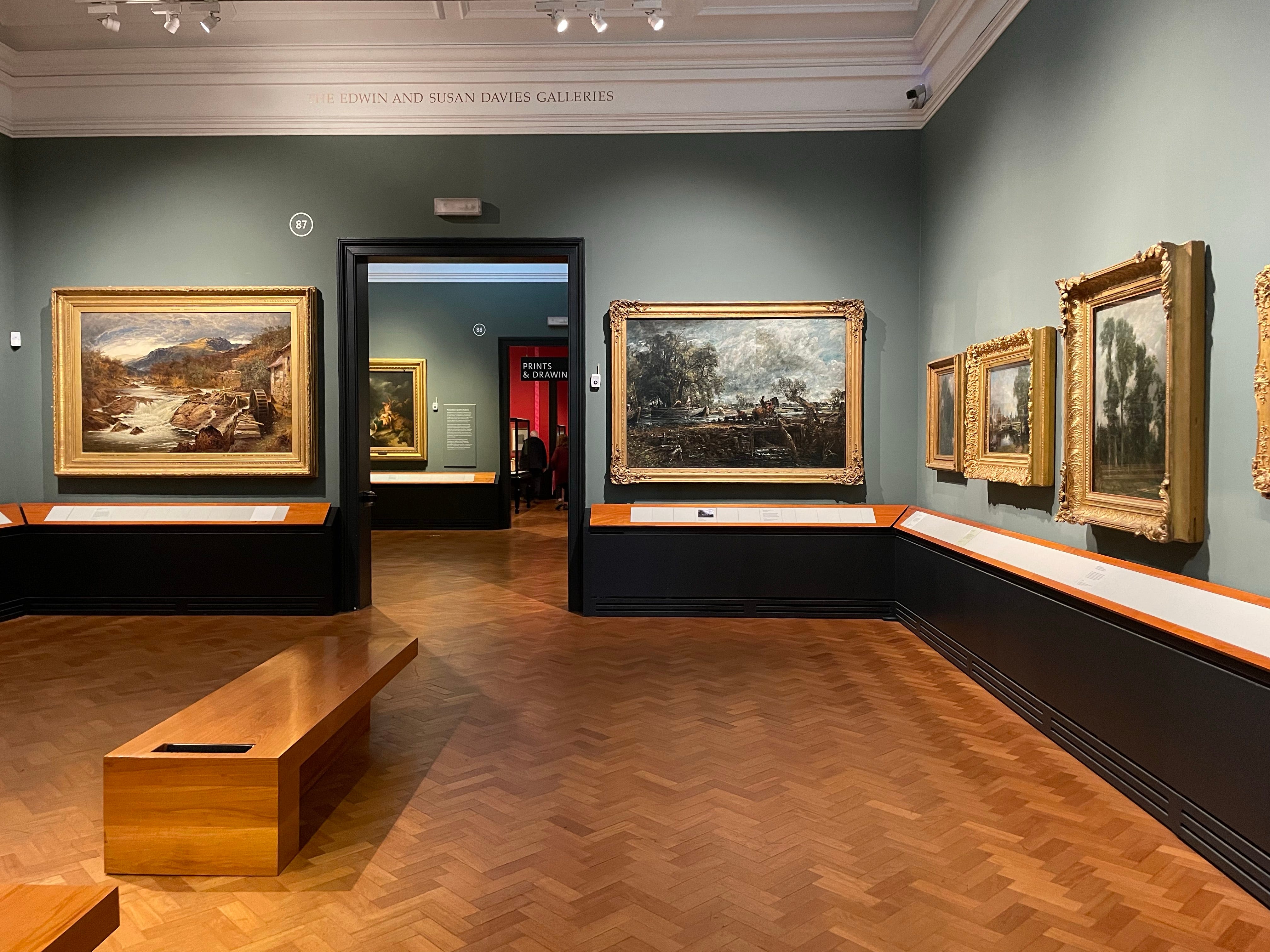
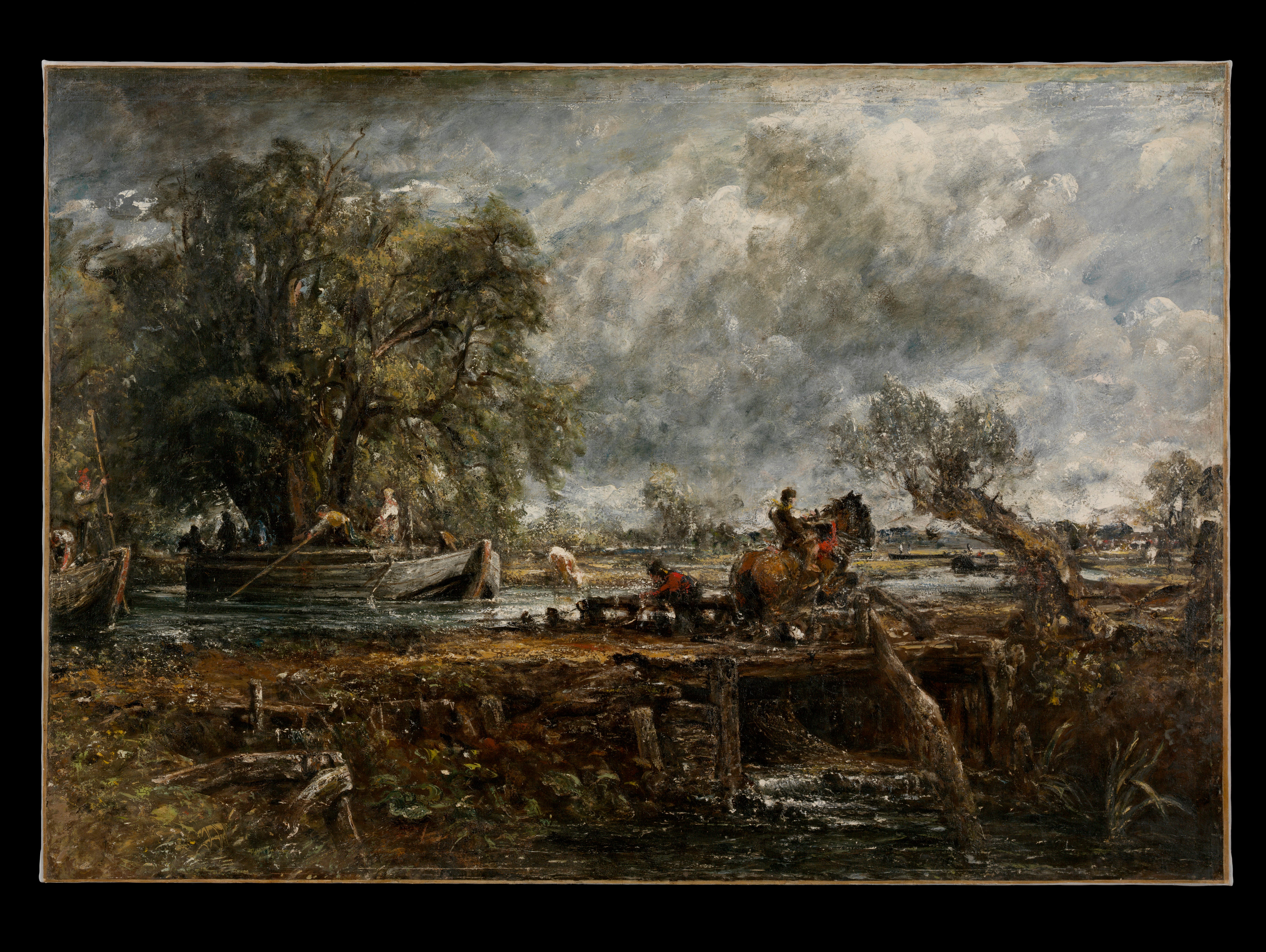
The Leaping Horse by John Constable hangs in the V&A in a room usually fairly empty of visitors. You can very often have the greatest painting in the world to yourself.
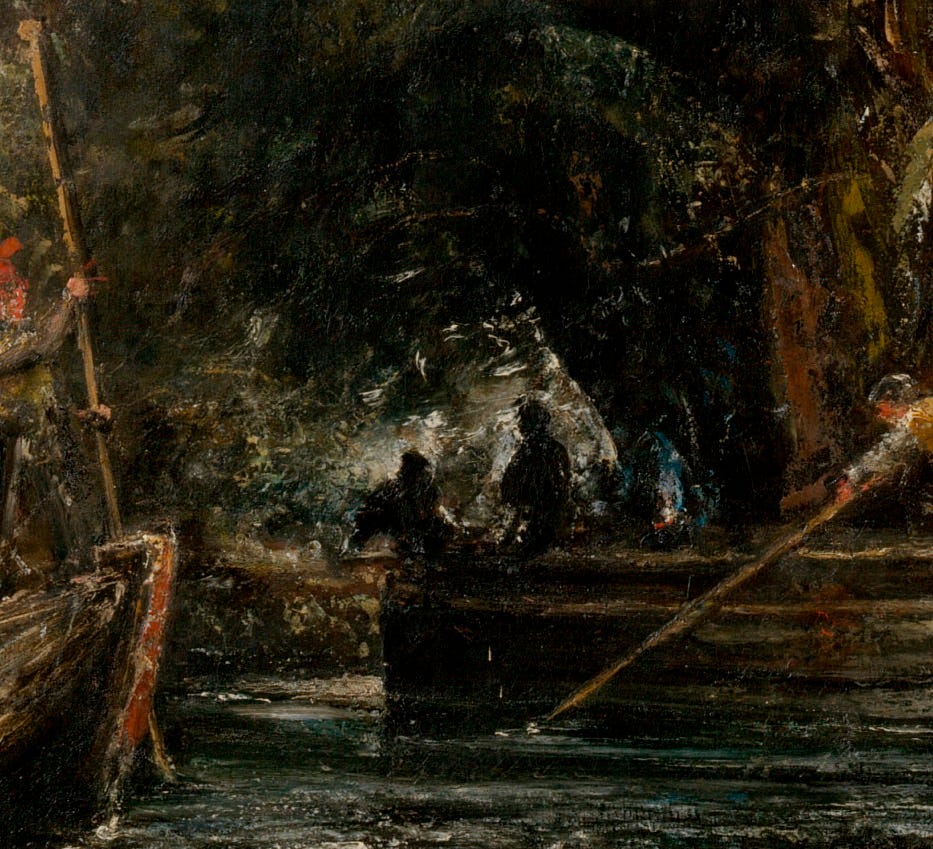
The Leaping Horse shows just that — a horse leaping over a wooden barrier on a towpath of the river Stour. On the far bank of the river is the barge that it is towing, pausing in its journey up river. Another barge waits alongside, perhaps with a tow horse just out of shot. Behind the first barge, through a gap in the trees are two dark silhouetted figures.
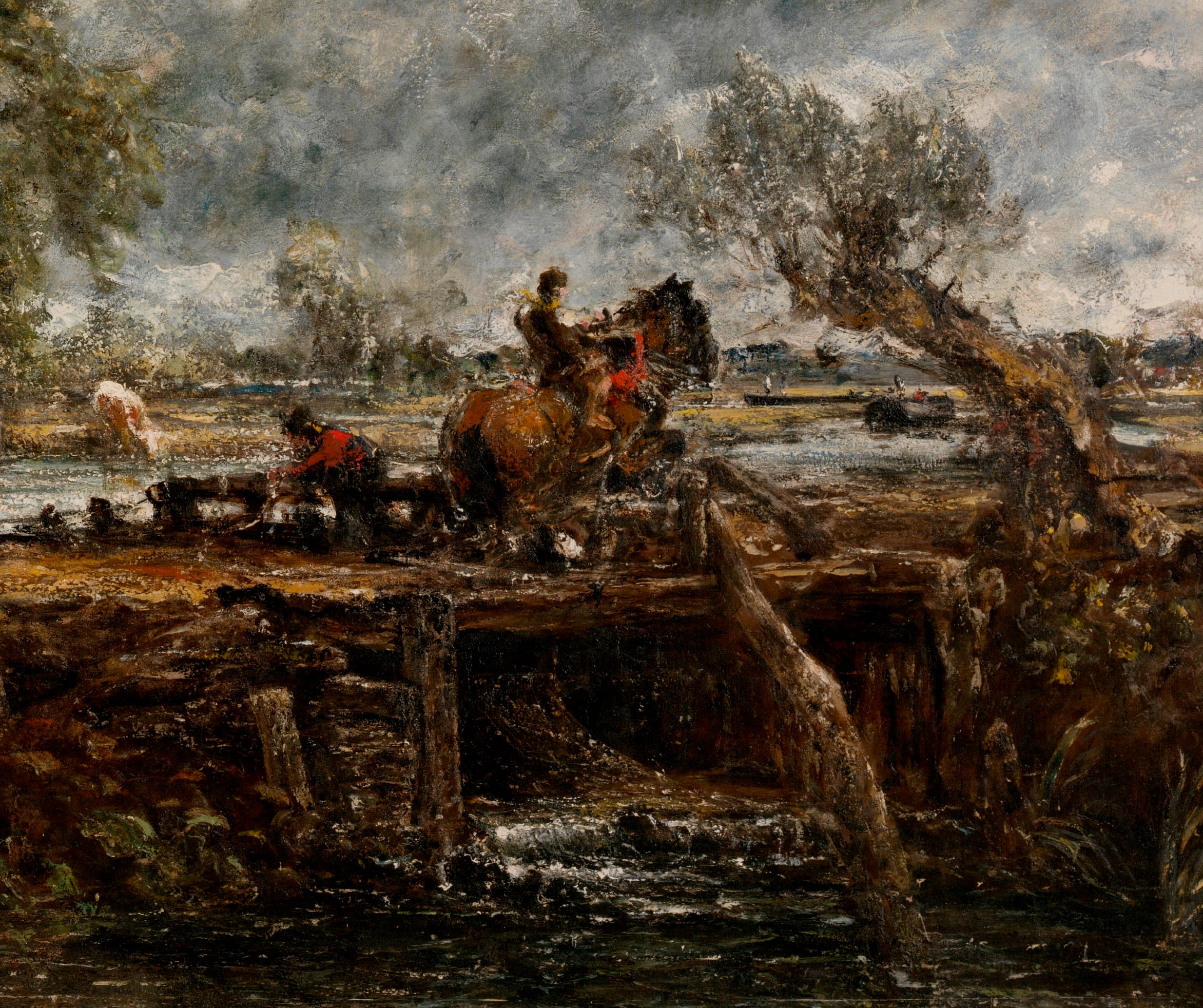
The horse is leaping on a wooden structure housing a sluice, like the entrance to a dark tunnel, somehow running beneath the river. The structure itself stretches along the lower half of the painting, and appears like a stage on which the action of the painting is taking place.
These are the slimy posts and pieces of old timber that Constable so loved, ‘old timber-props, water plants, willow stumps, sedges and old nets, &c &c &c' as he wrote to his friend John Fisher while working on the painting.
They have the solidity and satisfaction of baroque architecture. Bernini would have admired them, as he would have admired the horse itself, like his equestrian statue of Louis XIV.
‘One brief moment caught from fleeting time’ is how Constable described this painting, a phrase he took from Wordsworth.
And on the face of it this is what we see — a moment captured from an ordinary day on the River Stour, men working the barges, tow horses with their distinctive red harnesses at work, cows drinking, the wind agitating the surface of the river and ruffling the silvery leaves of a pollarded willow.
And yet the longer you look, the more the sense of agitation reveals something darker, a restlessness beneath the surface of that painting, like that darkened sluice opening, the entrance to a tunnel running (quite impossibly) to the silhouetted figures on the far bank. The subject is the leaping horse, but this feeling of agitation, of a gathering storm, occupies every square inch of canvas. What John Ruskin many years later was to call the ‘storm cloud of the nineteenth century’ is gathering here for the first time, in the first few months of 1825.
The world itself was about to make a huge leap. Later that year the first public railway opened, the Stockton-Darlington line, with George Stephenson’s first locomotive. The railways transformed life, and rendered the canals obsolete. A few years later photograph became public knowledge, transforming the way we saw the world, as did the introduction of gas and then electric lighting.
Constable worked by daylight and candlelight, never took a train, never saw a photograph, and never read Charles Lyell on geological time or Darwin on evolution. He was a traditionalist who disliked, feared even, reform, welcomed the Enclosure of common land, and had little sympathy for the workers who had their livelihoods taken from them by the new technology of threshing machines.
And yet he created paintings so radical and prophetic that they have been rightly seen as the origin of modern art. His leaping horse seems to tip the very world into a state of catastrophe. Not just the endless sudden changes of the wind on the flickering surface of the water, or the bustling of the branches and leaves of the cut willow and the stately elms. But a catastrophe of painting itself, as if all the sureties of the older world (think Gainsborough, Reynolds, Claude, Poussin) had been shaken to their foundations, and all that remained was the rubble of all that former ambition, held in suspension one last time.
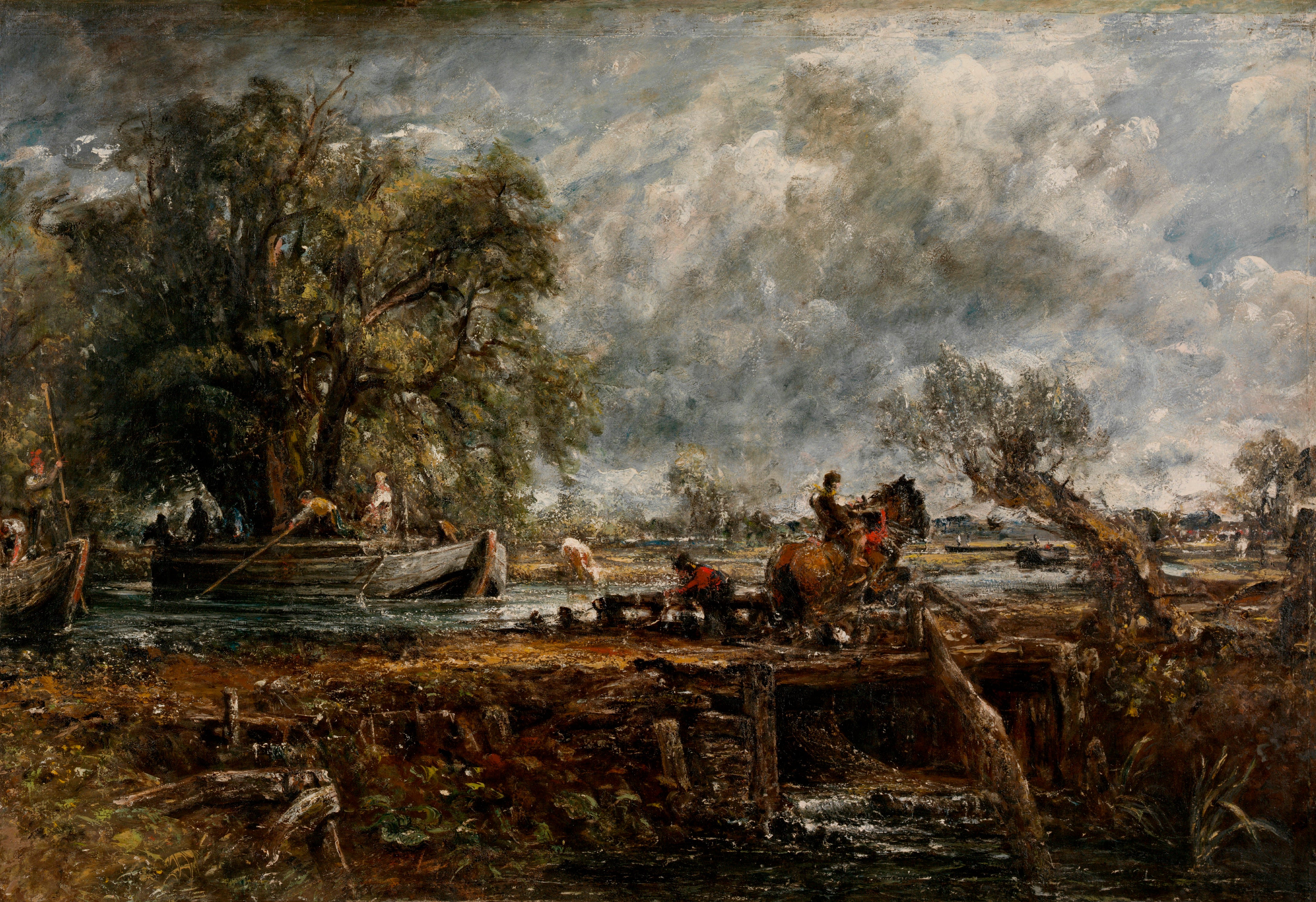
THE LEAPING HORSE, you will remember, was one of the ‘six-footers’, the large landscapes painted for the Royal Academy annual exhibition. The V&A version is one of the full-sized studies that Constable always made in preparation for the exhibited version.
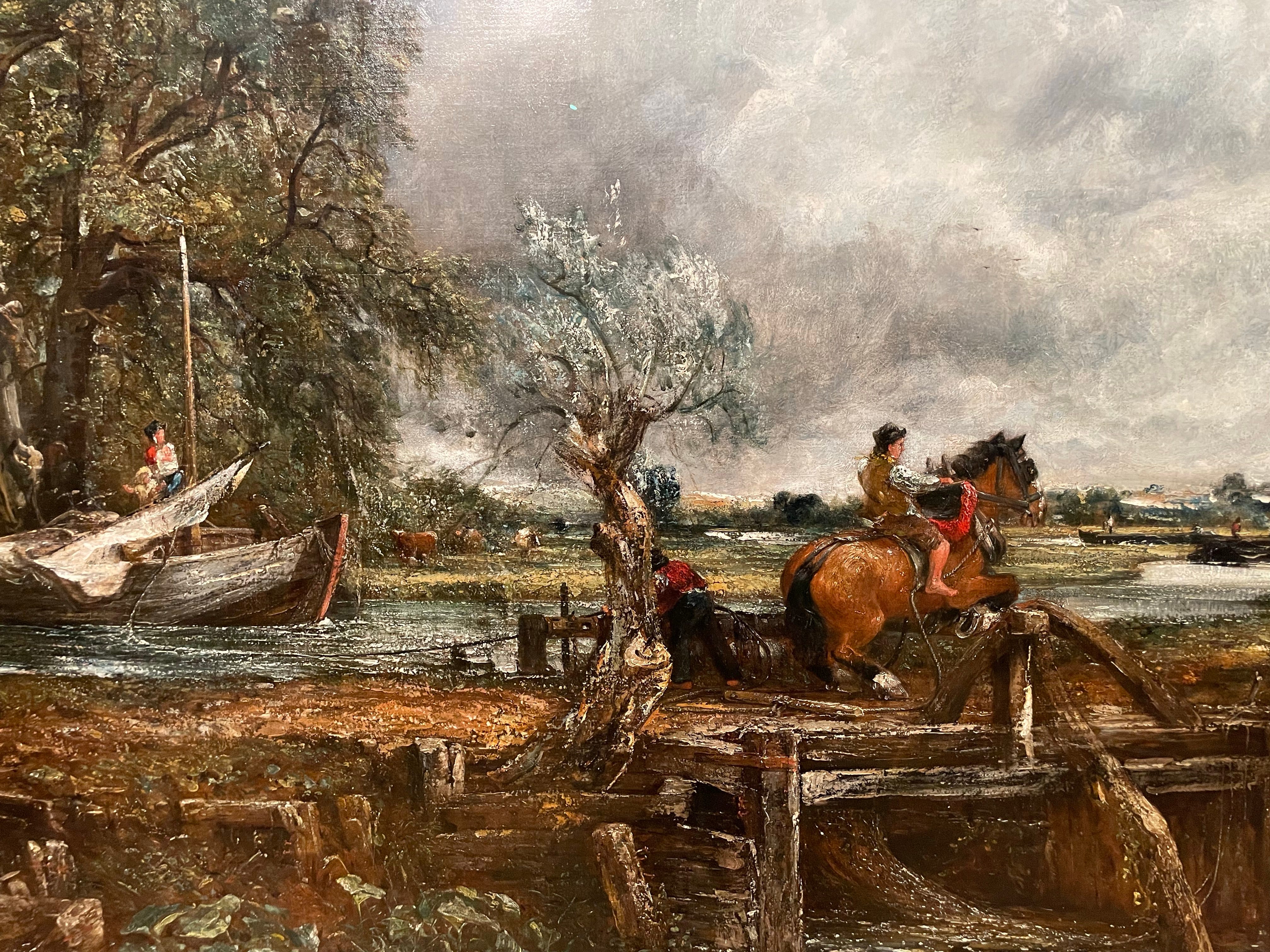
When it came to the finished version, now in the collection of the Royal Academy, Constable reined in the catastrophe just a little, toning down the storm and brightening-up the colours. It is catastrophe sugar-coated, like a public announcement on climate change.
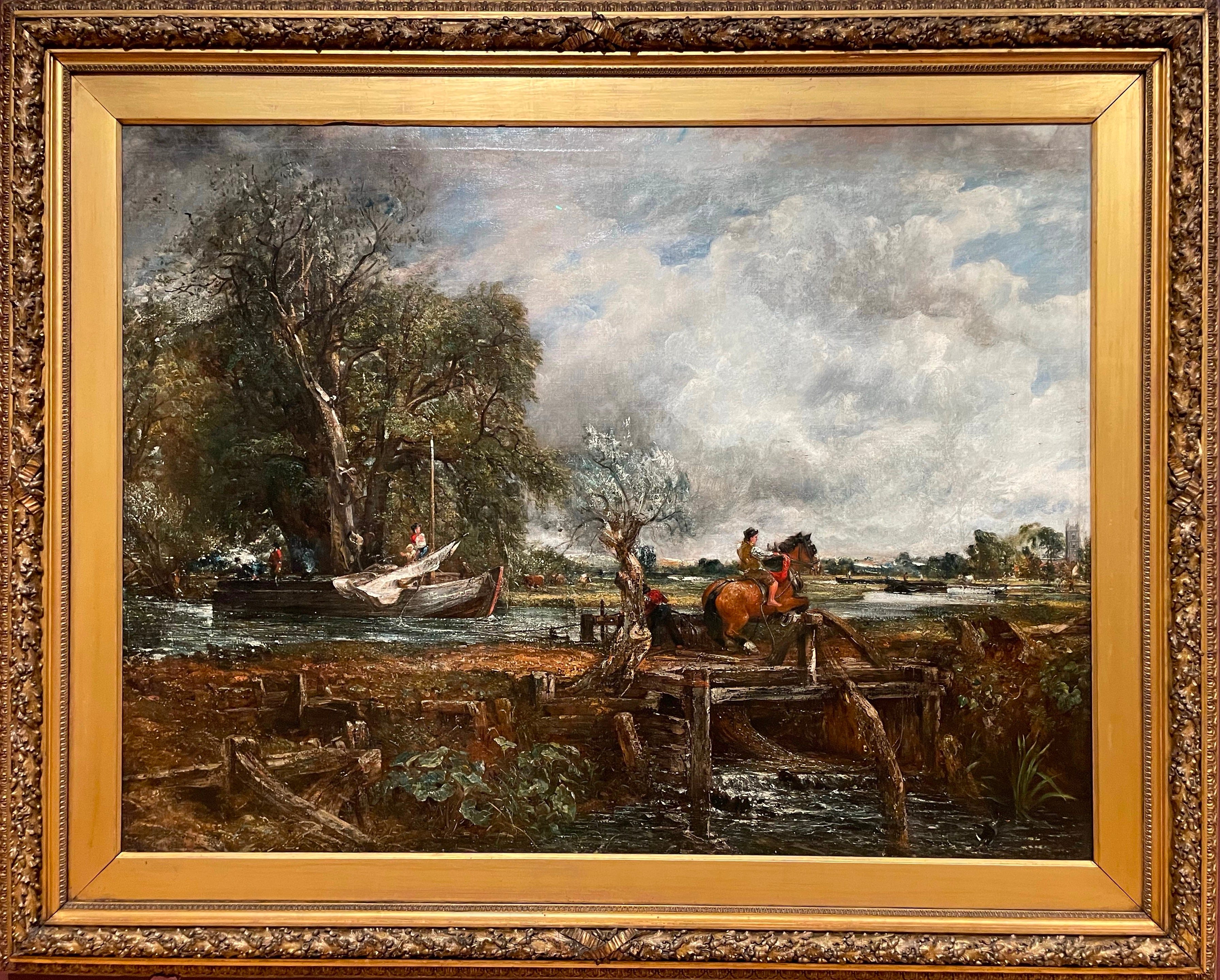
The silver-leaved willow stump has moved to the other side of the horse, as if a moment has passed (Constable made this change when the painting came back from the summer exhibition). The barefoot (why?) rider is brighter and clearer, and the ‘old timber-props’ seem to have had a scrub, the sluice tributary dredged.
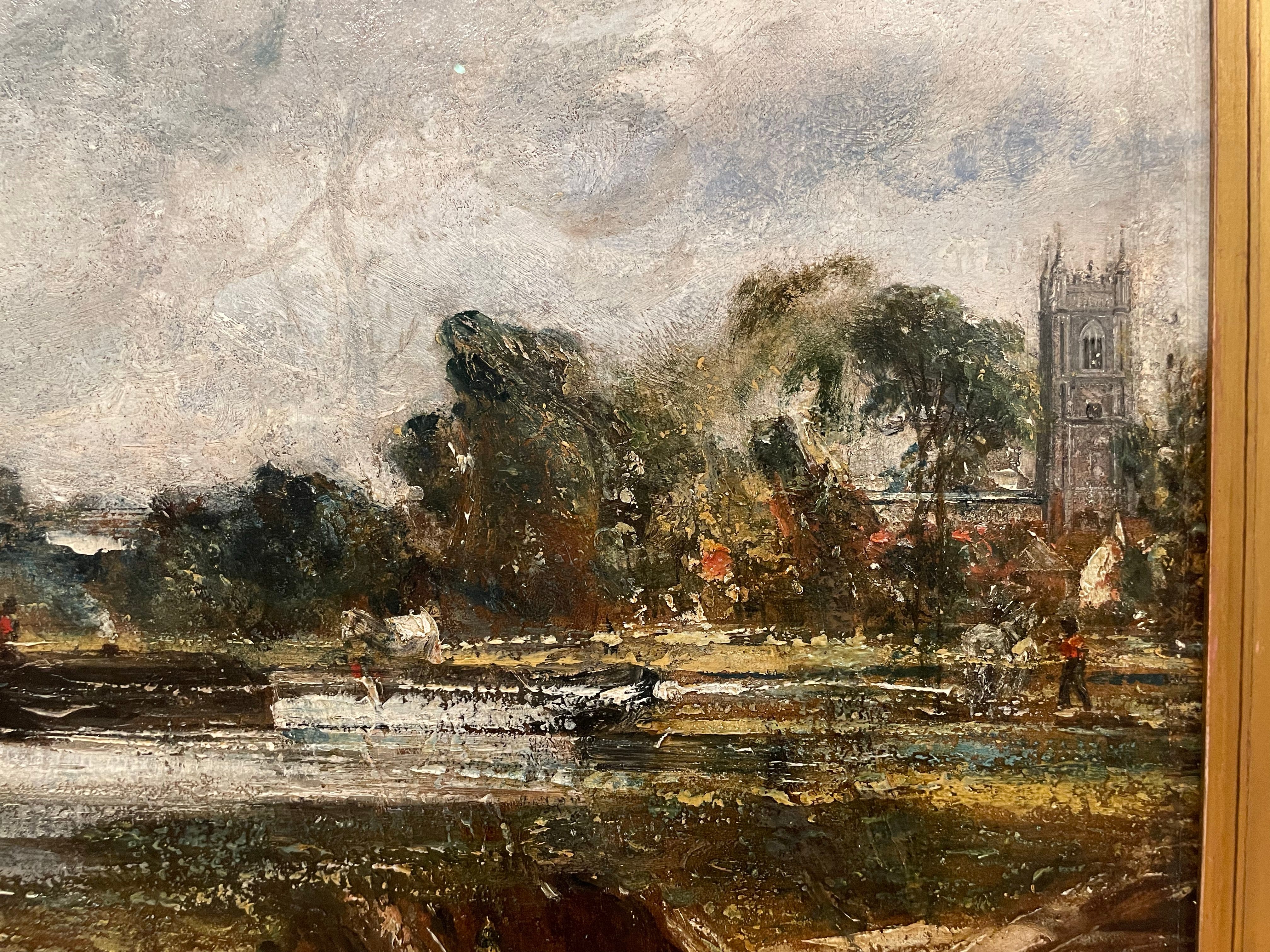
The tower of Dedham church has appeared on the right hand side, painted in an almost comically fastidious style. Dedham church is like a Tardis in Constable’s paintings, turning up all over the place for compositional convenience.
Another intriguing detail is that of the figures standing in the barge on the opposite bank. In the first version they are indistinct barge workers. In the finished version it is clearly a woman holding a baby with a young child by her side.
This must be (although nobody has ever pointed this out before) an image of Constable’s wife Maria Bicknell, holding their baby daughter Emily, born on the 29th March 1825, just a week or so before the painting was sent to the Royal Academy, with their next youngest (of six) children, the three-year-old Isobel standing alongside, waving to her father, standing on the opposite bank. Their oldest child, John Charles, was nine years old at the time. The Leaping Horse was made in the thick of family life.
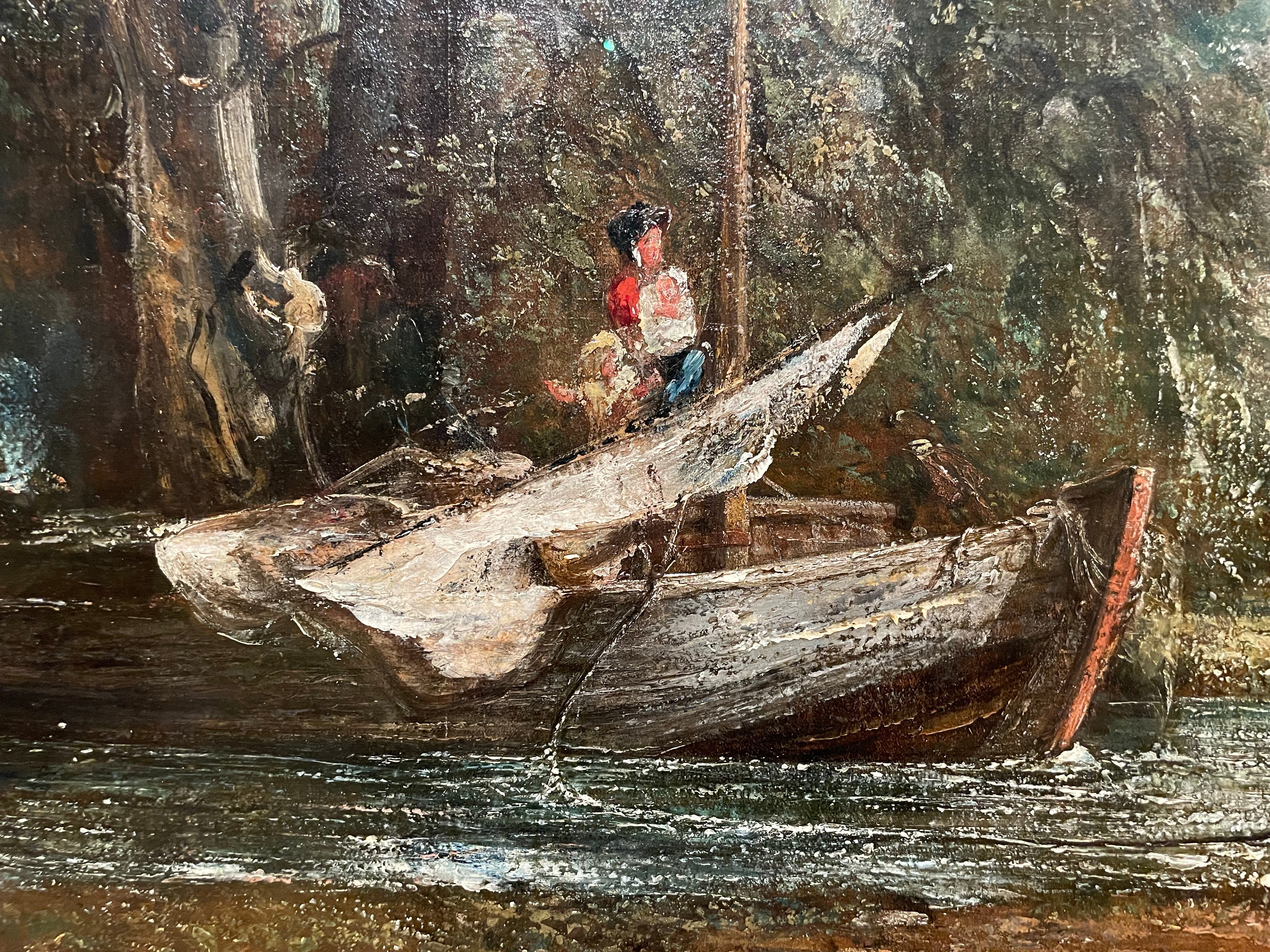
In the second, exhibited version, it seems that a decisive moment has passed. Perhaps the paintings arose unconsciously from Constable’s anxiety around Maria’s pregnancy, which was a difficult one. The silvery willow tree is like a champagne bottle opened in celebration. My quiver is now full, he wrote to his friend John Fisher, although the next year another child, Lionel, was born, and the effort of continual pregnancy surely contributed to Maria’s death the year after that.
But this is only one of the ideas that gathers around these twin paintings. Looking from one to the other (not literally of course), there is a sense of the world righting itself. Where the first version is all horizontals, the river, the sloping willow, the flatness of the timber-prop stage and distant horizon, in the second version verticals predominate – the white mast of Maria’s barge, the upright willow, the tower of Dedham church, and above all the leaping horse.
With the leap of a horse painting itself has taken off, reorienting itself from horizontal to vertical, turning from earth to the sky. If there is an air of celebration, however, it is a passing moment. The agitation and restless are still there, chronically embedded in the weave of the canvas, in the mind of the artist, in the world in which he lived. A sense of restlessness but also of catastrophe, of some great fundamental shift in the offing.
HOW DID CONSTABLE COME to make such a painting? The greatest and most quietly radical painting ever made? There is of course no straight answer - it is the mystery of creativity and art, the leap of imagination which seems to come from nowhere, creating something from nothing.
Gustave Flaubert once said that an artist should live like a bourgeois and think like a radical. Constable certainly lived like a bourgeois, but was hardly radical in his political views. Perhaps he saved up all his contrarian energy for the painting room.
There is another explanation for the ambition of The Leaping Horse, which is the story of Constable’s success in France. We have to go back a few years, to the Royal Academy exhibition of 1821, where Constable showed his painting Landscape: Noon, mercifully retitled by his friend John Fisher The Hay Wain.
Fortunately, we have an image of the 1821 exhibition, a gently satirical drawing by George Cruikshank, made for the bestselling novel by Pierce Egan Life in London, or, the Day and Night Scenes of Jerry Hawthorn, esq., and his elegant friend, Corinthian Tom, accompanied by Bob Logic, the Oxonian, in their rambles and sprees through the Metropolis. (It was adapted into a West End hit called Tom and Jerry).
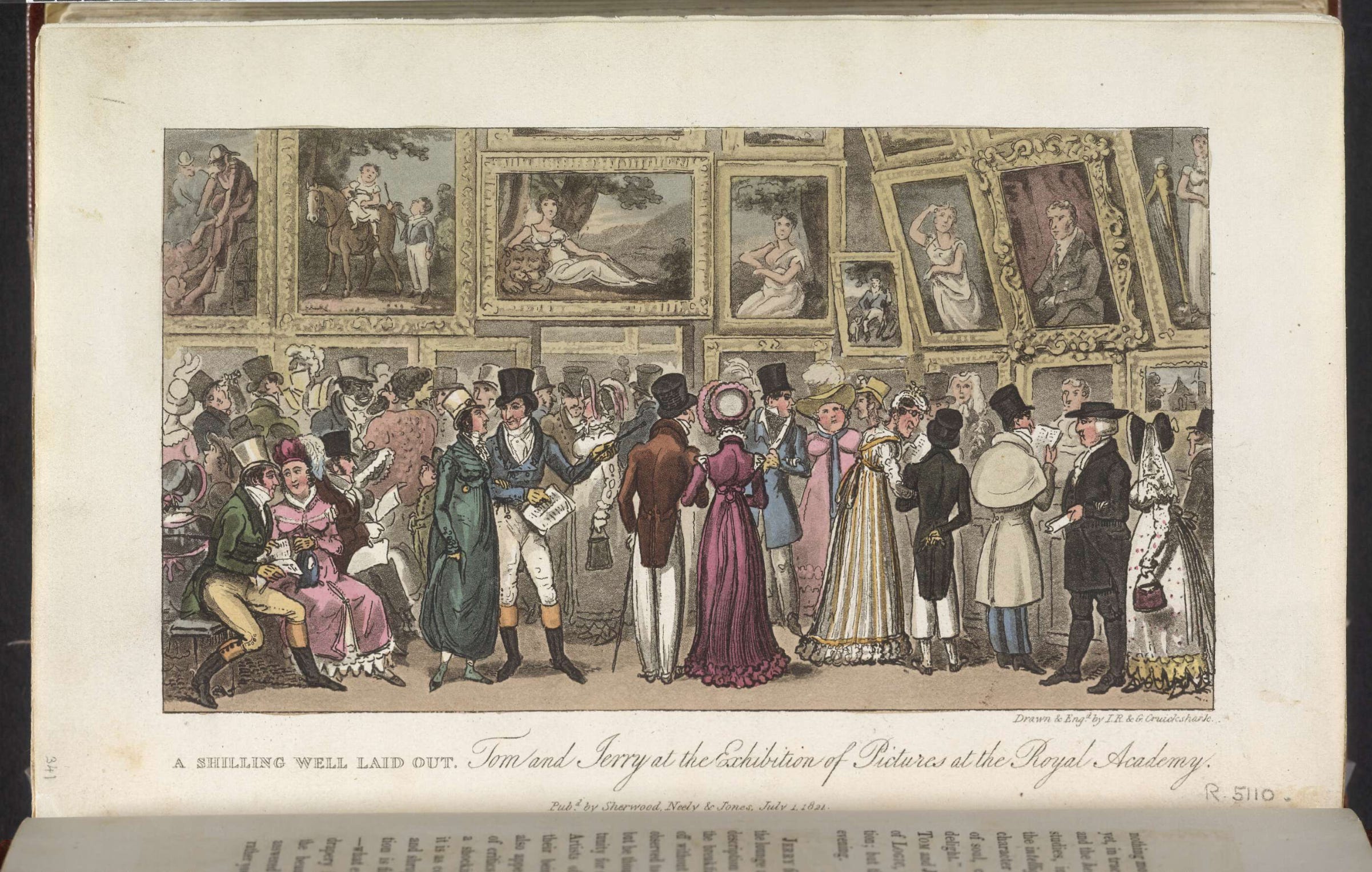
Unfortunately, Cruikshank’s doesn’t show the Haywain, although gives some indication of how such a thrillingly naturalistic and truthful image of nature would have stood out among all the society portraits.
Neither does he show one important visitor to the 1821 Royal Academy exhibition, the French painter Théodore Géricault.
Géricault was in London for the display of his recently-completed epic, The Raft of the Medusa, at the Egyptian Hall on Piccadilly. Thousands of people saw it, and it seems not unlikely that Constable visited the exhibition, although there is no record of this (a contemporary news report says that members of the Royal Academy attended the opening).
It’s well-known that Géricault saw the Haywain, but never pointed out that the occasion must have been when he was invited to the formal dinner at the opening of the exhibition at Somerset House in May.
Nor is it ever really asked why Géricault, who had just completed one of the most dramatic paintings of all time, showing humanity pushed to an extreme of violence, desperation and survival, would be so taken with a painting of a wagon stranded in a millpond in sleepy Suffolk.
But he was, and returned to France to spread the gospel of Constable. The story continues that Delacroix became another devotee of the English landscapist, as did the French art dealer with the very English name John Arrowsmith.
Arrowsmith travelled to London to offer Constable £70 for the Hay Wain, even then a derisory offer. Only two years later was he able to purchase the painting, along with another ‘six-footer’ View on the Stour at Dedham, and ship them to Paris to show in his gallery.
Later that year (1824), the paintings went on display at the Paris Salon, in the Louvre, like the RA Summer exhibition but much, much grander. Here they really stole the show. Constable was awarded a gold medal by the King of France — an electrotype cast of it was later set into the frame of the Hay Wain.
Géricault, quite tragically, never saw the painting in the Louvre Salon (this has not before been pointed out). He died on the 26th January that year, at the age of thirty-two.
Delacroix saw it, and is said to have repainted his Massacre at Chios on seeing Constable’s paintings in the Louvre —probably not quite true, but he had at least absorbed the ethos of Constable’s painting, the roughness and truthfulness of his style.
You can see it perhaps best in the painting hanging in the National Gallery in London, Ovid among the Scythians.
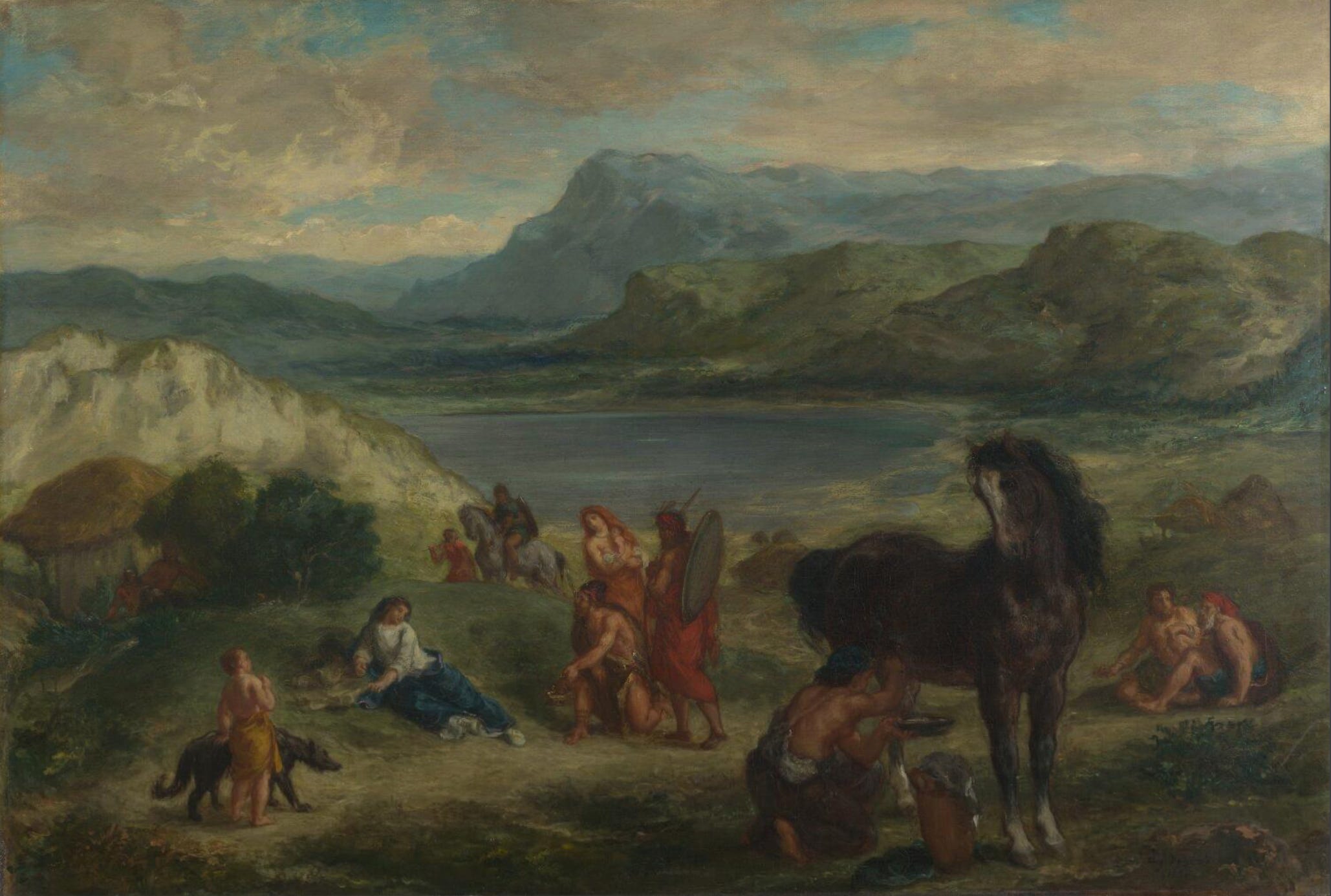
The subject is classical, Italianate, arcadian — the Roman poet sent into exile and being well looked-after by the North Sea barbarians — but the treatment is a far cry from Claude and Poussin; more like Ovid in the Lake District, or Dedham Vale.
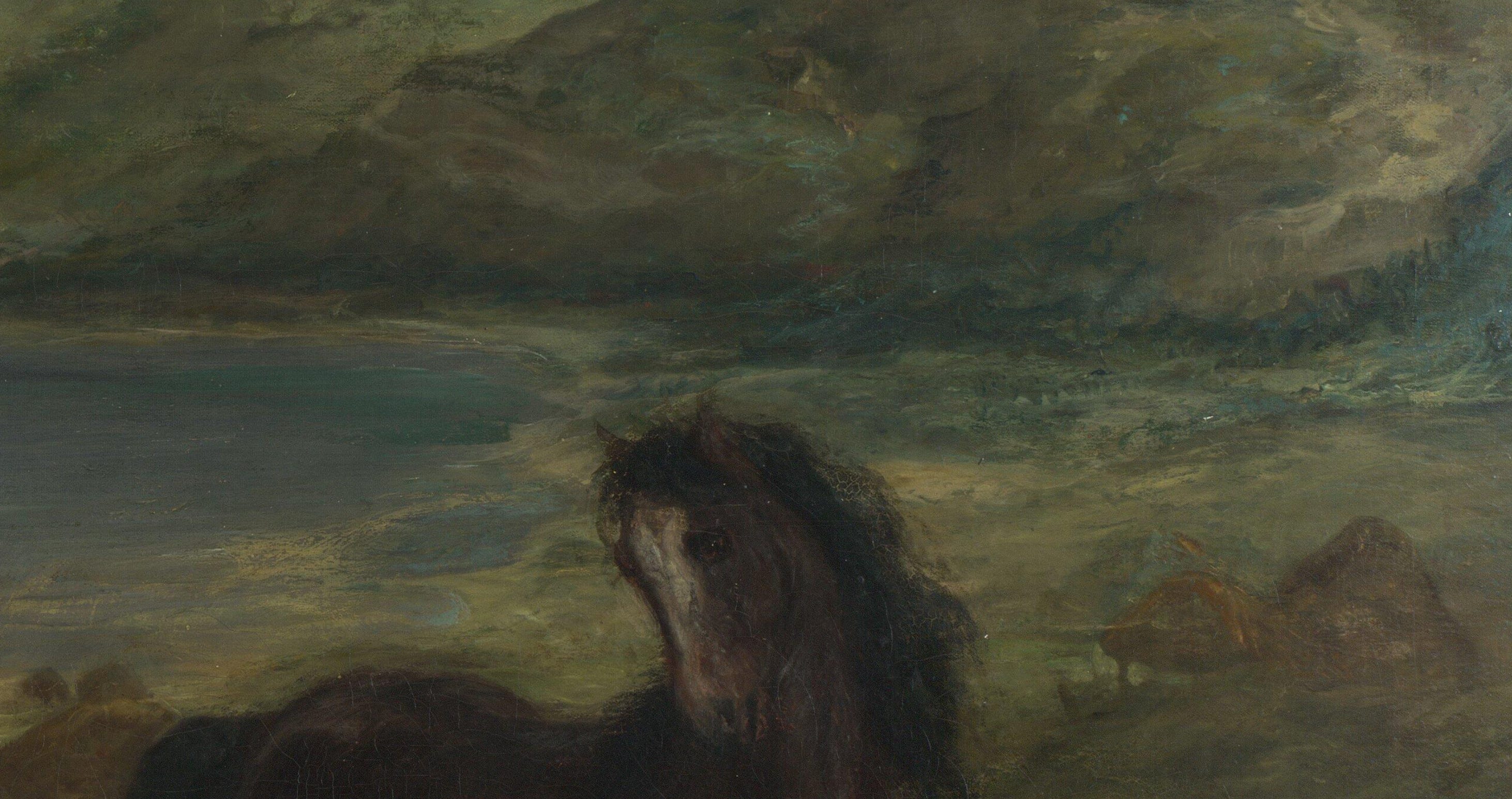
What Constable called his ‘rugged brokenness of style’, Delacroix called, flochetage, a sort of fleckiness of paint, colours and hues interwoven in small dabs, rather than smoothly blended.
The final part of the French story is Delacroix’s famous visit to London in May of 1825, when the Leaping Horse was on display in the RA Summer Exhibition. He had come to visit Constable, but it is not quite clear whether the two actually met.
Somehow Delacroix returned to Paris with one of Constable’s sketchbooks, in which he made a few of his own drawings — it is now in the Louvre. But more importantly it was from this visit that Delacroix claimed to have heard Constable describe his method of painting, as he (Delacroix) wrote in his famous Journal some years later:
‘Constable says that the superiority of the greens in his meadows is due to the fact that it is made up of a large number of different greens. What gives a lack of intensity and life to the verdure of the ordinary run of landscape painters is that they do it with a uniform tint. What he says about meadows can be applied to all the other tones’.
This ‘meadow-theory’ itself has a fascinating origin (this is definitely an aside). Early in life Constable was strongly influenced by a character called John Thomas Smith, or ‘Antiquity Smith’, and in particular by a book that Smith illustrated and wrote in 1797, Remarks on Rural Scenery, about the aesthetic value of dilapidated, decaying cottages. Smith makes exactly this point about painting meadows:
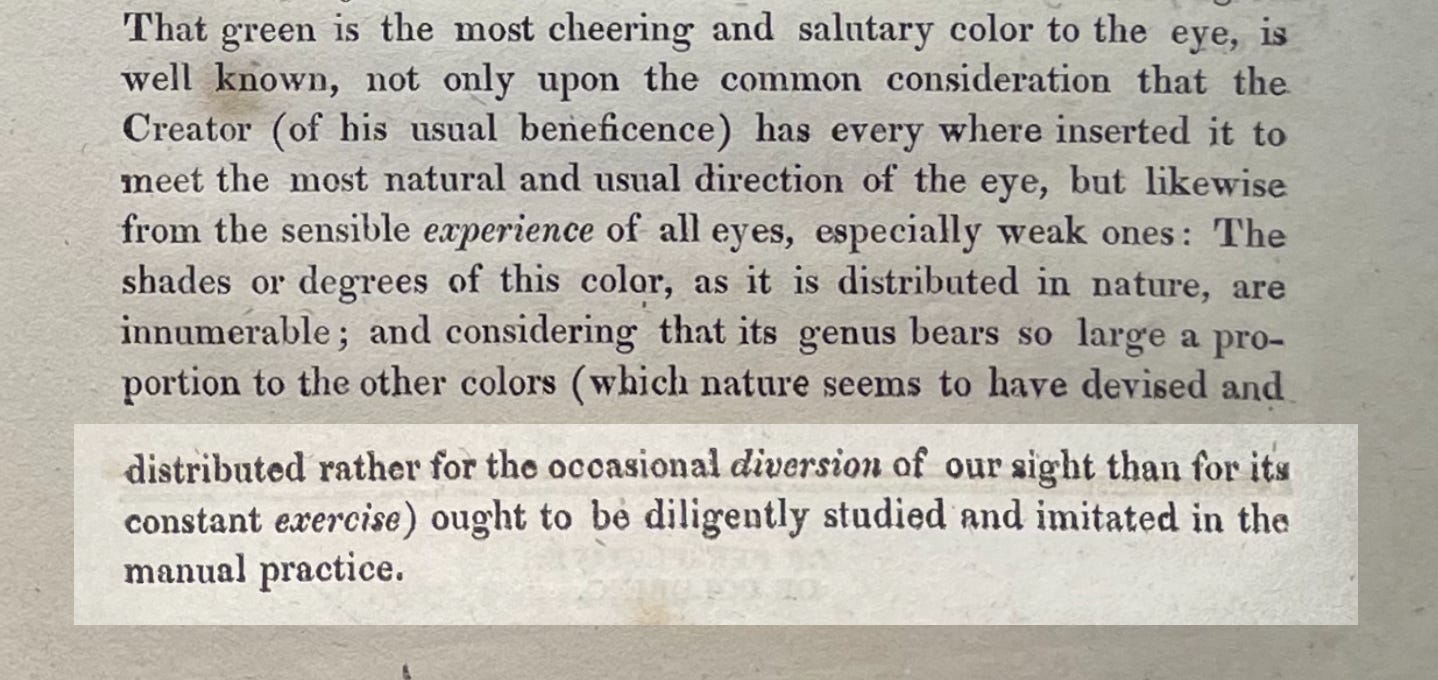
An aside, but only just – the origins of flochetage and ‘rugged brokenness’ in a book on the aesthetics of dilapidation and decay leads to an idea that stands at the heart of Constable’s painting. And this is what I call ‘Dunghill Theory’.
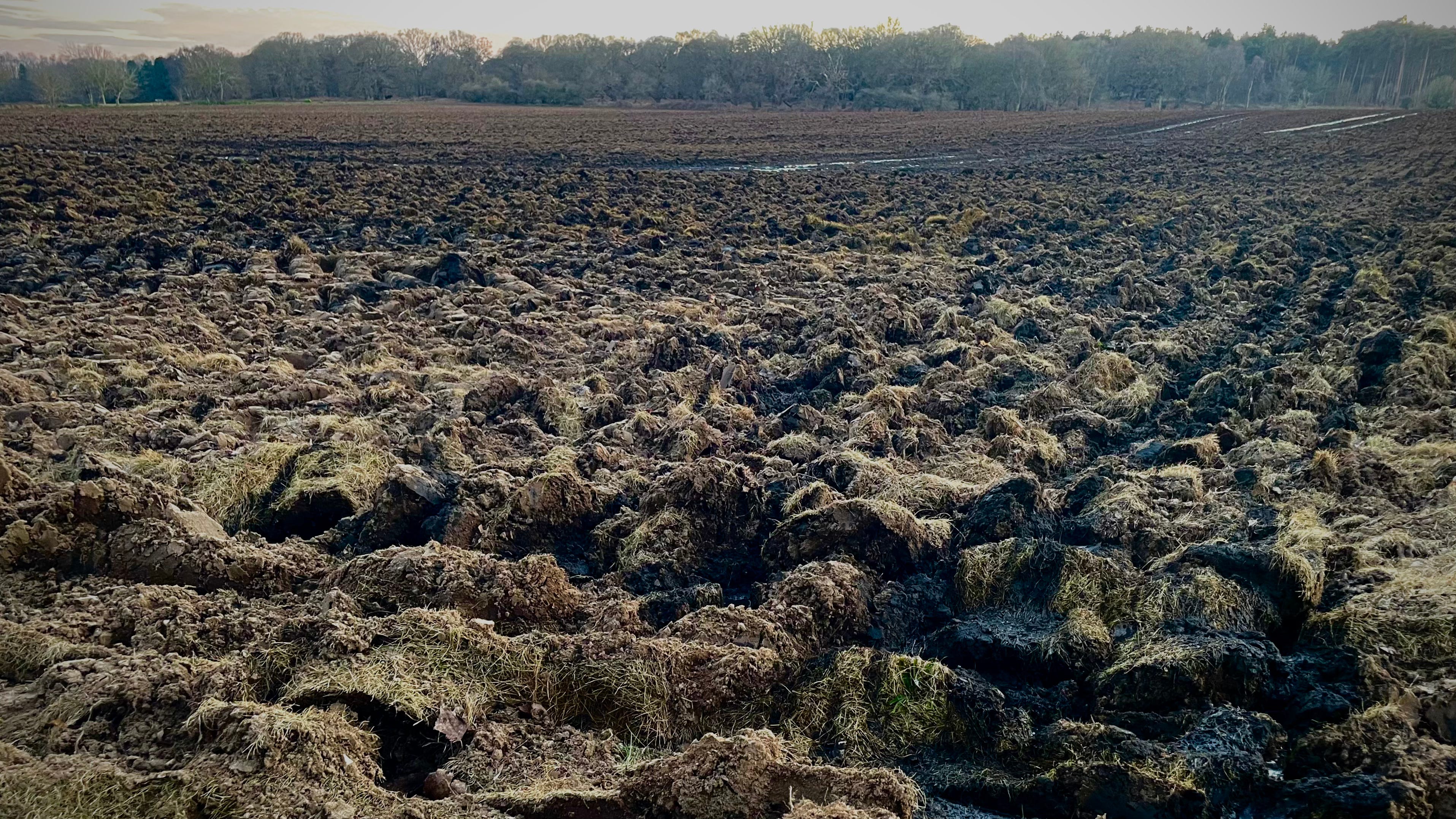
DUNGHILL THEORY is a theory not only about Constable but about all painting. In short, it is that painting is a machine for transforming earth into light.
In late 1814 Constable completed a painting, in fact commissioned as a wedding present, showing a view of the Stour Valley. It was a view he had painted many times before, but not with a huge pile of manure in the foreground.
It’s usually called The Stour Valley and Dedham Church, but I prefer my own title, which is The Dunghill.
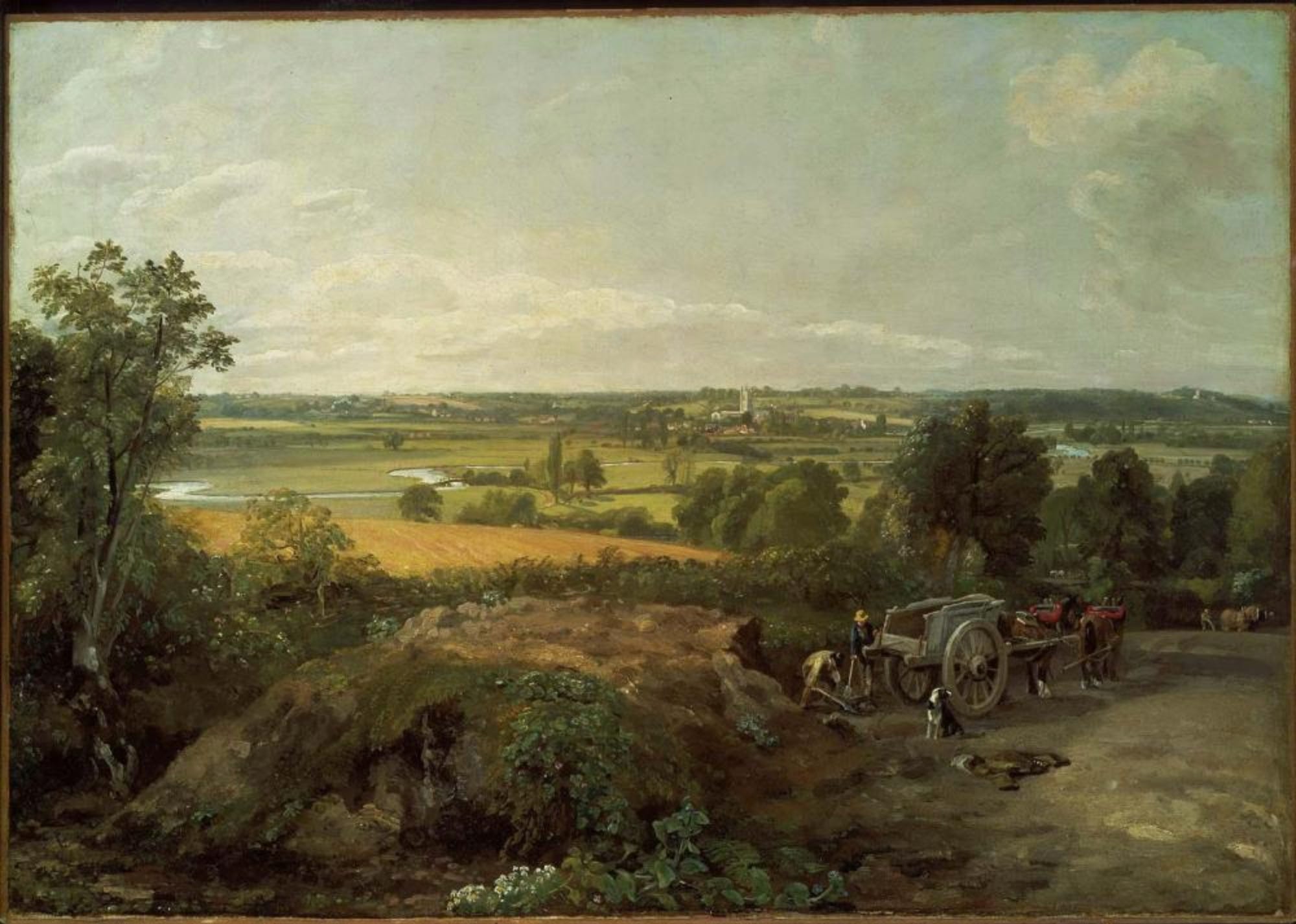
For years prurient art historians described the mound as composed of gravel, but it is clearly manure. And, as Ian Fleming-Williams helpfully pointed out over fifty years ago, it is a particular type of dunghill known in Suffolk dialect as a ‘runover dungle’, that is, a dunghill designed for wagons to drive up and dump their loads, helpfully compacting the pile, so that it decomposed better and was ready for muck spreading later in the year — the activity shown in this painting.1
There is an earlier version, more of an oil sketch, painted at the beginning of September in 1814, showing the pile of manure before the workers had begun to load it on their wagons. It is in Leeds City Art Gallery (although not currently on view), and is usually known as Dedham Vale, but I prefer to think of it as A Bigger Dunghill
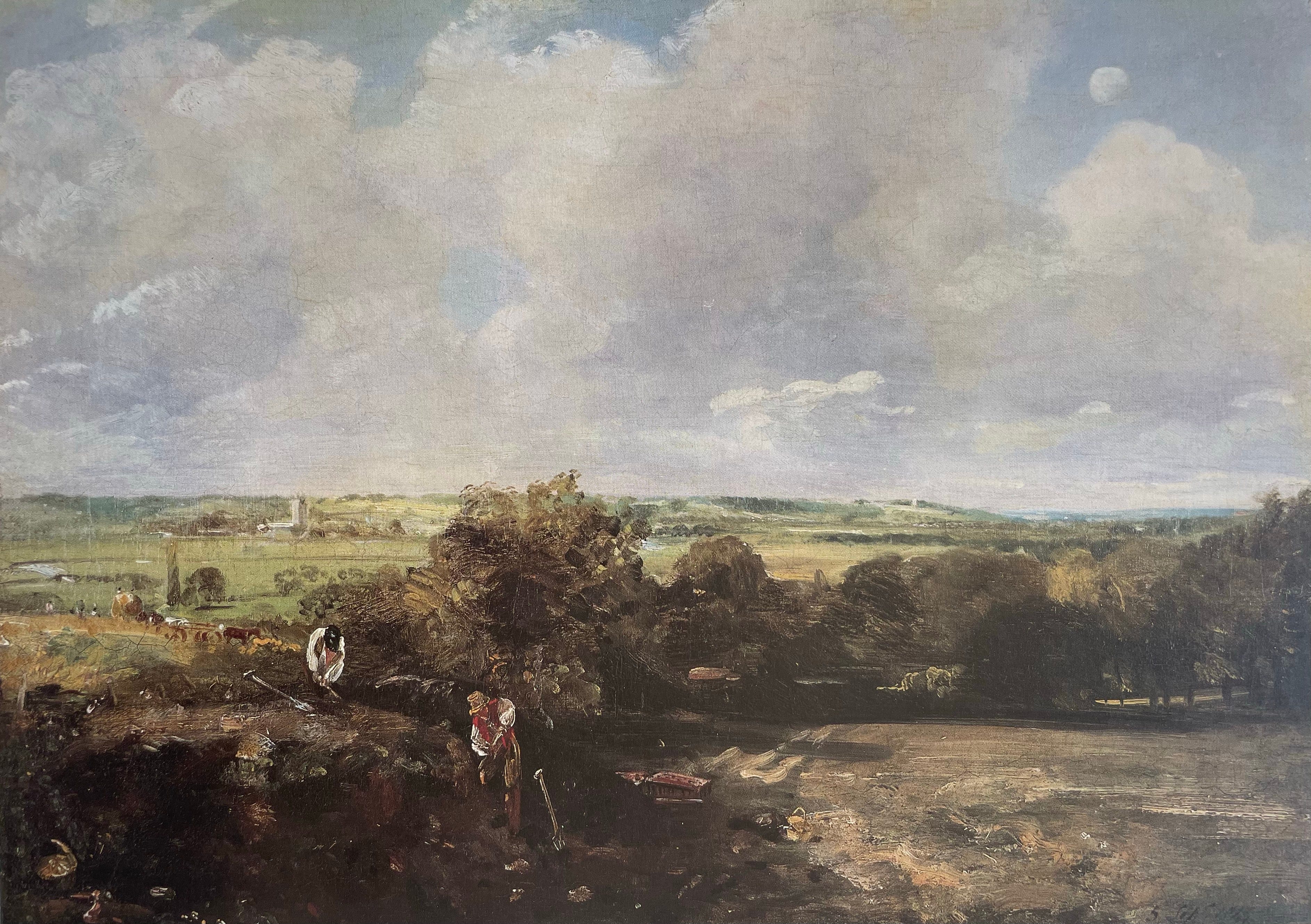
That the dunghill is the subject of both paintings is not supposed to be a joke. Rather they were emblems of wealth and plenty, enormous mounds of agricultural humus ensuring a bountiful harvest and plentiful returns.
And this was surely part their attraction for Constable, who once said that he never saw an ugly thing in his life.
But they also take on a different, deeper meaning. The more you look at Constable’s paintings, the more you see dunghills everywhere, piles of indifferent earth that seem to signify something about origins.
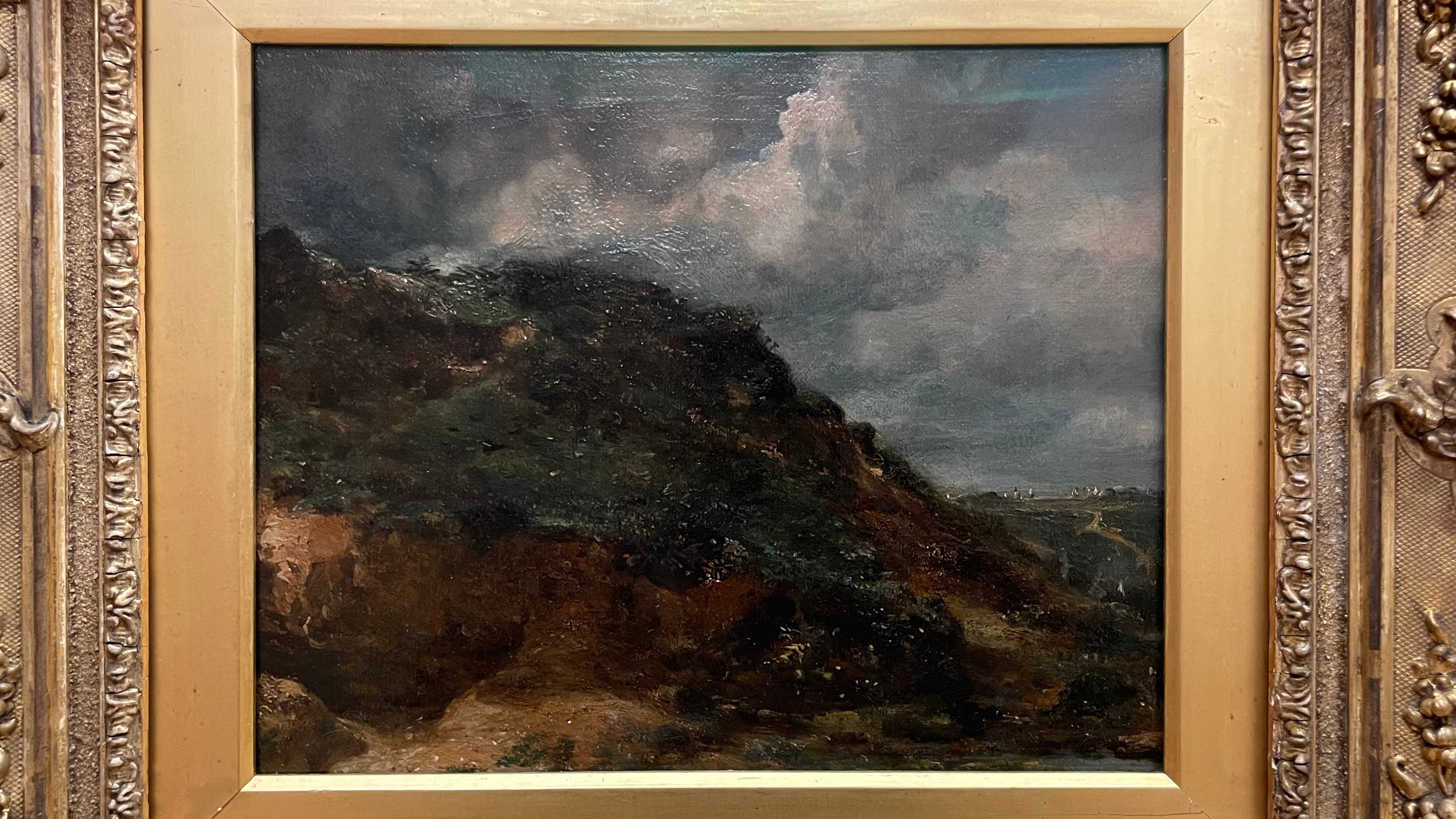
The painter Paul Cézanne once said that only one thing ever truly painted is the origin of the world. This is what the dunghill seems to stand for in Constable’s painting, a place of origin, a sort of degree zero of painting, from which emerge the basic elements of painting, colour and light.
Dramatically so in one of his last paintings, Hampstead Heath with a Rainbow, made in 1836, in the year before his death. The foreground is dominated by these mounds of earth, that seem to be restlessly decaying before our eyes, then transformed by the miracle of perspective and refraction into the great arc of a rainbow (although a rather pale one).
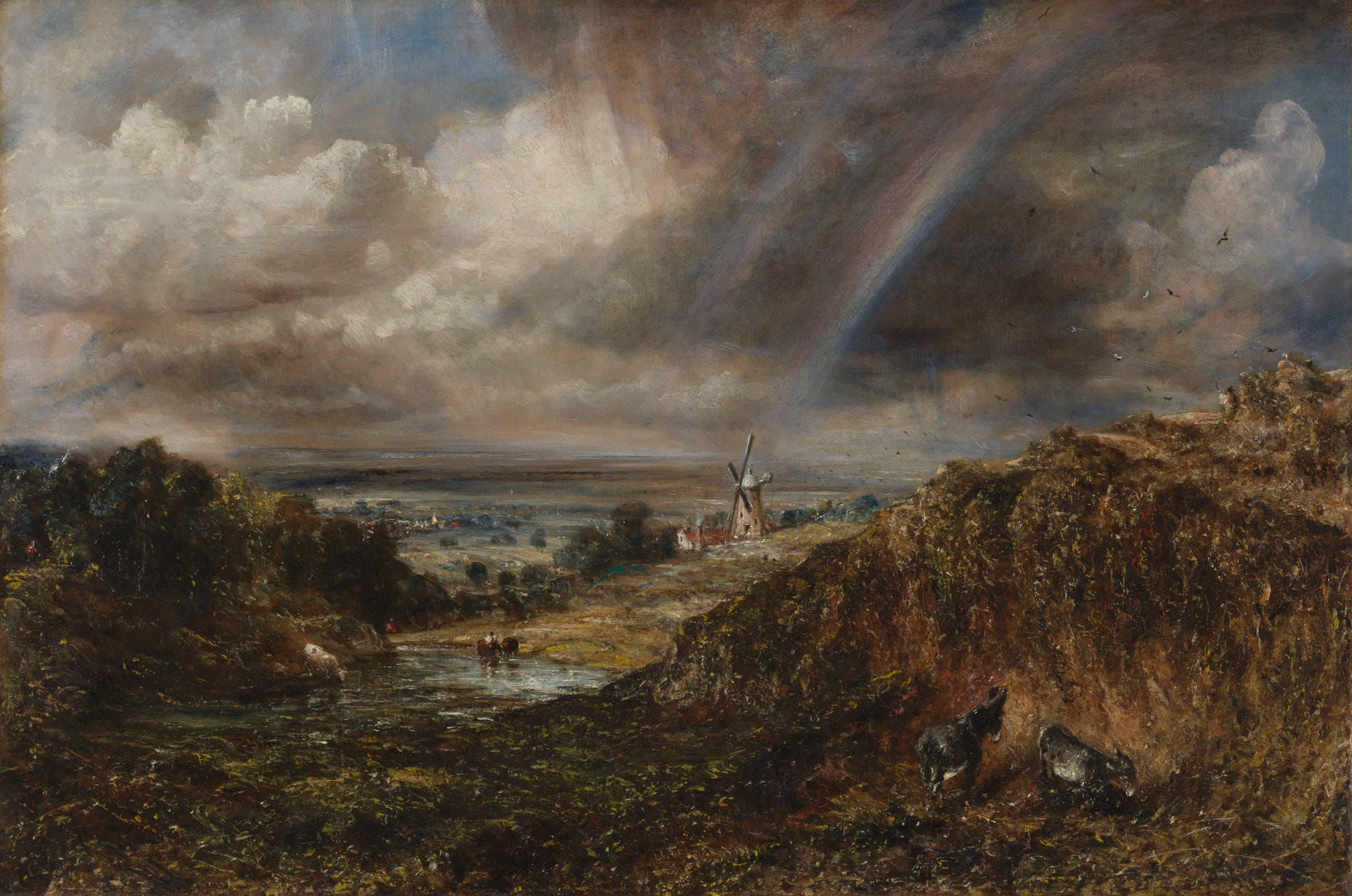
Painting as a machine for transforming cold earth into colour and light, for turning the horizontality of the mute world into the speaking verticality of art. Constable would not have put it like this — Delacroix almost did, once reportedly saying ‘Give me some mud from the street, and I will turn it into the richly-coloured flesh of a woman’. (‘Donnez-moi la boue des rues et j'en ferai de la chair de femme d'une teinte délicieuse').
There is of course no direct evidence that either artist realised the aesthetic value of dunghills, or would have subscribed to ‘dunghill theory’, beyond the evidence of their art.
The closest I have found is Frank Auerbach’s description of his process of drawing, how he would first put down lines of pencil on the page, as a way of ‘manuring’ it, before overlaying it with a final drawing done with pen.2 He happened to be talking about drawing he was making from the Hay Wain, standing in the National Gallery.
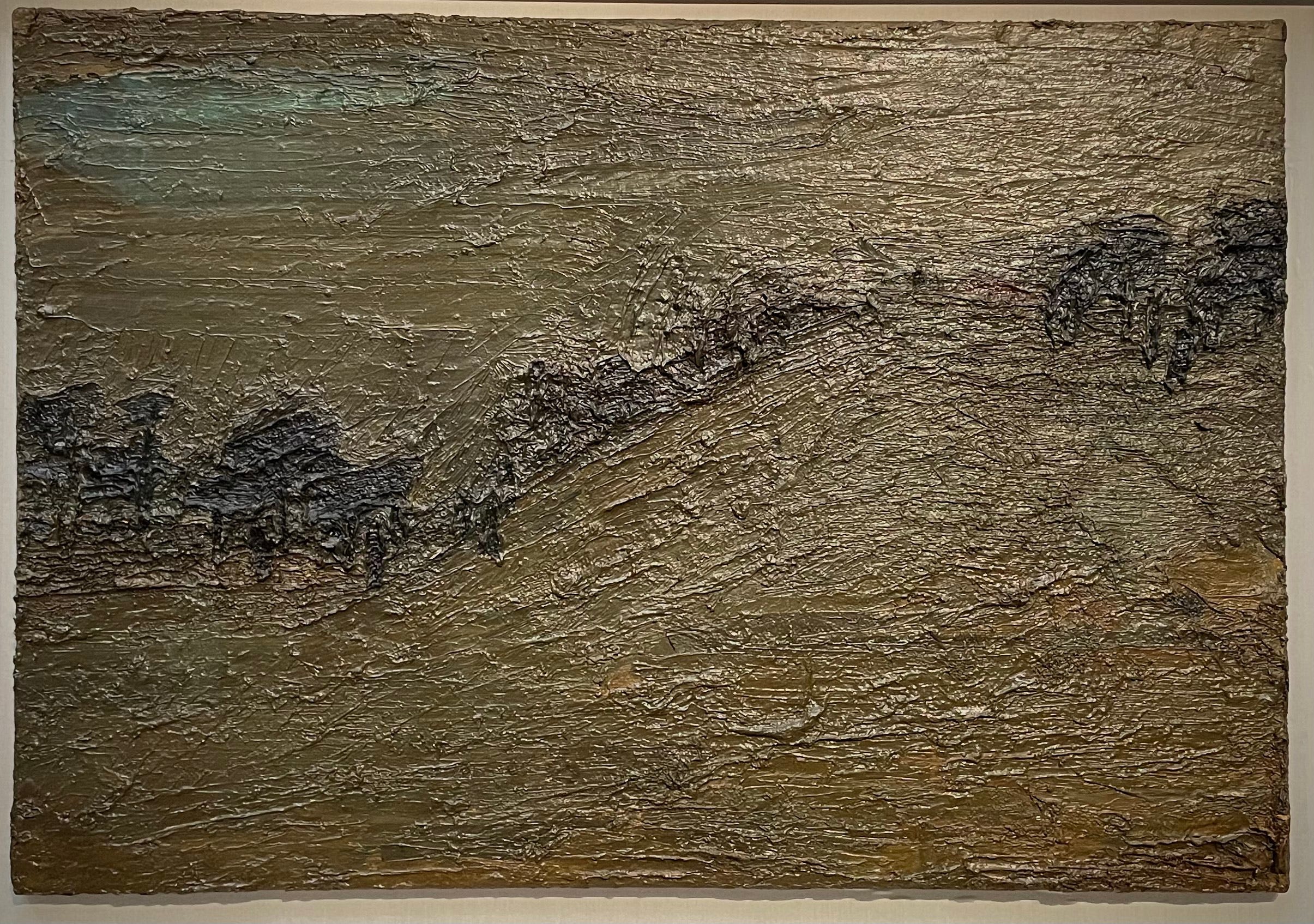
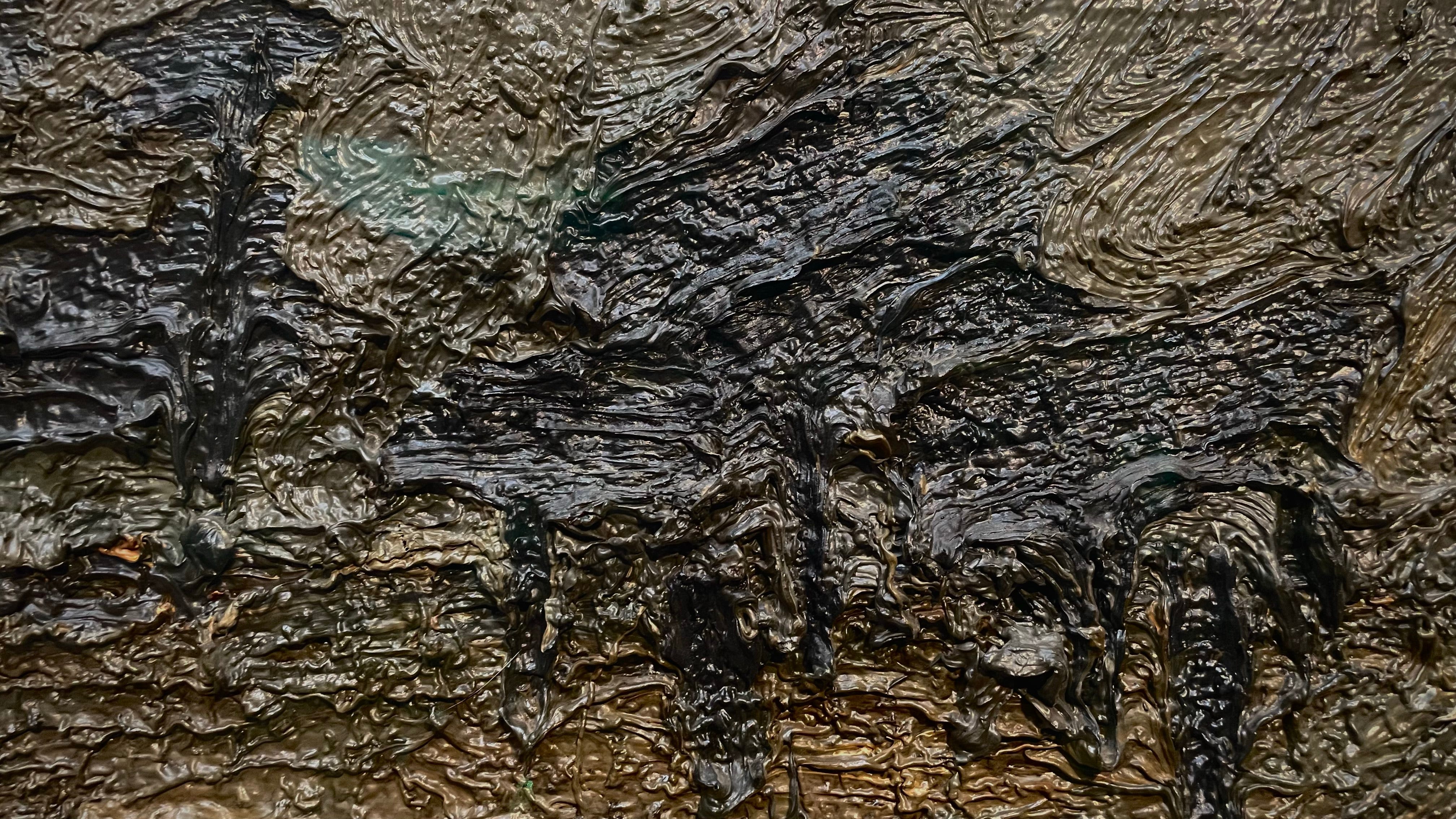
And in paintings such as Primrose Hill: Winter Fog, hanging in the Fitzwilliam Museum in Cambridge, Auerbach takes painting to this degree zero, painting as a dunghill, as the origin of the world.
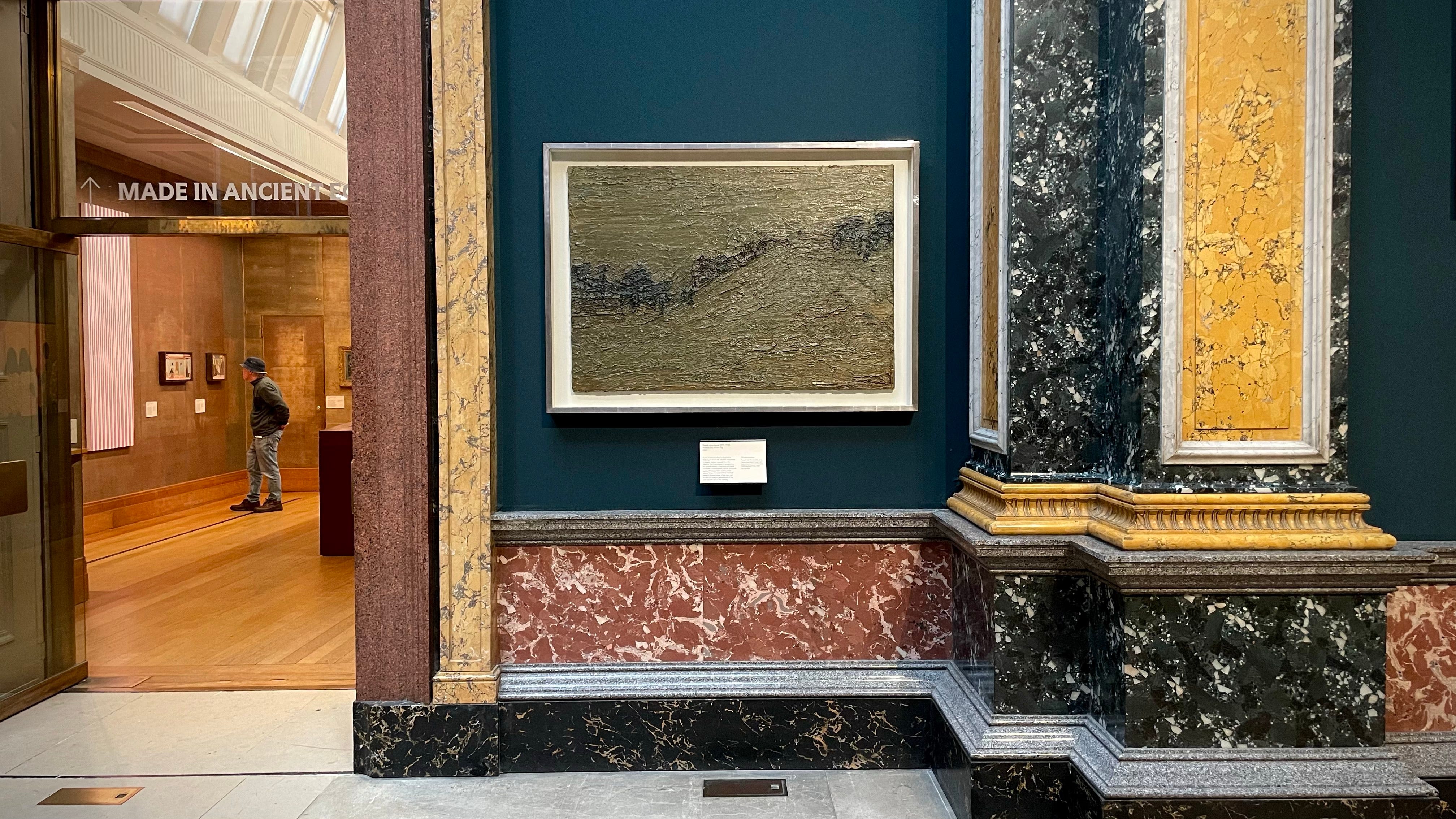
Turn a corner in the Fitzwilliam and you see the opposite of all this, like one of Constable’s rainbows emerging from sodden earth, a vertical canvas made by Bridget Riley in 1968, Banner, displayed alongside Italian fifteenth-century painting, itself a time of origins and emergence.
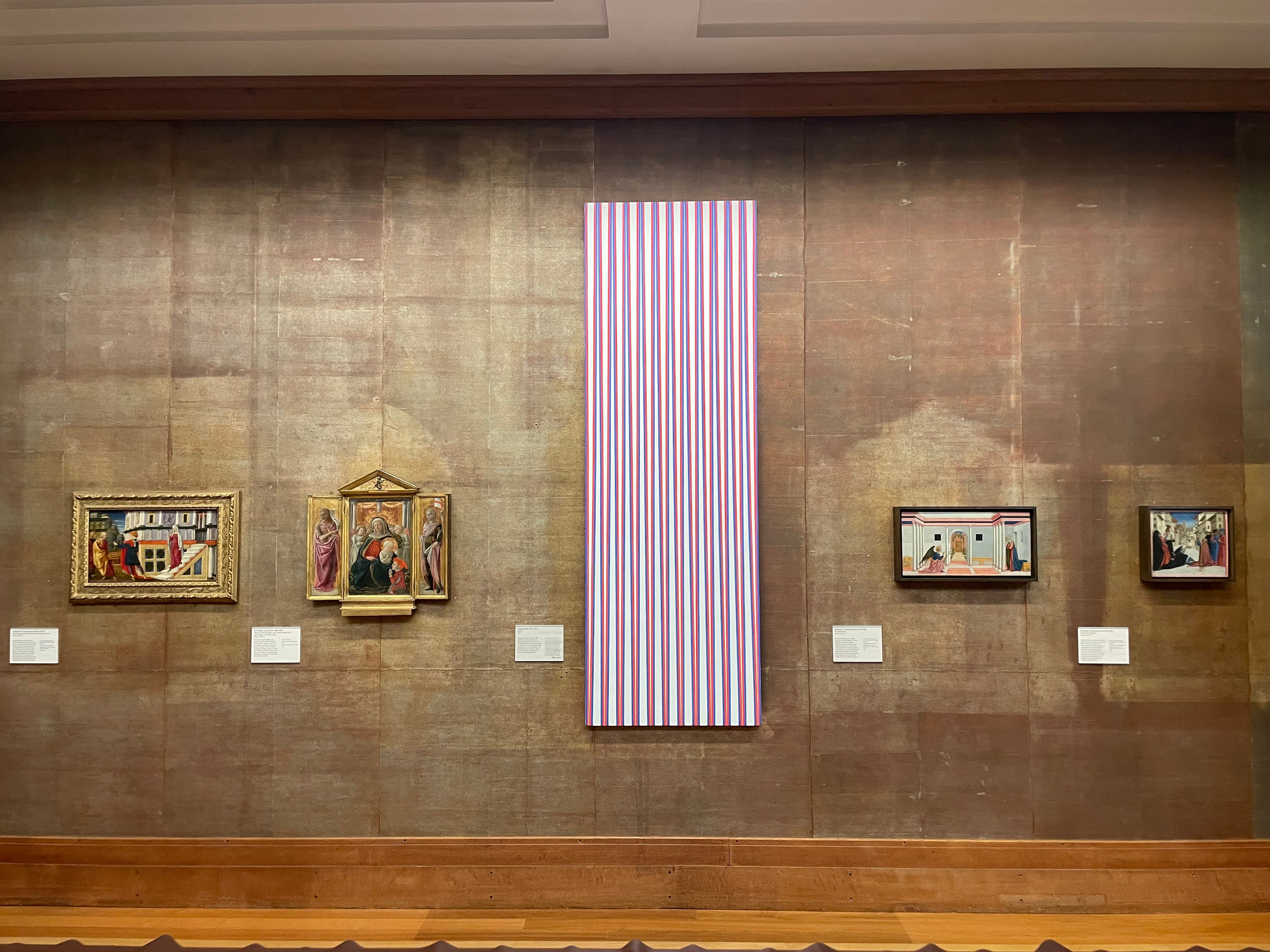
Painting as a machine for turning earth into colour, manure into a rainbow, for converting the horizontality into the vertical…
Looking back over one hundred fifty years of painting, this was the radical leap that Constable made, at a time when his personal and professional life was as full and rich as it gets — his floruit, to use an unduly neglected word — and which he so beautifully and mysteriously symbolised in the image of a leaping horse.
What after all is art, what is love, what is parenthood, if not a leap?
Afterword
Sometimes the simplest questions are the best. I’m grateful to the person in the audience of the lecture summarised in the essay above, who asked the wonderfully simple question: did the horse make it?
Did the horse make the leap over the barrier in The Leaping Horse? A good question, because if you look closely at the horse, it is hardly in a leaping, or jumping position at all — the weight is on the back legs, and it is far too close to the wooden barrier to clear. (Horse lovers and equestrianists?)
I wrote about this in relation to George Stubbs’s famous Whistlejacket (and am pleased to report that the National Gallery have changed the label on this painting to describe the horse not as ‘rearing’, but in the classical dressage position known as ‘levade’).
Of course, Constable’s The Leaping Horse is (only) a painting, and questions of composition and balance etc.. always come before this sort of realism. And yet it is reasonable question, as it leads us to ask from where Constable might have derived the image of his leaping horse. He was hardly in the way of making images of such heady action — this is absolutely the most exciting thing that happens in any of his paintings.
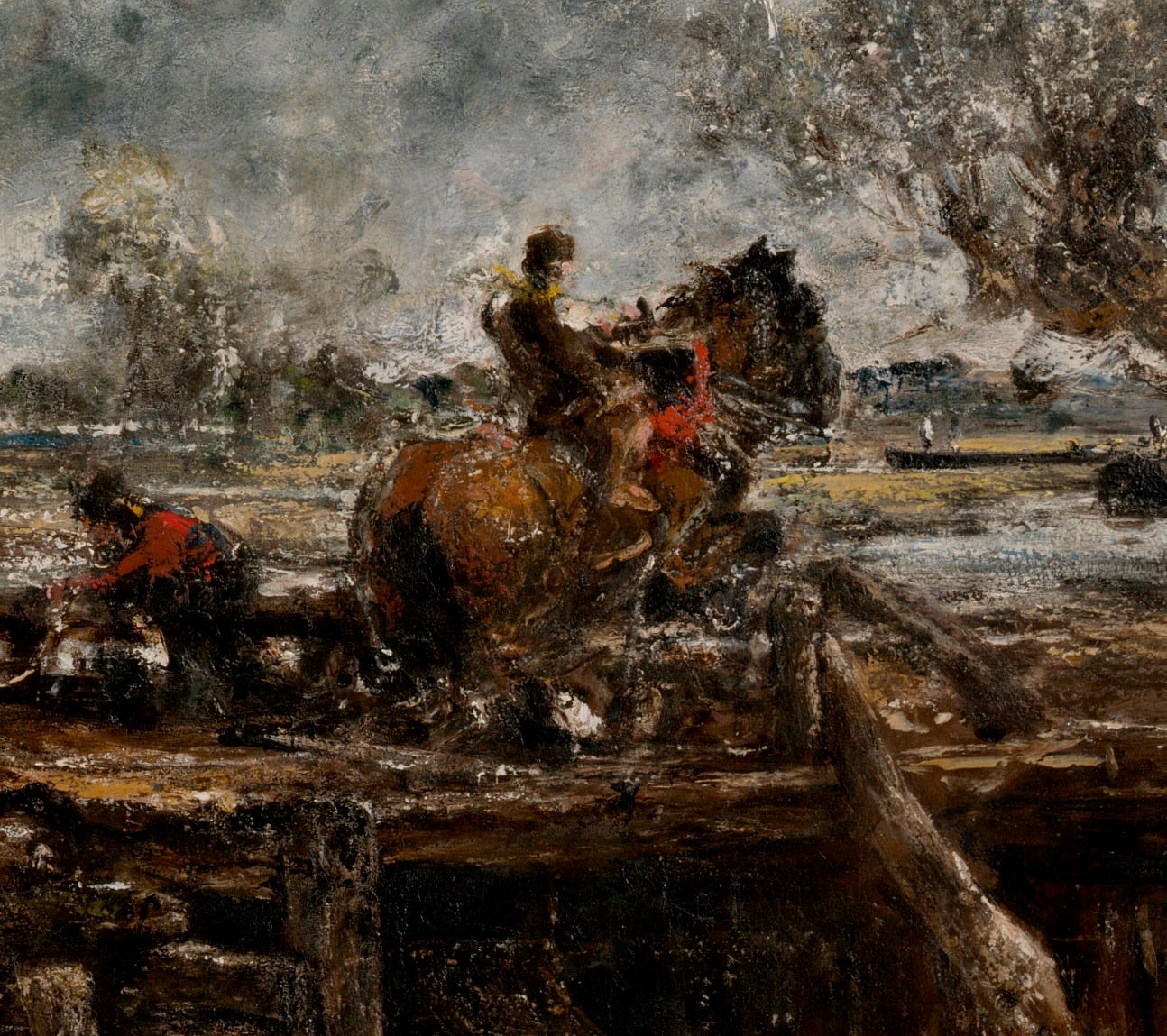
Over the past few months, during which I have been studying Constable’s paintings and reading about him quite intensively (to the point of some exhaustion), I’ve asked myself whether Constable might have copied his horse from an existing image.
And then, just the day before the lecture, I came across this lithograph, a print held in the British Museum:
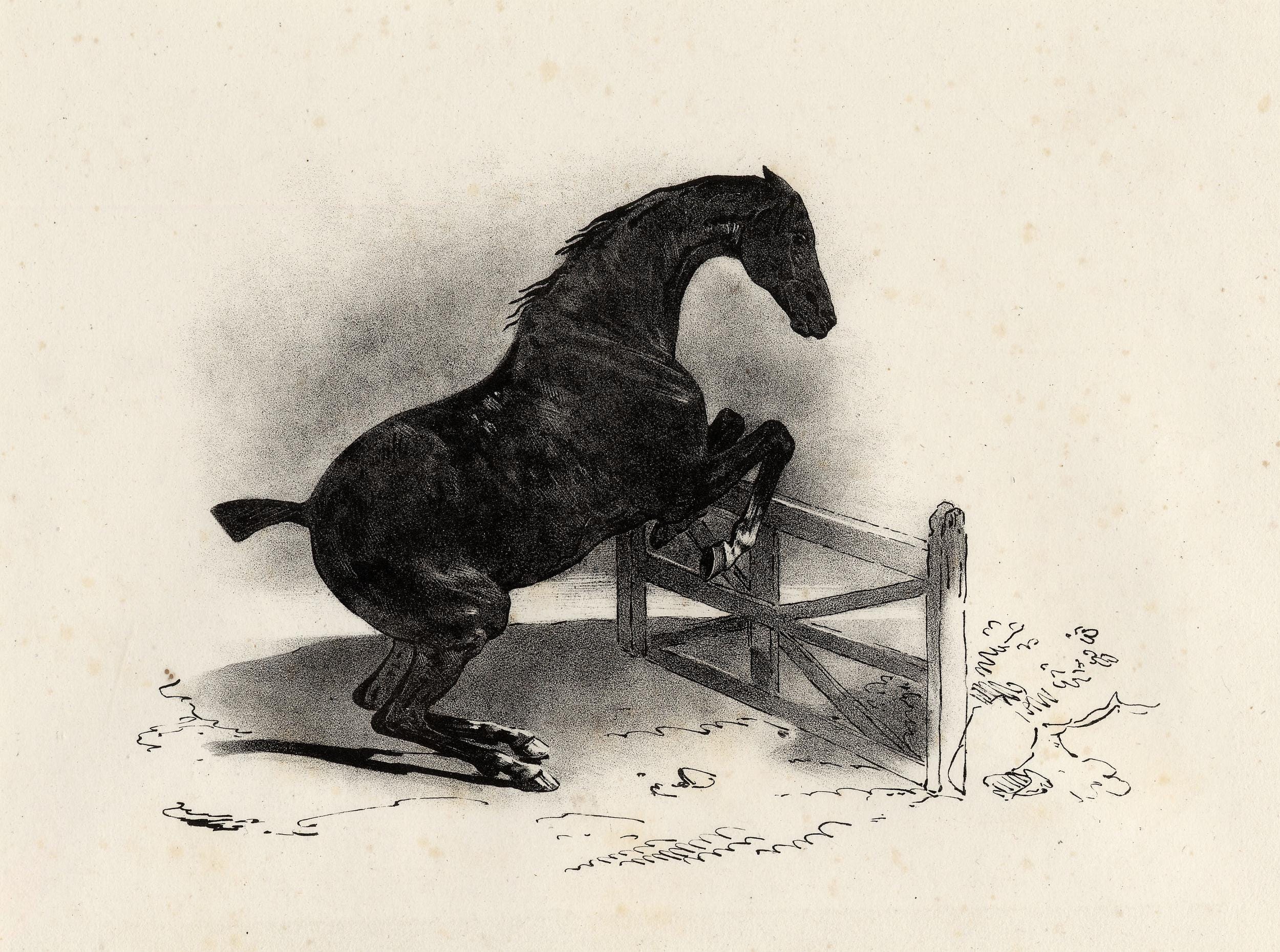
A horse ‘leaping’ over a low wooden barrier.
It was created in 1823 by the obscure artist Louis-Pierre-Marie Courtin, and is supposed to have been copied from a print by… Géricault. The very artist who had spread Constable’s fame in France.
Although the British Museum collections search describes it as being from a print portfolio by Géricault titled Suite de sept petites pièces, I’ve not yet found any evidence of this series or what it contained.
There is no proof that Constable saw this print, although it is very close to his leaping horse, and he could easily have come across a copy in the print shops of London. It does make you think that perhaps Constable took as much from France, in terms of ambition, ideas and imagery, as he gave.
The 2026 Snape Art Talks, featuring Dr. John-Paul Stonard on the life and work of John Constable, run from the 23rd February to 31st March, every Monday at 6.30 pm in the Britten Studio. For more information and tickets visit Snape Art Talks.
Ian Fleming-Williams, ‘A Runover Dungle and a Possible Date for ‘Spring’, The Burlington Magazine, Vol. 114, No. 831 (Jun., 1972), pp. 386-391+393
See the essay on Auerbach by Richard Morphet in the catalogue for the exhibition Encounters. New Art from Old, National Gallery, London, 2001.
This is a wonderful piece. I love the thought and learning and giving that’s gone into it. Entirely fascinating. And yes, as one who knows, the horse will have made it.
I do love that question, "Did the horse make it?" That kind of curiosity will serve the questioner well throughout life.