

Painting as Wound
An English painter in Bath

LAST WEEK I WAS IN CONVERSATION with the English painter Glenn Brown, alongside his exhibition which runs throughout the summer in Bath: Glenn Brown in Bath: Arrows of Desire (link to a recording of the talk to follow).
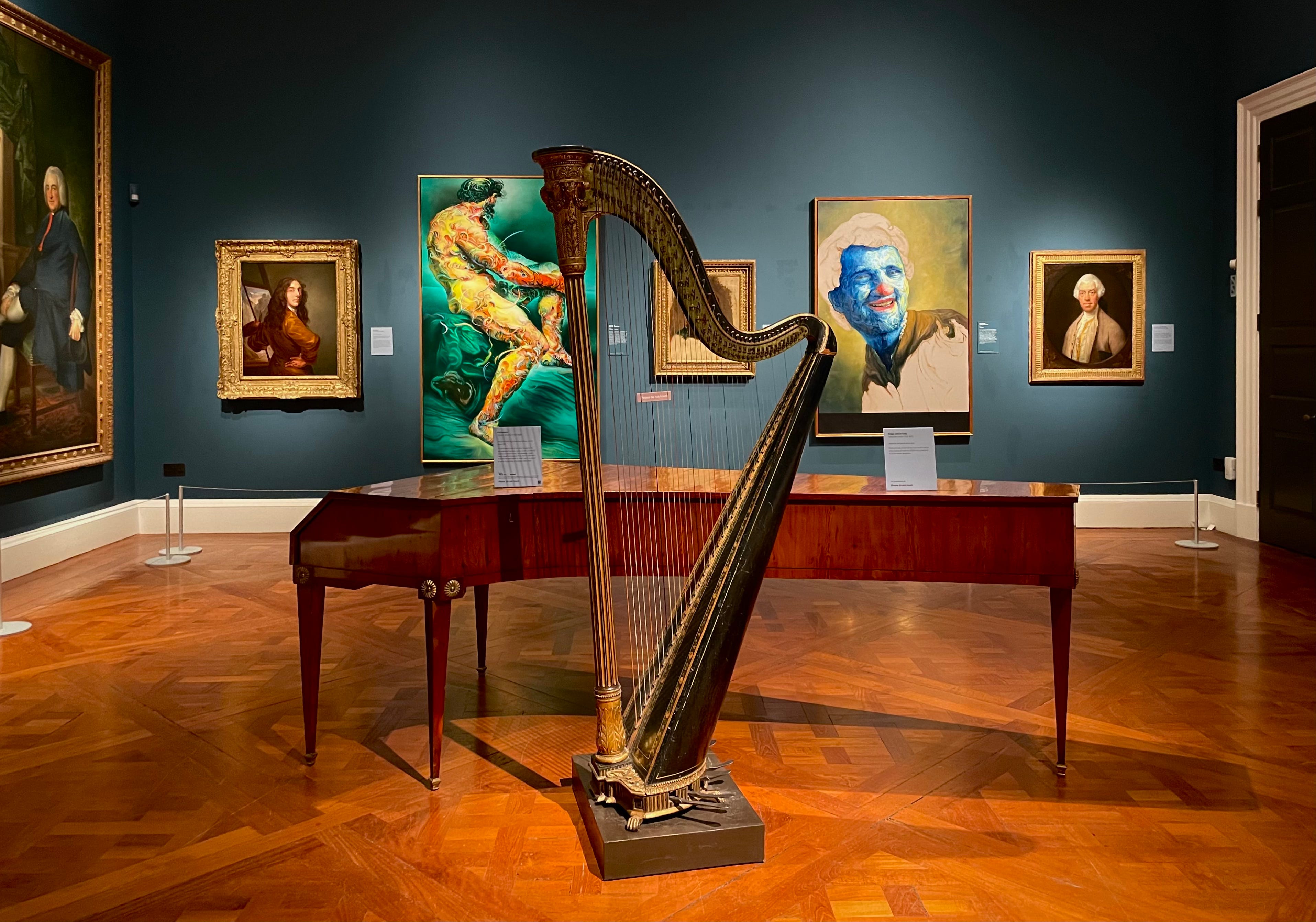
Brown’s paintings hang in the Holburne Museum, and in the restored period rooms of No. 1 Royal Crescent, the great sweeping Georgian terrace overlooking the historic city.
At the heart of the exhibition (at No.1 Royal Crescent) is a remarkable installation, under the title ‘Grottoesque’, which is alone worth the journey to Bath.
I won’t show any image-spoilers, but note only that it involves many shells and custom-designed wallpaper, and is a highly original encounter between present-day art and Georgian England.
Showing his paintings among museum collections has becomes Glenn Brown’s specialism: he is really an artist-historian, you might say. Museum collections are a natural environment for paintings that themselves stage an encounter with the past. For the past three decades Brown has borrowed imagery from two distinct periods: seventeenth and eighteenth-century old master painting, drawing and printmaking, from the likes of Rembrandt to Jean-Baptiste Greuze; and more recent postwar art, notably that of Frank Auerbach and Georg Baselitz.
Brown transforms impressions of these earlier works into paintings exuberant in their use of colour and distortion, but also pretty disturbing and often quite grotesque. Here he departs from art history into the realm of disruption, bringing to mind a remark from Joshua Reynolds, one of the greatest painters of the Georgian era:
… next to the man who formed and elevated the taste of the public, he that corrupted it, is commonly the greater genius.1
What this means is that each painting, and drawing becomes a fascinating contradiction of attraction and repulsion that fixes itself as an unforgettable image in your mind — dream images, perhaps, shot through in equal doses with a typically English feeling of melancholy spiced with dark comedy.
The contradiction is right there, within the image itself, where images can be overlaid to form rebus-like pictorial puzzles.
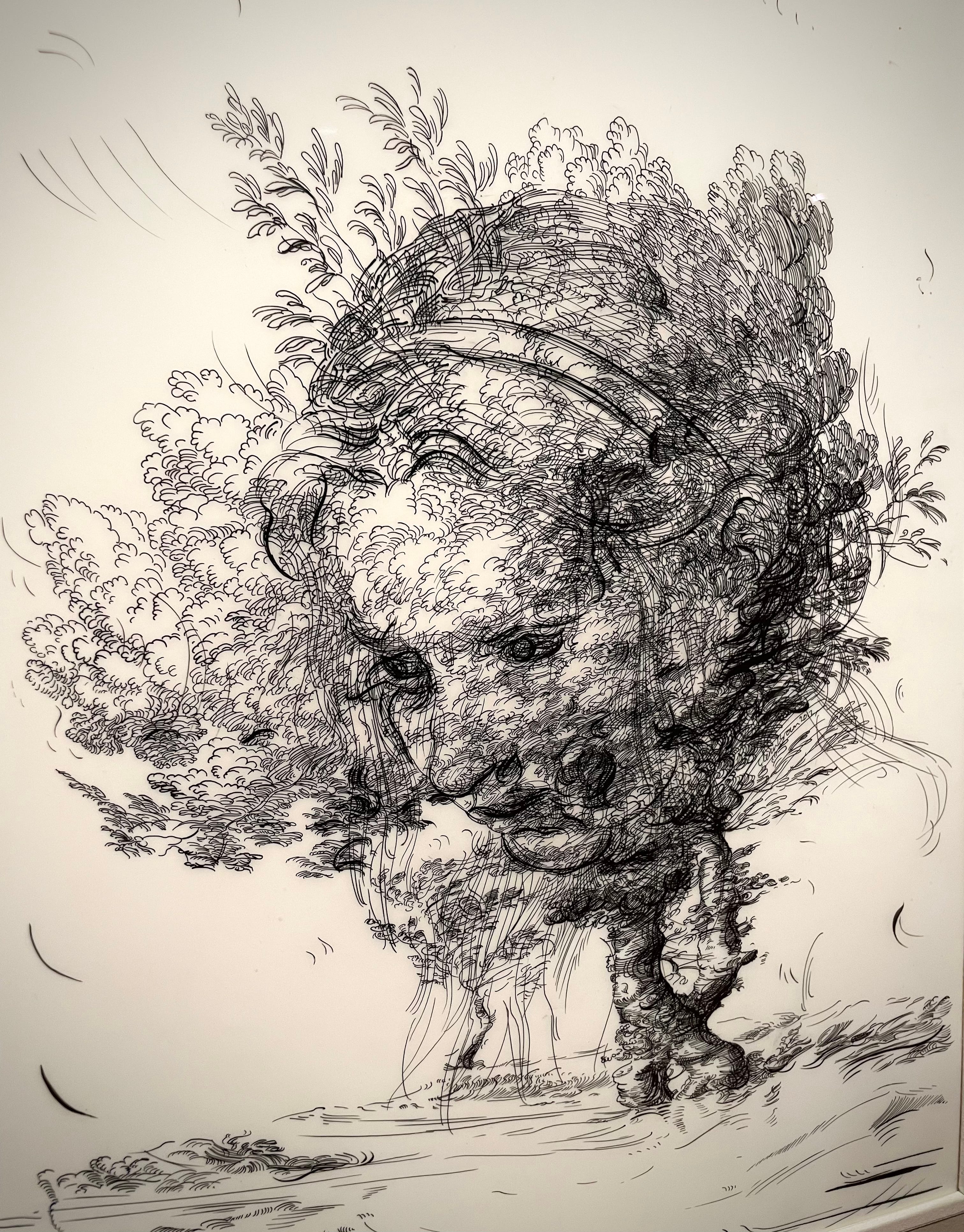
These drawings bring to mind Francis Picabia’s Transparencies, his paintings that overlay imagery. But in Brown’s case the transparency goes much deeper, both technically and art historically, suggesting the way that one image is always ‘thought through’ another".
Images come from images, as E.H. Gombrich famously taught us (as I write here), rather from the visible world.
THE QUALITY OF GLENN BROWN’S WORK that really preoccupies me, however, looking at the paintings in Bath, is the grotesque impression of a punctured surface.
These are images full of wounds. The paintings themselves are wounds.
Perhaps I was affected by the experience (excuse the personal digression), the previous night, of experiencing wincing pain in my leg (muscle injury), lying sleeplessly in a bed alongside which happened to hang one of Brown’s drawings.
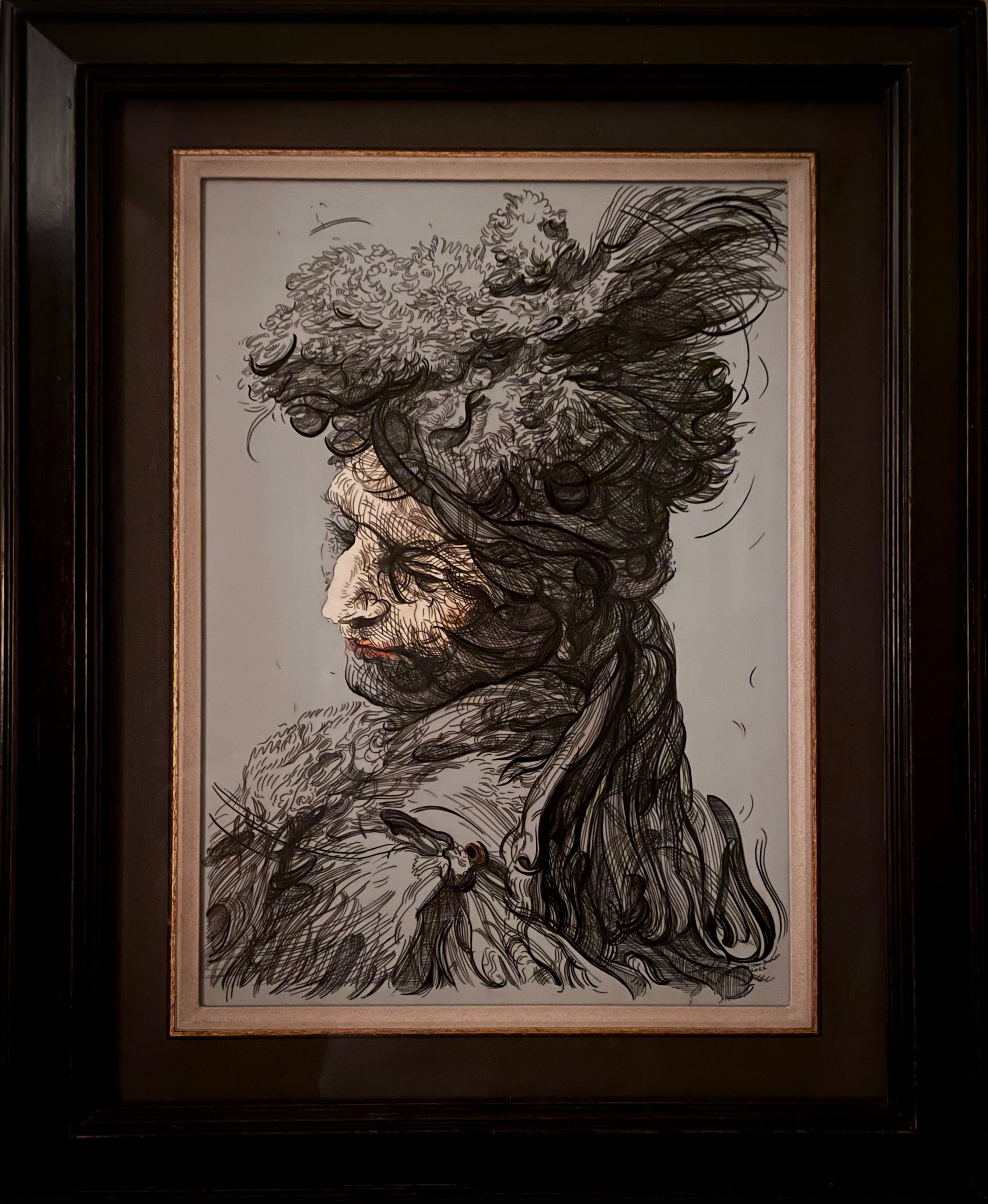
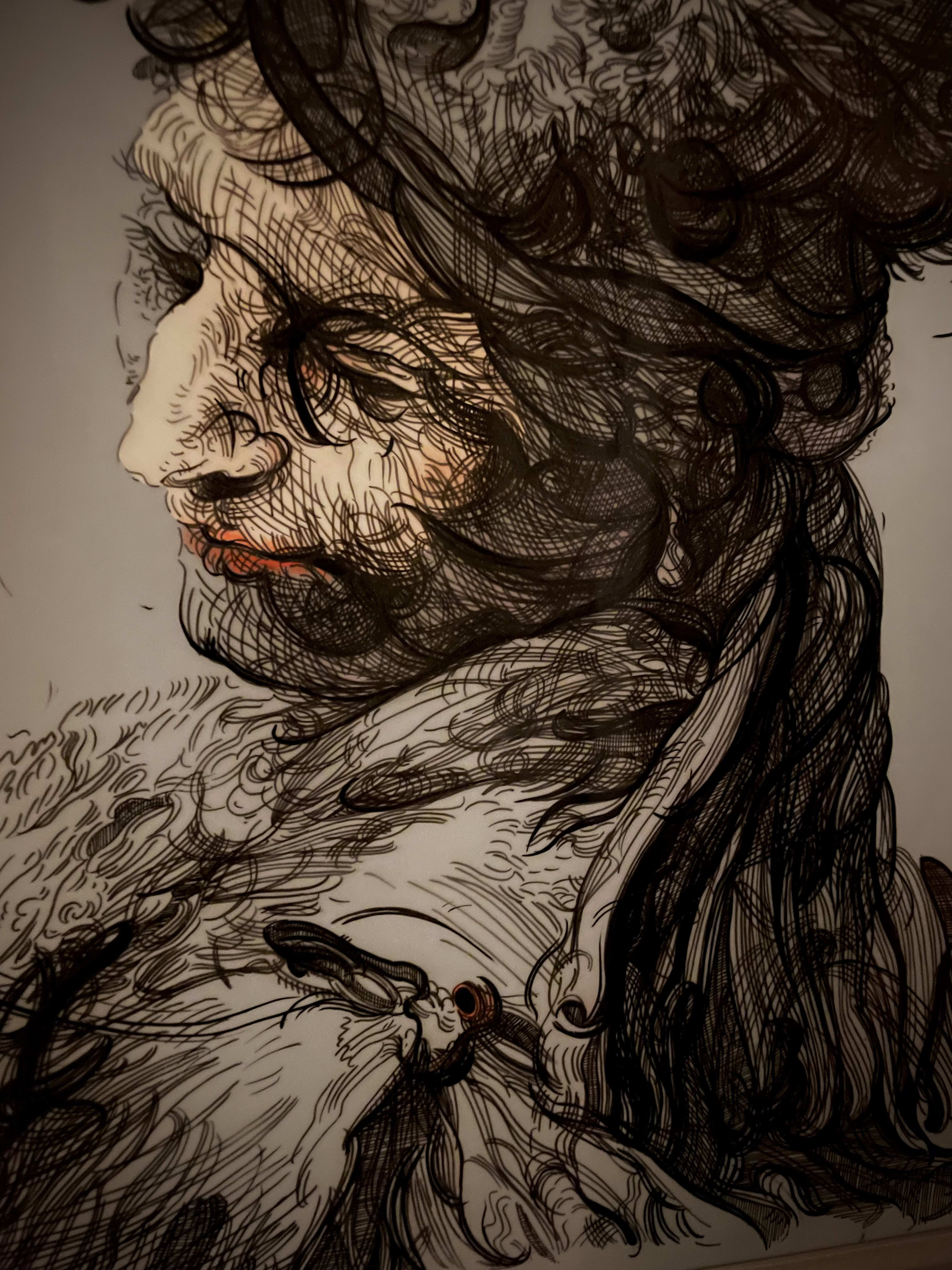
Looking at an image of pain while in pain is intensely therapeutic. The image seems to take and hold your pain, acknowledge it, generalise it, hold out a hand to relieve you of the worst thing (apart from the fact that it simply hurts), which is the loneliness of pain.
And it is rare that we are not in some form of discomfort, looking at art. Perhaps our feet hurt, or simply that we are nursing some gloomy thoughts. I don’t think we ever leave all our woes at the gallery doors. We do not visit these places for moments of unalloyed happiness, which is why we walk around in reverential silence. We know why we are there.
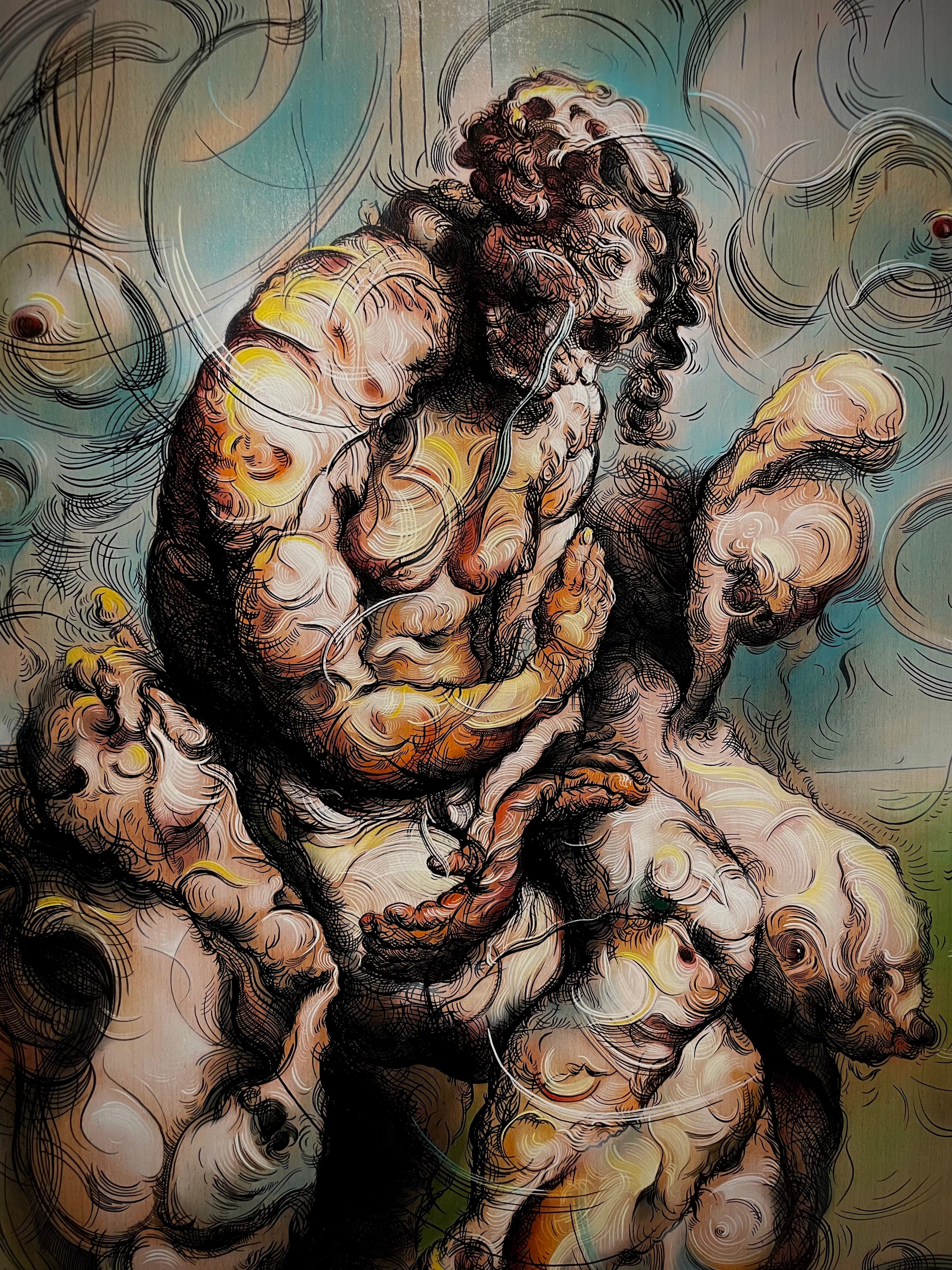
A headless blue woman reaches out a finger that has been dipped into a side-wound, a clear allusion to Christ on Calvary. Die Mutter des Künstlers (‘The Mother of the Artist’), is the title of Brown’s painting made in subaquatic blue, a grotesque apparition that seems to arise from some unnamed personal trauma. At the Holburne Museum it is surrounded by melodramatic gesturing figures in paintings by Johan Zoffany and (top left), Francis Hayman.
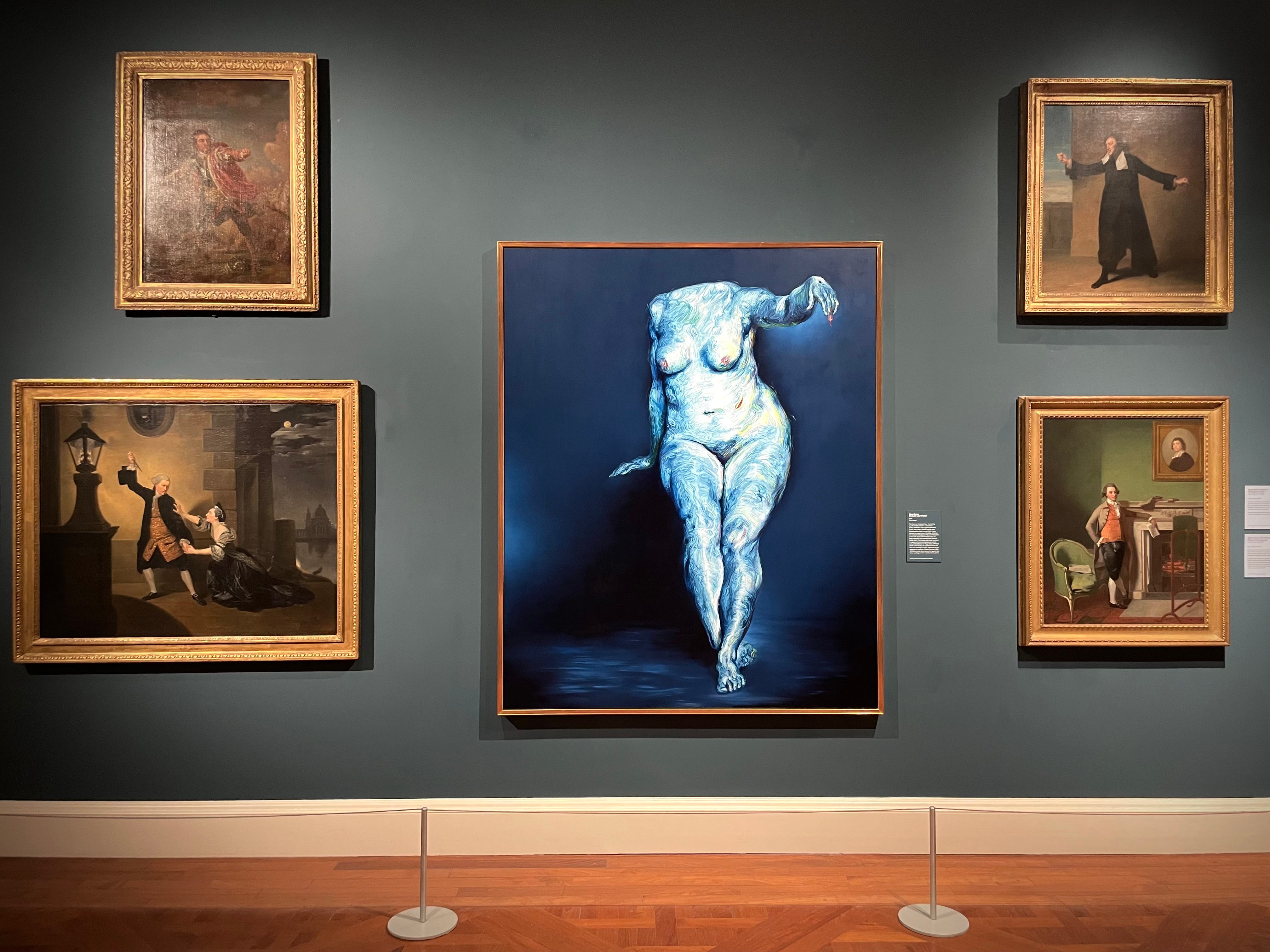
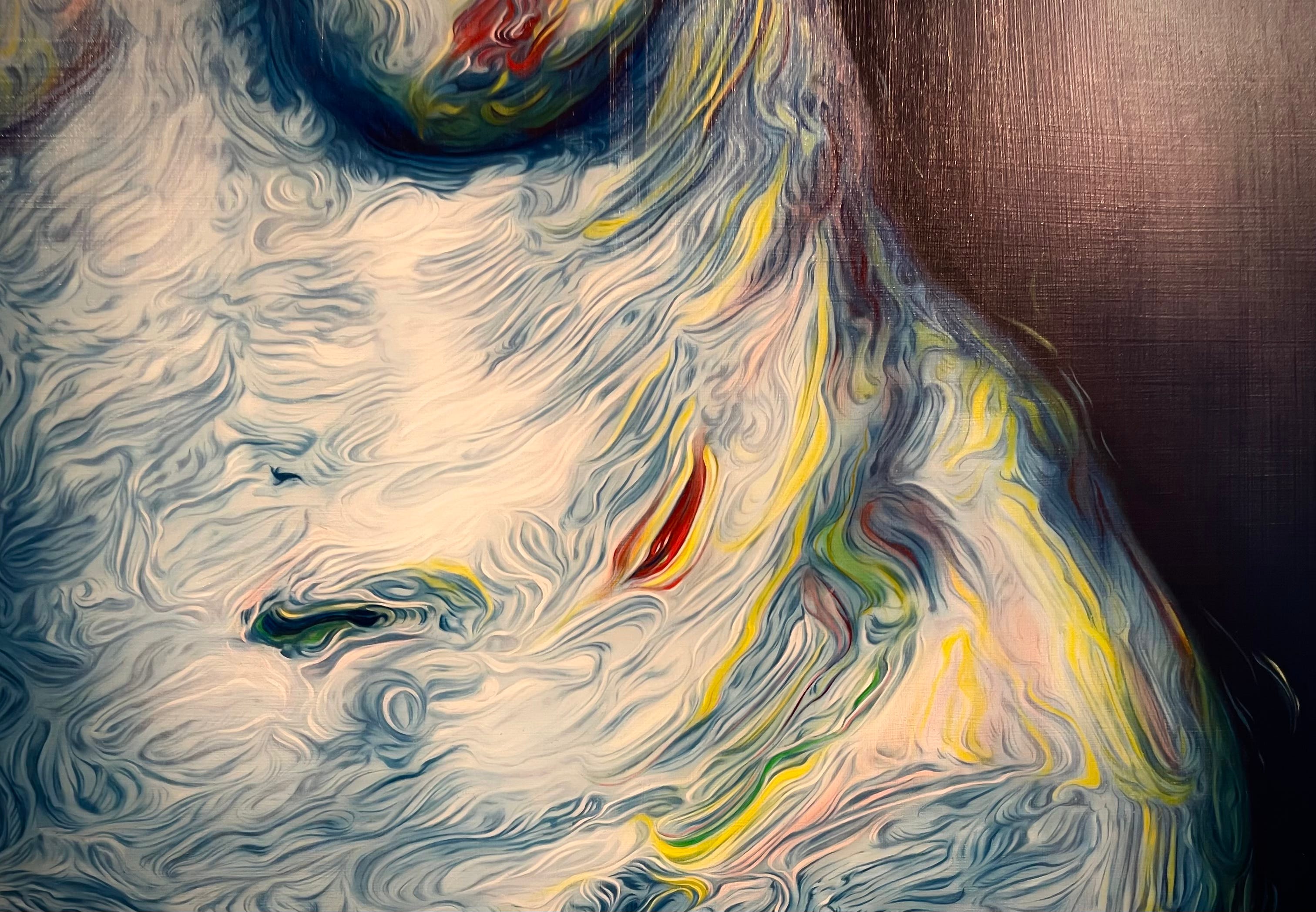
The festering surface of the body in Die Mutter des Künstlers seems itself under microbiotic attack, or like the swirling surface of a gas giant seen through a space telescope. It is in terrible motion, as if the agitation of white flecks that runs through the paintings of Gainsborough and late Constable had become an infectious disease, transmissable through the act of painterly appropriation, to use the fashionable term.
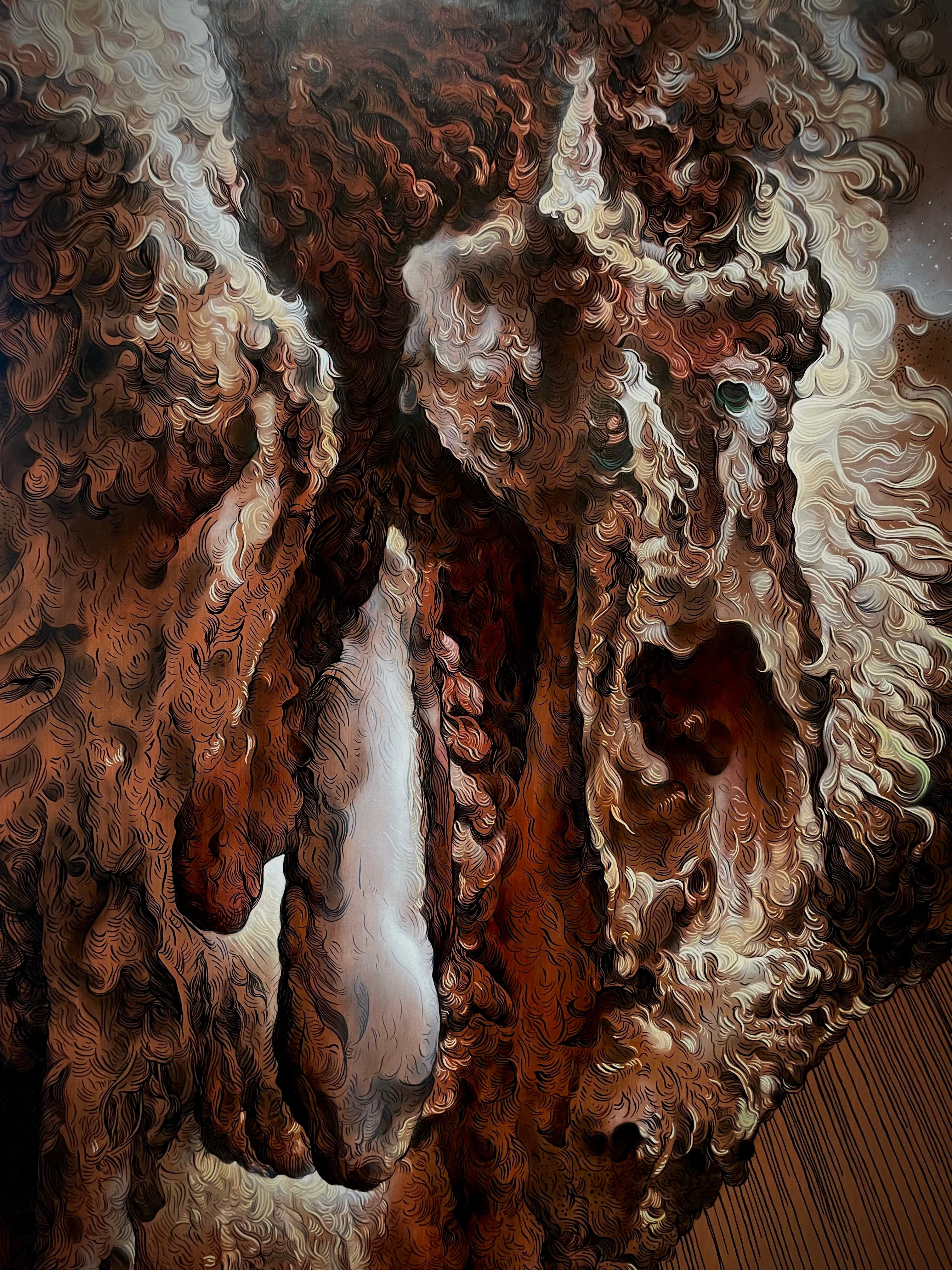
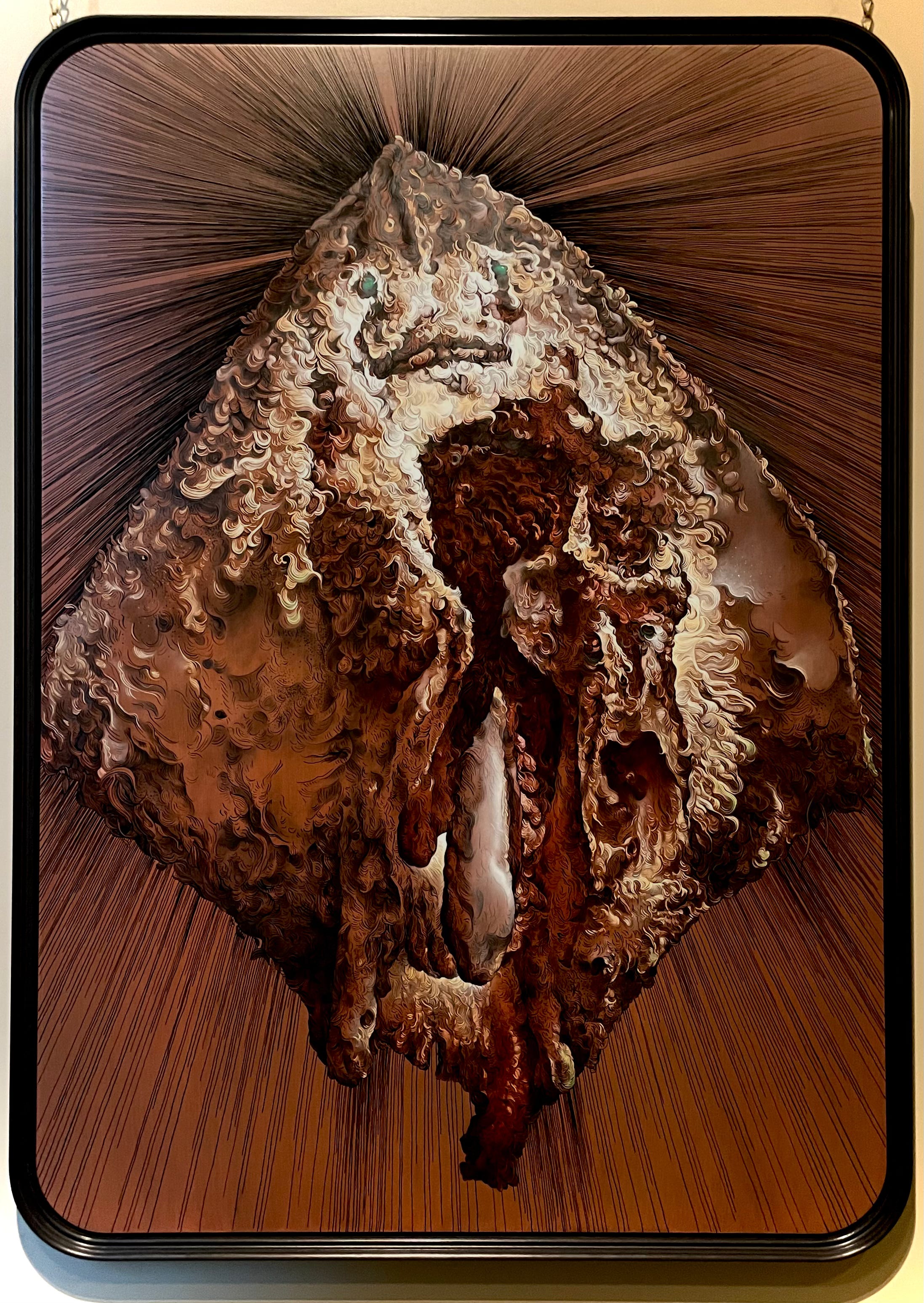
Even when the wound is not literally shown, Brown’s images are full of punctures and holes, and a sense of the festering, swirling colour-mass of a fresh wound.
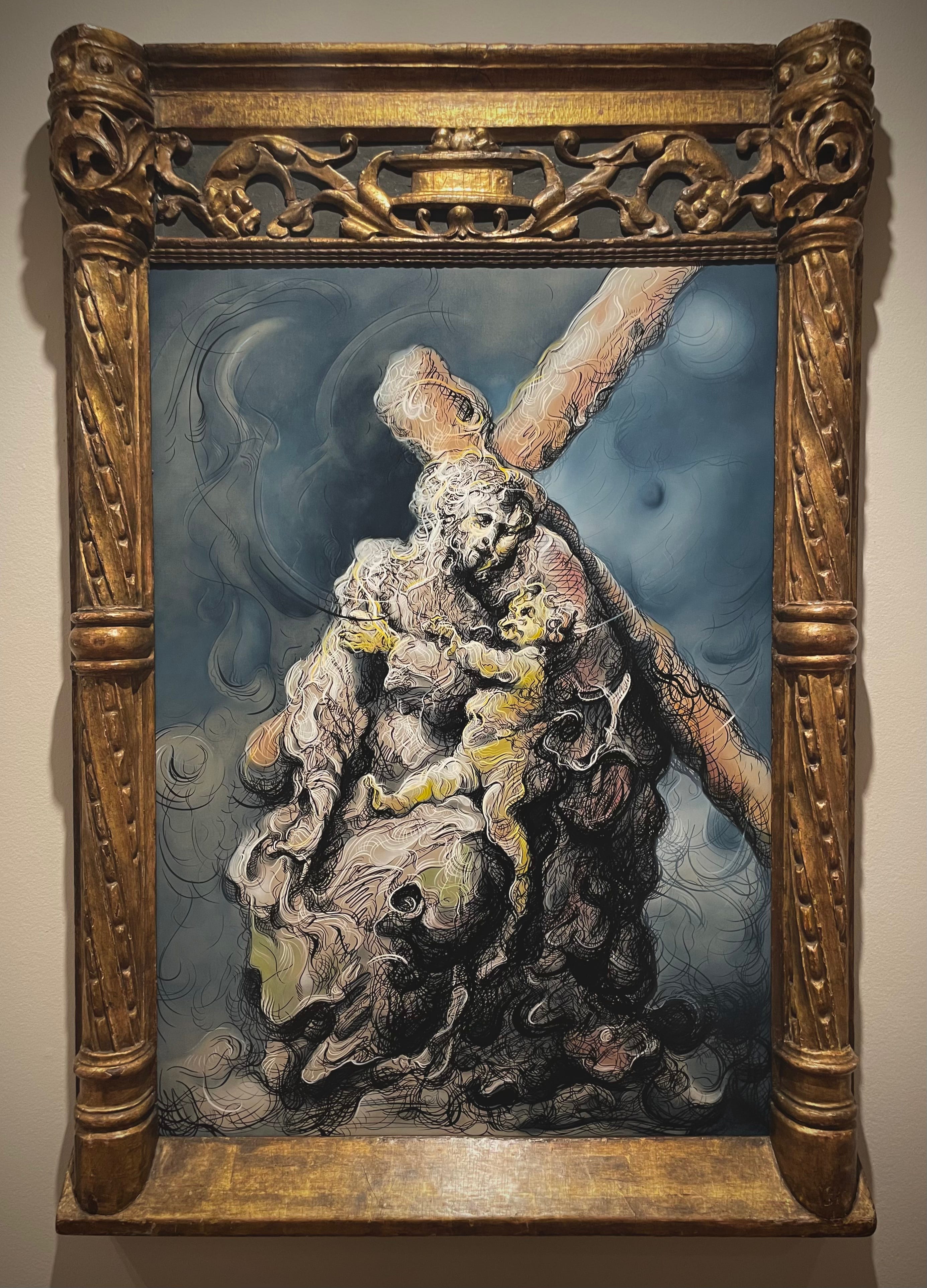
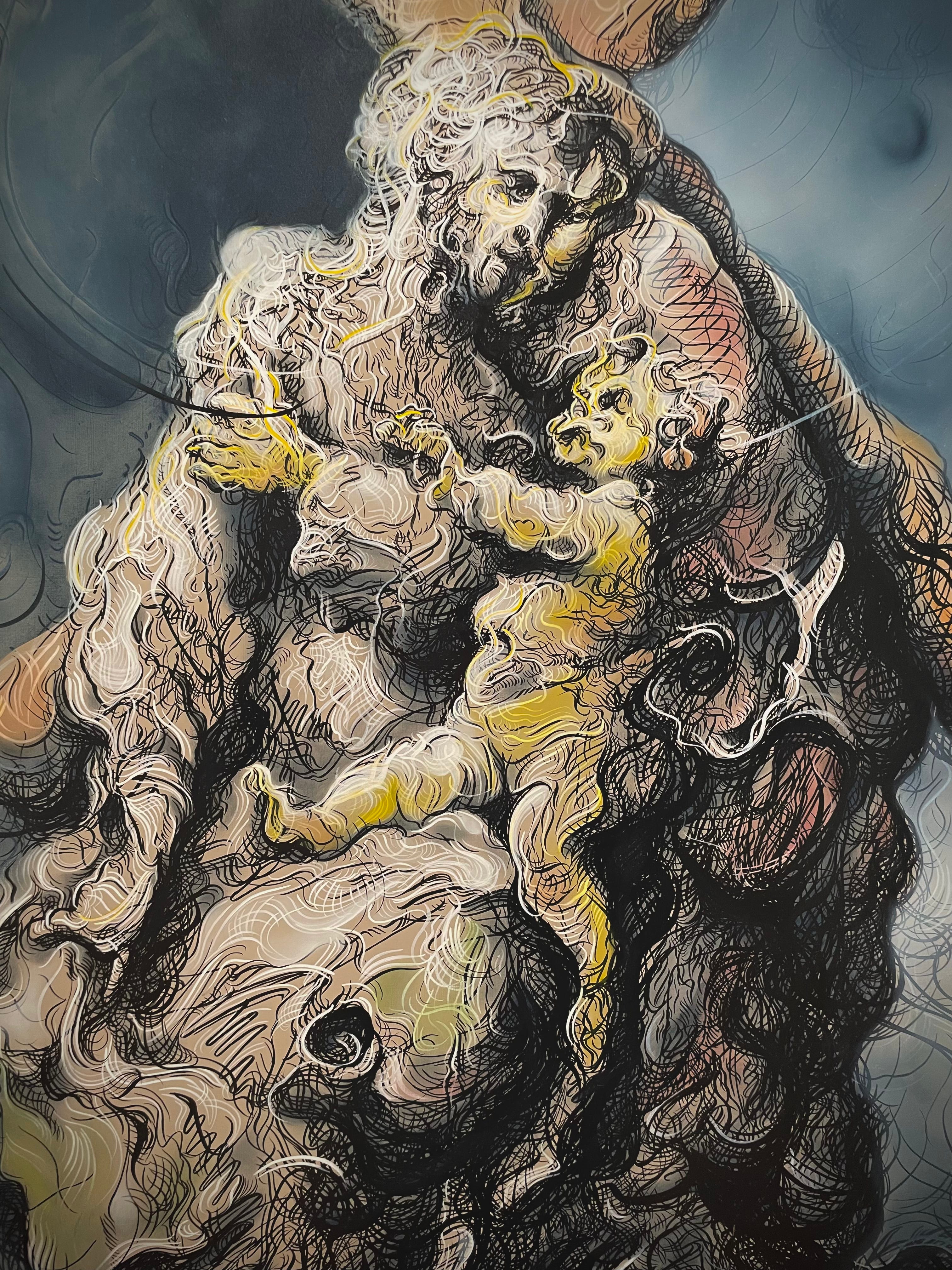
Wounds are a source of deep fascination. We cannot take our eyes off them, even though they make us wince and arouse a feeling of disgust. They leave an itch we are compelled to scratch, even though we know we must not. That itch begins as a look.
There is the ‘beauty’ of a wound of course, the sunset purple and cadmium red of bruised flesh, the deep magenta and vermillion of punctured and torn skin, the lamp black and Naples yellow of exposed innards, and this might be the first thing that holds our attention.
But it goes much further, reaching back to some innate need to know what is happening to the animal body. Wounds fascinate because they are full of information about the trauma that created them.
You often hear it said that all art comes from trauma. Art is a response to trauma, a compensation, a form of expression of inner pain, alleviation, some sort of therapy.
But how is this so? Trauma divides. It creates a sense of contradiction, of dissonance - between the disrupted and the functioning body, between the disturbed part of the mind that cannot accept a fact, and the rational part that can. The same happens, as we have seen in recent years, in the body politic — there is nothing more divisive than the trauma of political upheaval.
We thirst for knowledge for how to navigate such a world, how to overcome trauma, to heal the division. How to overlay contradictory events the better to understand them. We look to works of art for this knowledge, and find it best in those registers that contain within themselves great contradictions, in the ‘disruptors’ that Joshua Reynolds described (to Coleridge) as the greater geniuses.
We search for this knowledge not in beauty, but rather in the awfulness of art. Art, in the end, is a terrible thing by comparison with the world it represents. Samuel Palmer put it best, in his letters: the ‘leafy lightness’ of nature cannot be reconciled with ‘the unwinning severity, the awfulness, the ponderous globosity of art’.2
Forty years before Palmer, John Ruskin had written (in the third volume of The Stones of Venice) of two types of ‘grotesque’: the ‘sportive grotesque’ and the ‘terrible grotesque’3 The grotesque itself is divided, a schizophrenic combination of the obscene and the ludicrous, of the tragic and the comic. The grotesque is a response to trauma. It is laughter in the dark.
This is the message of Brown’s paintings and drawings: of their overlaid imagery; of their tragi-comic contradiction of ‘sportive’ and the ‘terrible’ grotesqueries; of their paradoxically punctured, wounded, surfaces; of the dissonance between the old masters and the great firmament of contemporary art.
Painting as wound is painting as a source of knowledge about suffering. The suffering about which, as W.H. Auden once wrote, the old masters were never wrong.
Cited by Samuel Taylor Coleridge in his Biographia Literaria, p.40.
Samuel Palmer to John Linnell, 21st December 1828. In: A.H. Palmer, ed., The Life and Letters of Samuel Palmer, Painter and Etcher, London, 1892, p. 222.
John Ruskin, The Stones of Venice, vol. 3, (chapter 3, ‘Grotesque Renaissance’, section XXIII), London n.d., p. 135
Positively the most sensitive and thought provoking analysis of GB’s work.
These images, especially seen placed among other, centuries older works, are fascinating, as is your beautifully written and provocative discussion of the exhibit. I have sat at my desk with these images on my screen for some time now, feeling impelled to stay looking at them, to move on and then go back, to coax their narratives from them. There is such intensity, which seems to grow greater in close-up. The horror they hold doesn't dissipate. It must be quite an experience to see the drawings in person. I wonder how the show is being received by the people who attend it.