

The Lock
Or, what is more important, art or life?

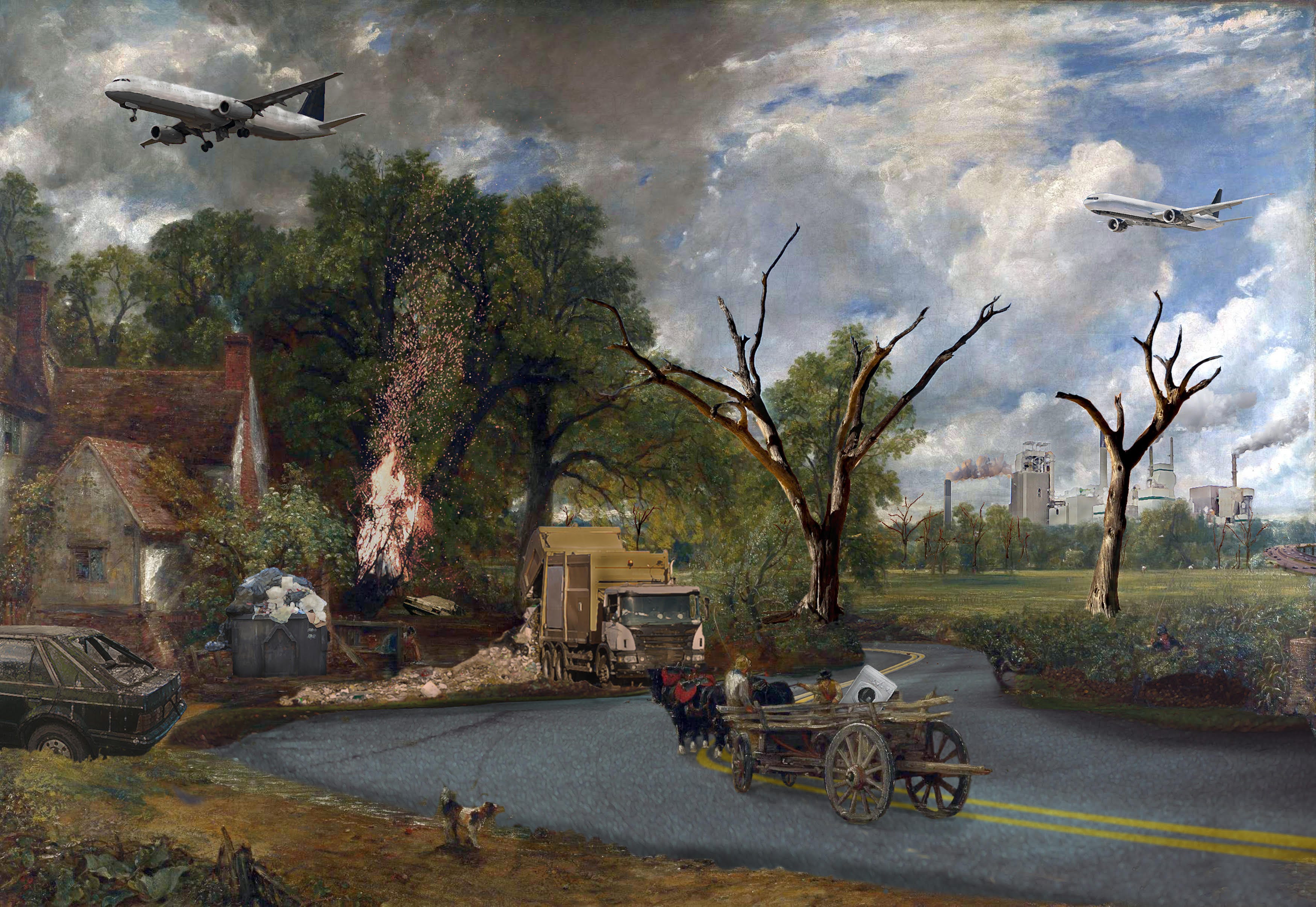
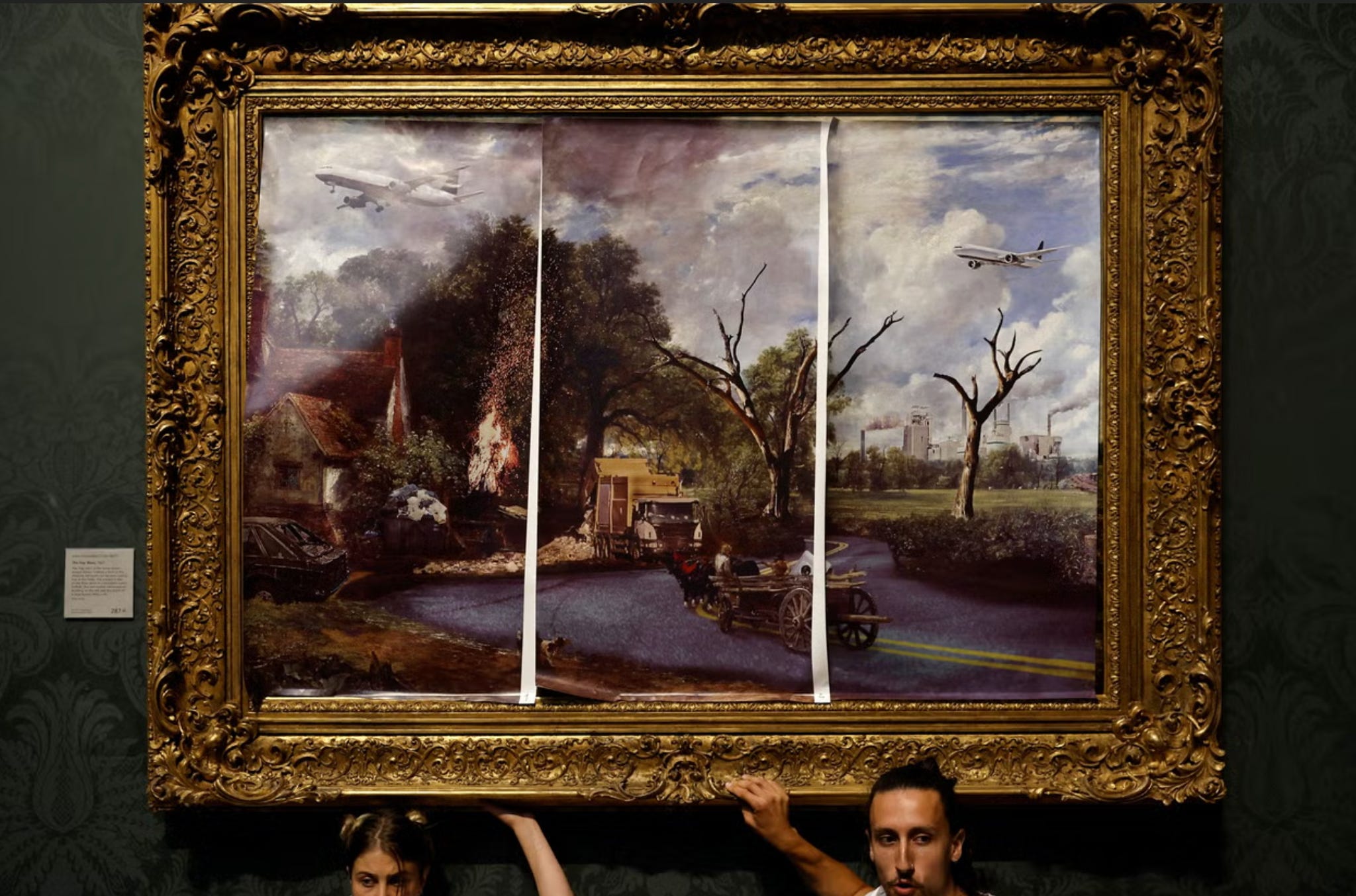
ON THE 4th JULY 2022, two young people entered the National Gallery in London and attached a printed image to the glazing protecting The Hay Wain by John Constable.
They read a statement, which was widely reported in the press:
“Art is important. It should be held for future generations to see, but when there is no food what use is art. When there is no water, what use is art. When billions of people are in pain and suffering, what use then is art.”
“You can forget our ‘green and pleasant land’ when further oil extraction will lead to widespread crop failures which means we will be fighting for food. Ultimately, new fossil fuels are a death project by our government”.
In the replacement image (reproduced above), the trees are dead, the canal concreted-over, a fire burns behind Willy Lott’s cottage, and planes (presumably from Stansted) fly overhead.1
We might with relief think of the reality. Dedham Vale is not like this, (although in the 1960s was cut through by the A12), and still feels more like a reminder of what is worth saving, rather than what has been lost.
The action by Just Stop Oil was, it might be said, an effective protest, in which the painting was not damaged, and a powerful and important message put across. And yet the idea that Constable himself was a painter of a ‘green and pleasant land’ is far from the truth, however much his paintings might offer an escape from the awful realities of war and climate breakdown.
Art is important, and Constable especially. His paintings speak to us with a clarity and urgency nowadays, not on the banal level of politics, but offering something much deeper, something to do with our sense of time, and our place in the world. The protestors from Just Stop Oil chose the right painting, but for reasons they might not have suspected.
I
PROTEST WAS IN THE AIR as Constable was making his ‘six-footer’ paintings, of which The Hay Wain is the best known, and which span the first half of the 1820s.
He was well aware of the changes in rural society, the growing discontent among agricultural works. The introduction of threshing machines, replacing the age-old tradition of hand-threshing using a flail, was the cause of widespread resentment and rebellion. The enclosure of common land by an act of Parliament was another transformation with far-reaching consequences. Village life was changing, as Eric Hobsbawm and George Rudé write of the Enclosures in their 1969 book, Captain Swing:
‘Those who had built a cottage on some patch of common or waste, or who relied on common or waste lands keeping a pig or two, a cow and maybe some geese, and to collect firewood and whatnot from them, could not but be disastrously hit by their division into exclusive and fenced-off private property and which they no longer had a share’.2
The next year, 1822, when Constable was painting one his most sublime images of the Stour Valley, The Orange Sail (my title), his brother Abram was writing to him that there was not a night on which fires could be seen in the vicinity of East Bergholt, hayricks and property set alight by those protesting against the labour-saving threshing machines.
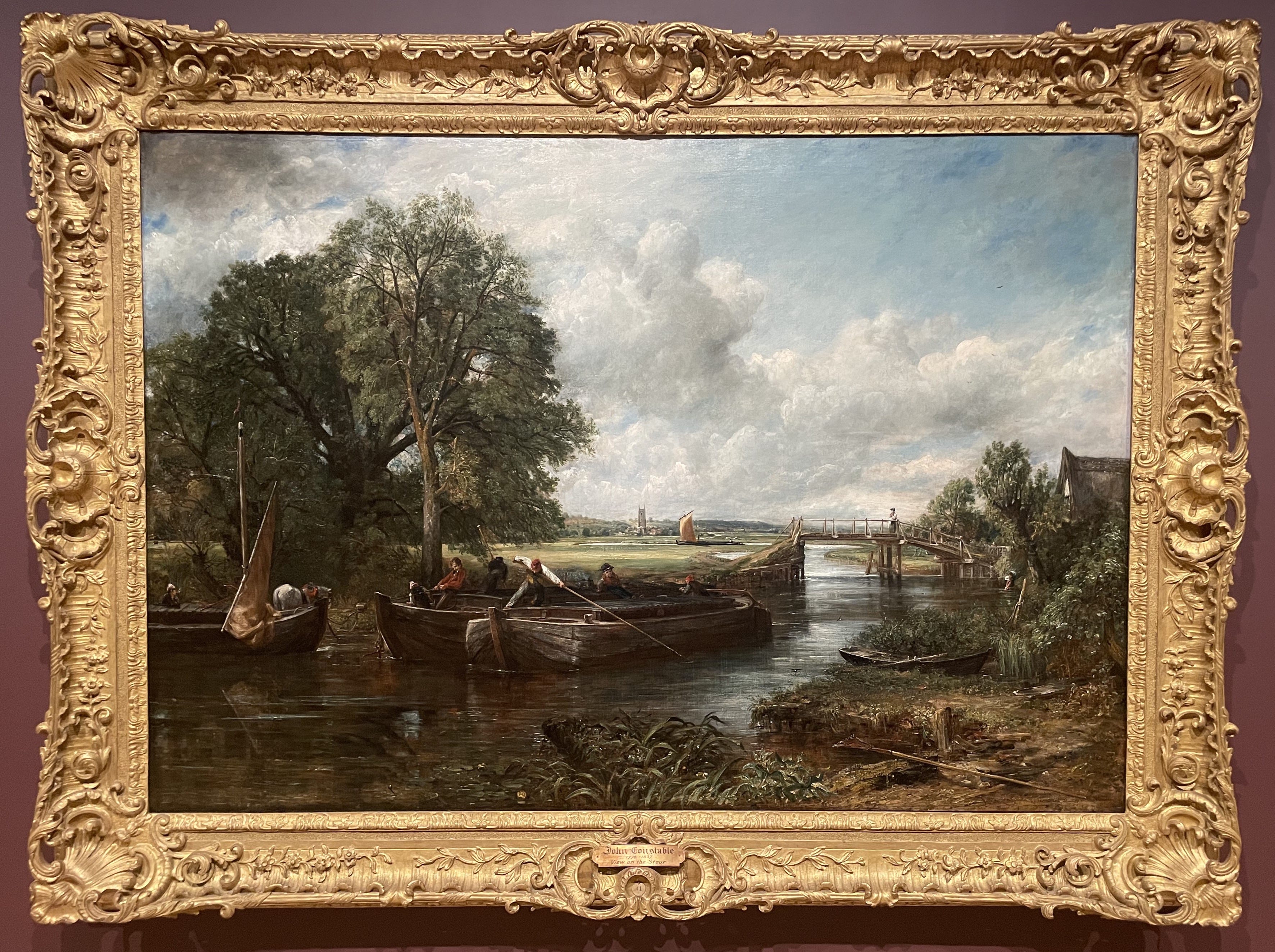
February of 1822 was a flashpoint of this discontent in Suffolk:
‘Over the twenty-eight days of February there were at least twenty-two incidents. Threatening letters proliferated [...] On the 16th two hundred men assembled at Diss. and the Riot Act was read to them; on the 25th mobs at Eye and Occold [...] dragged threshing machines into the street, but left them undamaged, repeating their performance the following day. On the 28th the Reverend Mr Betham of Stonham had a stack fired, and on 7 March his cow-crib, cow-house, and stable [were] in flames. On 4 March more than a hundred marched to Attleburgh, destroying twelve threshing machines, the Laxfield mob wrecking a further seven’.3
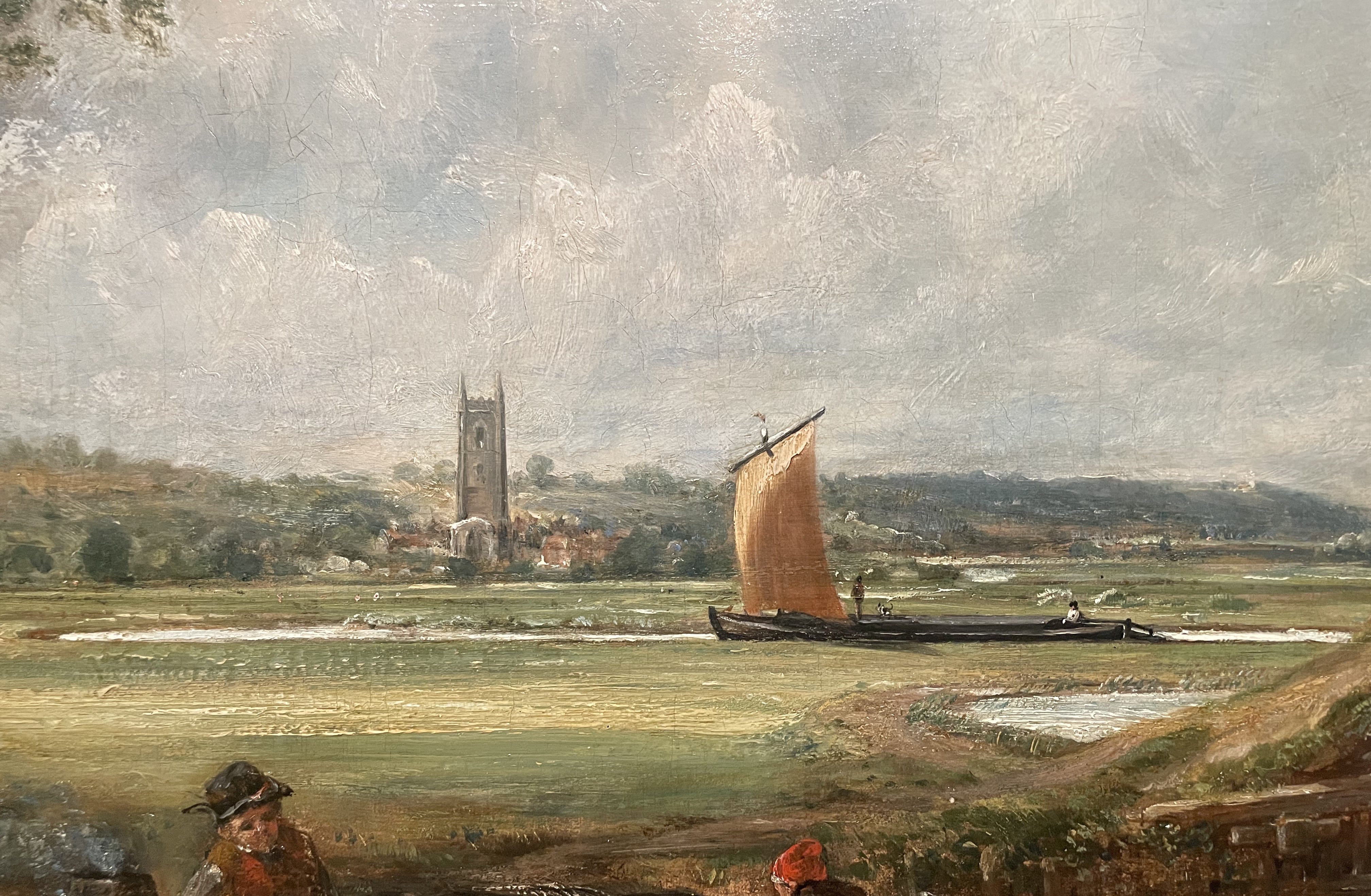
Constable’s vision of the orange sailboat wending its way calmly along the Stour could not be more business-as-usual in the face of this discontent — not that Constable was under any obligation to be a social realist, or to be aware of the history that would be told of his moment over a hundred years later.
But there is a change in his painting from this moment, that decisive spring of 1822, and a different mood emerges, one of restlessness and change, of disturbance to the natural order. What is rarely pointed out is that at this moment rural workers appear in unprecedented heroic guise. The barefoot boatsman’s boy in the Leaping Horse might bring to mind Napoleon crossing the Alps, or a Roman general on his rearing charger.
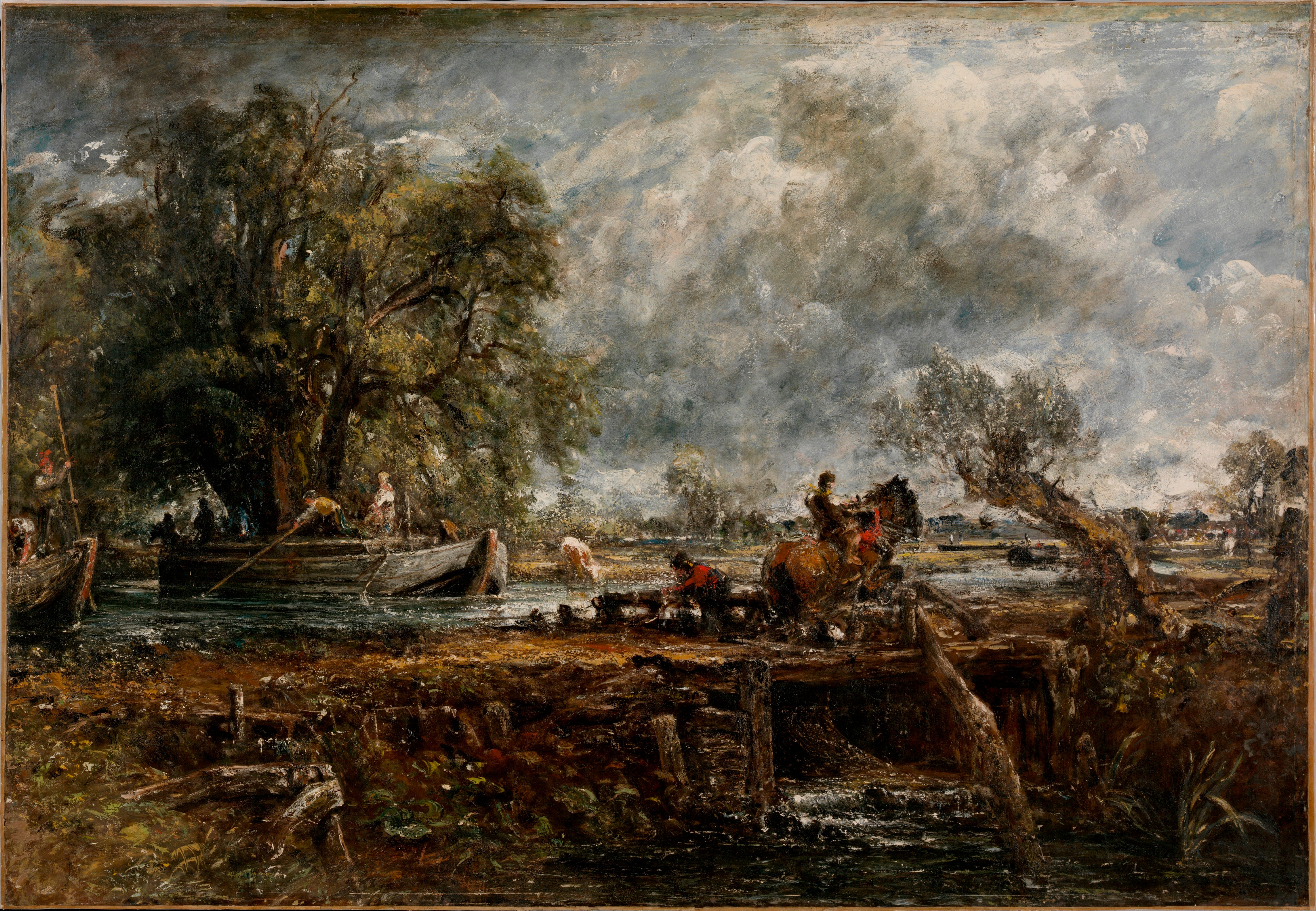
And then there is the painting made the previous year, known as The Lock, in which a lock keeper is shown performing the Herculean task of lowering the level of a river, so that a barge, seen tethered in the lock basin to the right, might continue its journey down river to the wharf at Mistley.
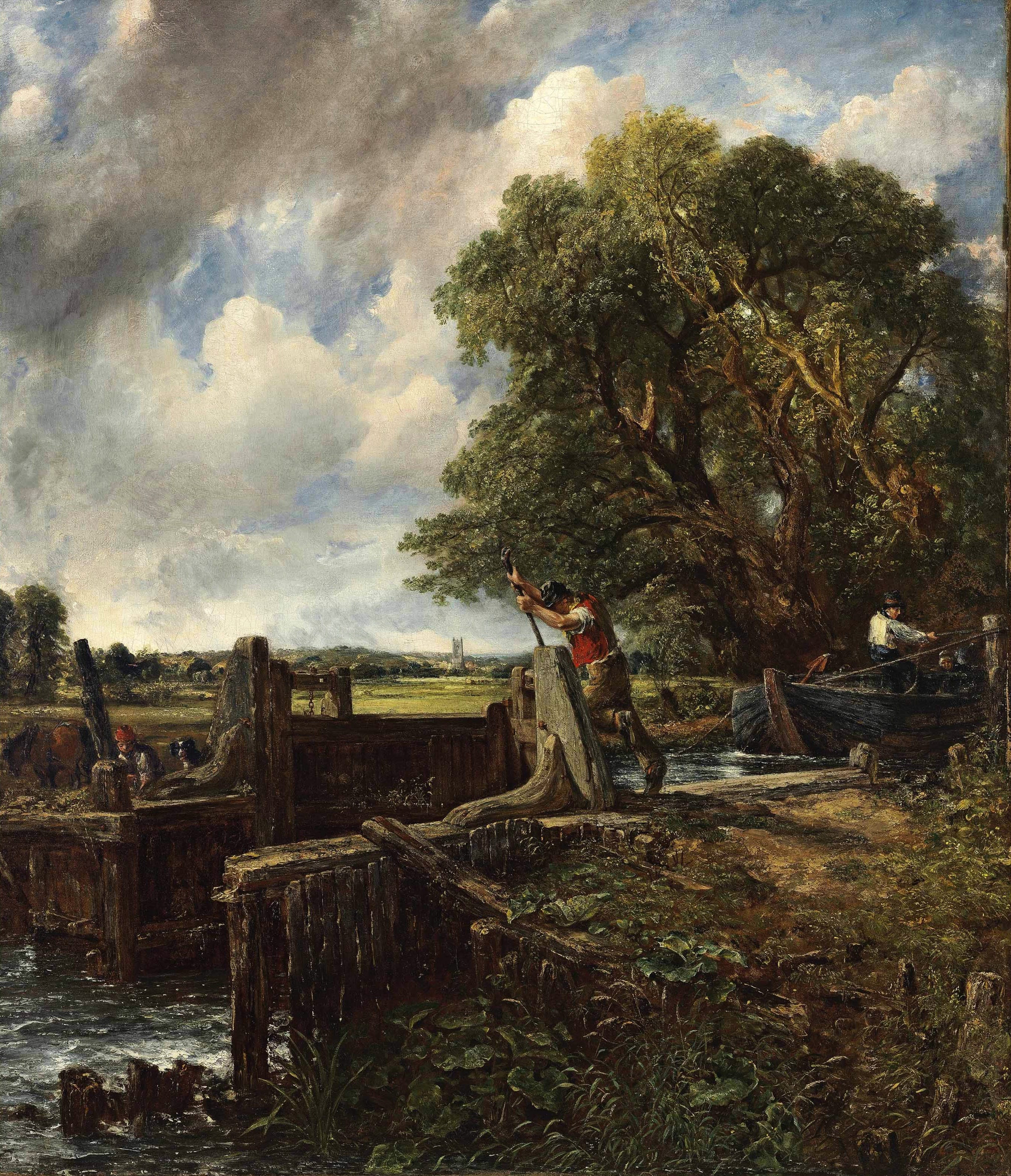
It was shown at the Royal Academy in 1824, and bought on the opening day. For Constable it felt like he had finally arrived — it was the first painting bought by someone he didn’t know. On the 8th May he wrote to his friend John Fisher: 'For long [I] floundered in the path — and tottered on the threshold — and there never was any young man nearer being lost than myself, but here I am & and I must now "take heed where I stand'. He was forty-eight years old.
The purchaser was James Morrison of Basildon Park, Berkshire. As I mentioned in a previous post, The Lock hung at Basildon Park for decades (where I must have seen it as a child), and then for three more decades in the Thyssen-Bornemisza Museum in Madrid, after being bought by Baron Thyssen on the advice of Lucian Freud (so I’m told).
After Thyssen’s death, it was sold in 2012 by his fifth wife and widow, Carmen Thyssen (a former Miss Spain, so it happens), for the relatively small sum of 22 million pounds, and has now it seems disappeared, quite pointlessly, into a private collection. Perhaps it is in a box in Geneva Freeport, or an Uzbek bank vault.
All the more ironic for a painting, like so many of Constable’s evocations of Dedham Vale, that were intended to give clear visibility to rural workers, showing the landscape not as an Arcadian retreat, or a vision of wilderness, but rather as a working environment.
You get a better sense of this in the second version Constable painted two years later of The Lock, fortunately still on public view (in the collection of the Royal Academy in London) in which the heroism of the lock keeper finds even greater echo in the surrounding landscape:
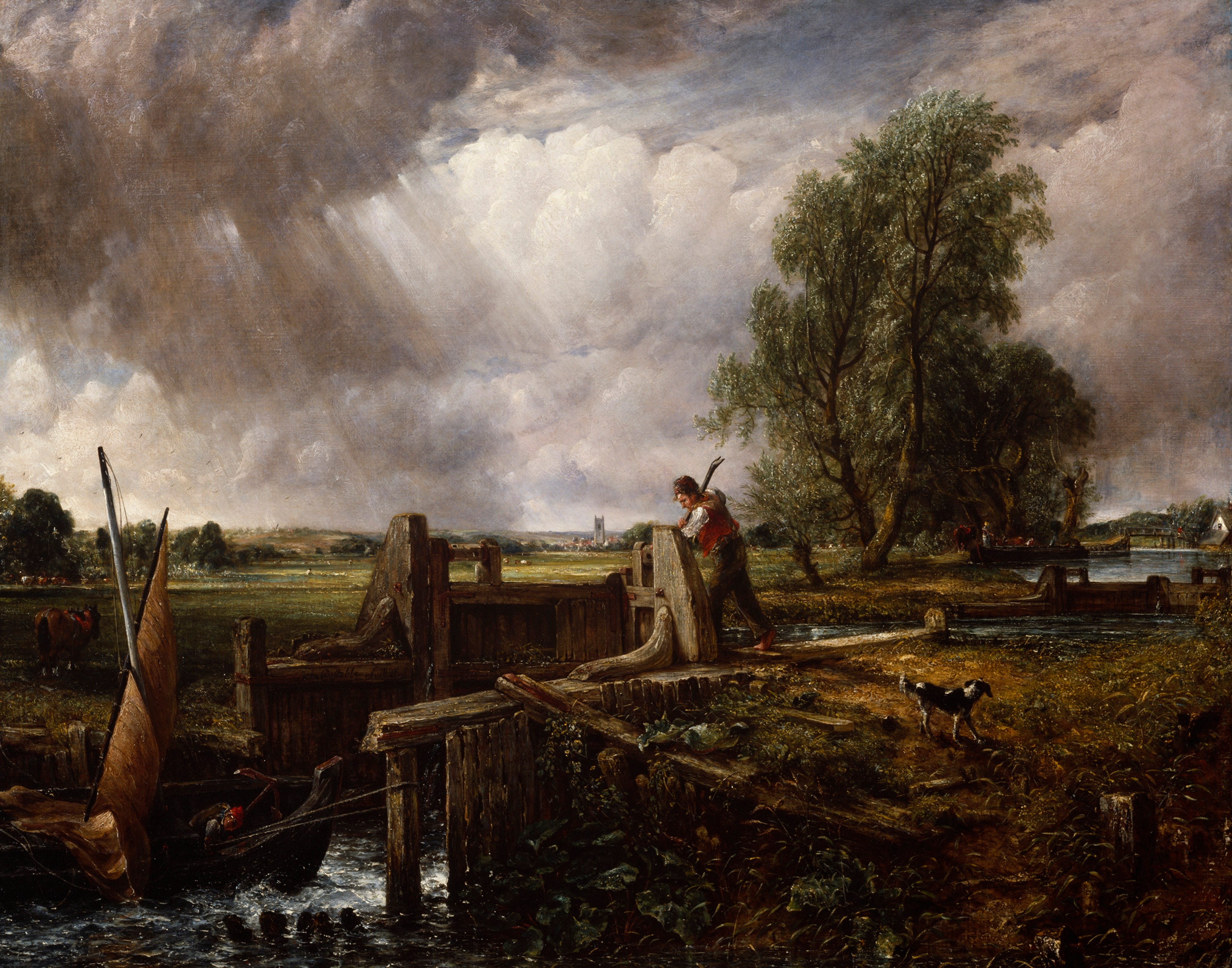
I find this a remarkable painting, one of Constable’s greatest. It is the drama of the moment — the lock keeper, who has unbuttoned his red waistcoat, is opening the gates of the lock with a crowbar (or some such tool), and the great weight of water is beginning to seep and spill into the lower reach of the river.
The waiting boat with its orange sail, furled and drooping in the water, is jostling around, pulling against the timber to which it is tethered. The boatsman keeps low to hold his balance. His tow horse waits in the water meadow behind.
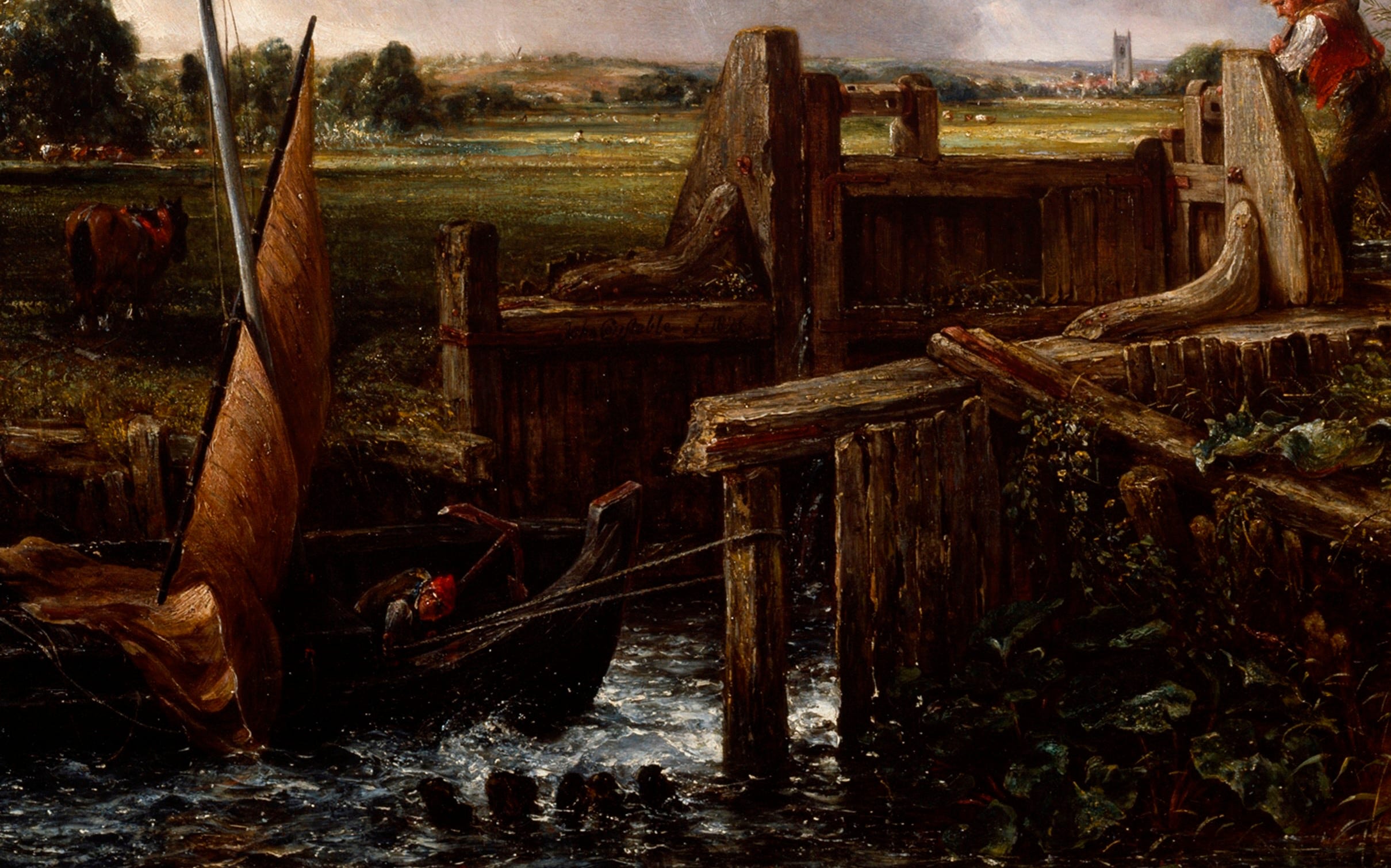
The scene (I should have mentioned before) is of Flatford Lock, with Dedham Church dead centre, and to the right, along the river, Flatford Old Bridge. It’s rarely if ever pointed out that the timber structure of Flatford Lock was built in the year Constable was born, 1776, and replaced with a new structure the year after he died.
Flatford Lock was Constable, and his paintings of it are a self-portrait in timber, which he paints with an unerring brush, transforming the striations of paint into the grain of wet timber with unspeakable alchemy. It is a self portrait that he signs.
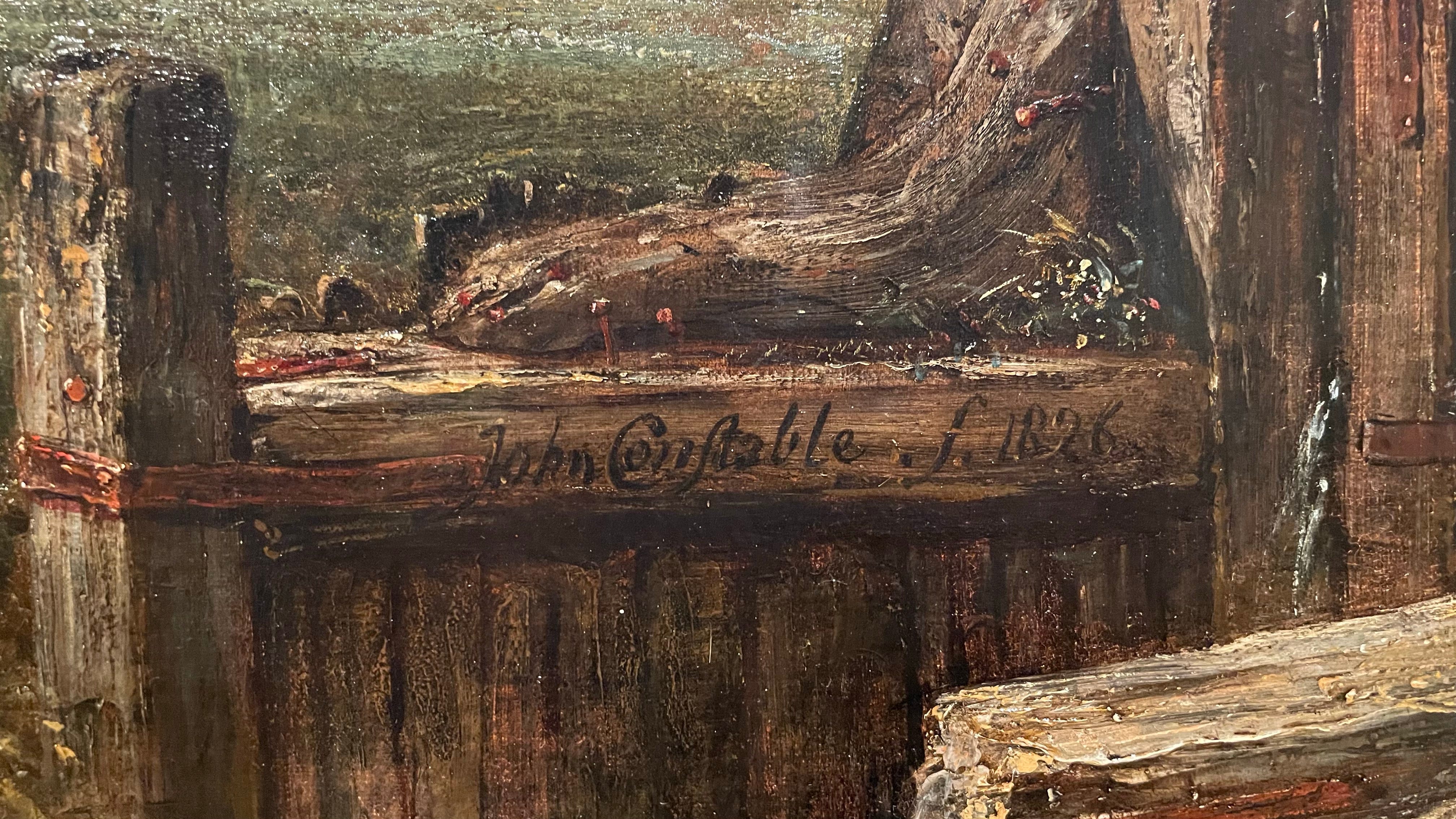
It would be a wonderful symbol for life, if Constable was a symbolists — the ups and downs, the buoyancy of happiness, the emptiness of depression. But with Constable a wooden lock is a wooden lock, and it is enough to love the wood from which it is made.
In the wider picture, the landscape seems to magnify and aid the lock keeper in his heroic and somehow magic task: to lower, then raise, a river, so that a boat might continue its journey towards the ocean.
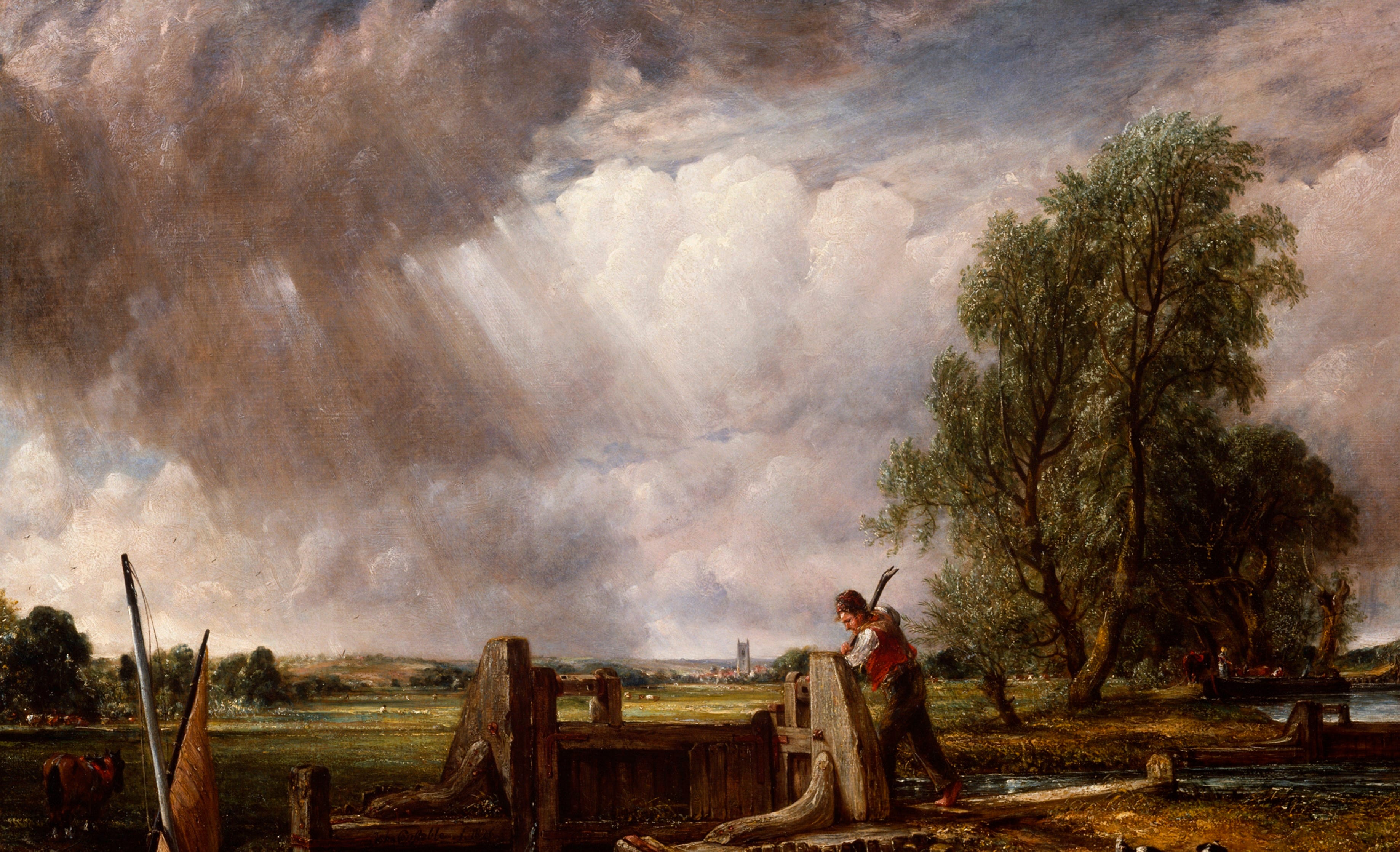
Dark clouds sweep in from the left, shedding light and water over the fields where scythesmen cut the hay, and horses draw filled wagons, the summer rain seeming to fall into the bold timbers of the lock, an energy then channelled through the lock keeper and released into the twisting, bustling form of the two elm trees on the far side of the lock, whose silvery leaves reach up into the tense summer air.
The one problem with the painting (as so often with Constable) is the title: A Boat Passing a Lock. This is the title that it carried when it was submitted as Constable’s diploma piece to become a full RA in 1829. Fine, but the boat is not passing the lock, and the subject is clearly the lock keeper, and to title the painting otherwise seems wrong. Constable’s friend, John Fisher, referred to the first, upright version as The Navigator, a word used to describe those who had built the canals (thus ‘Navvys’), which didn’t stick. In the first version the figure is somewhat lost in foliage, but stands out far better in the second — The Lock Keeper it is, then.
This is what the picture does. It’s as if all nature is at work, transforming energy from sun and wind to the human labour of agriculture and commerce.
The important thing to note is that nobody else was making such powerful images of rural workers, or envisioning the landscape filled with the busy-ness of work.
Fifty years earlier George Stubbs had painted wonderfully rhythmic images of haymakers and reapers, but they were made with an eighteenth-century gloss, posed with fine linen and shiny buckles on their hayricks, as if they were the chorus from a Gilbert & Sullivan opera (it has been argued that people did dress up for harvesting, which seems more than likely, but still).
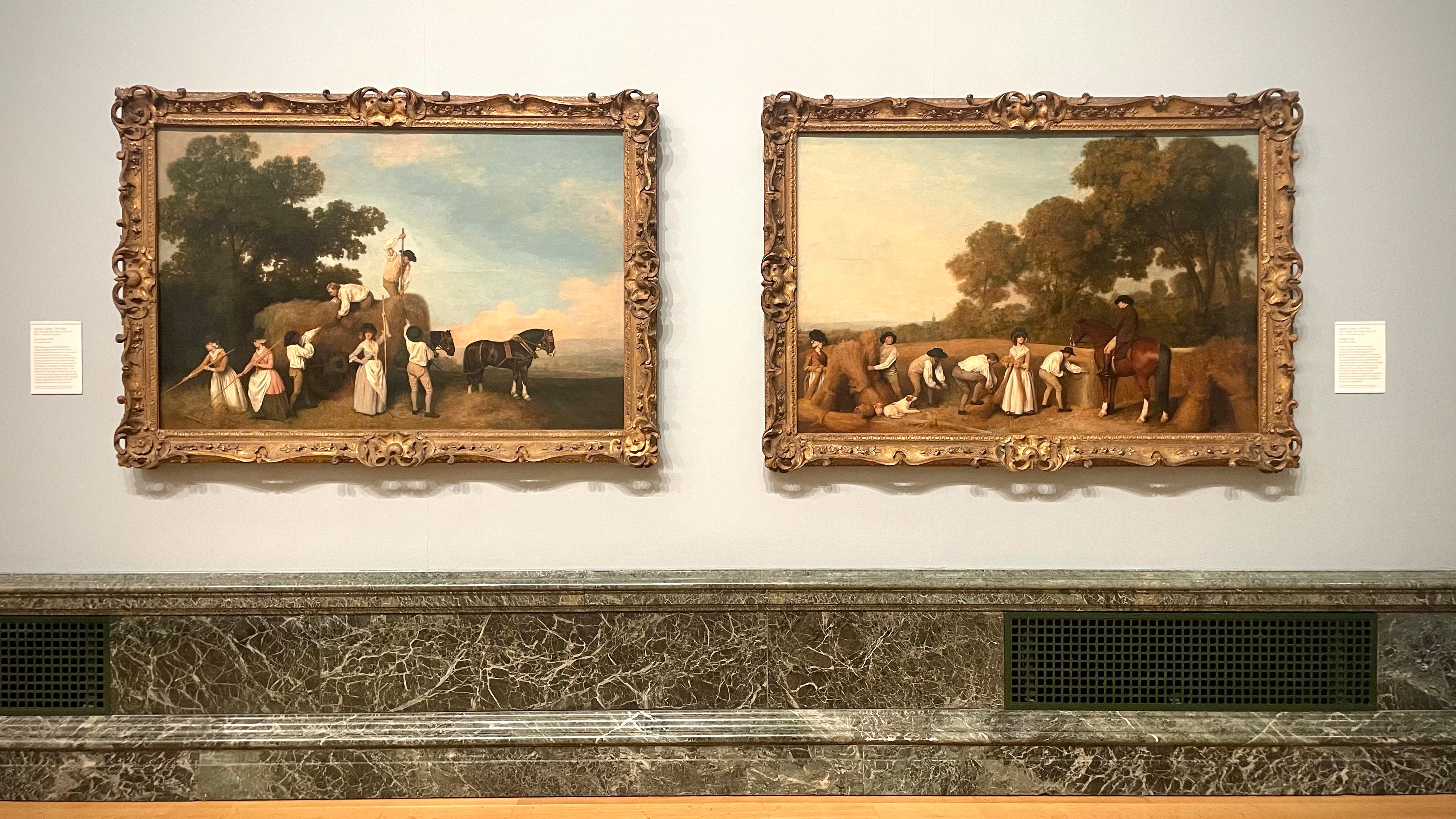
Constable’s world is never about to break out into song. His image of the lock keeper is animated by the roar of gushing water from Flatford Lock and the mill beyond, and by the sound of the wind over the vale.
A YEAR AFTER HE PAINTED the second version of The Lock, Constable travelled to Suffolk from London with his two eldest children, John Charles, then nine, and Maria Louisa, or Minna, then seven years old. It was October 1827, and this was the first time any of his seven children had seen his childhood home.
There is a wonderful letter from his brother, Abram, replying to John’s suggestion that he bring his family to stay at Flatford Mill:
‘I really don’t see how you can with prudence put your kind plan into execution this time, advanced as the season is [it was already the end of September] — & if it was possible to receive you at Flatford with your little ones, I think a more dangerous place for children could not be found on earth. It would be impossible to enjoy your company, as your mind would be absorb’d & engross’d with the children and their safety’.
John compromised and brought only the two eldest.
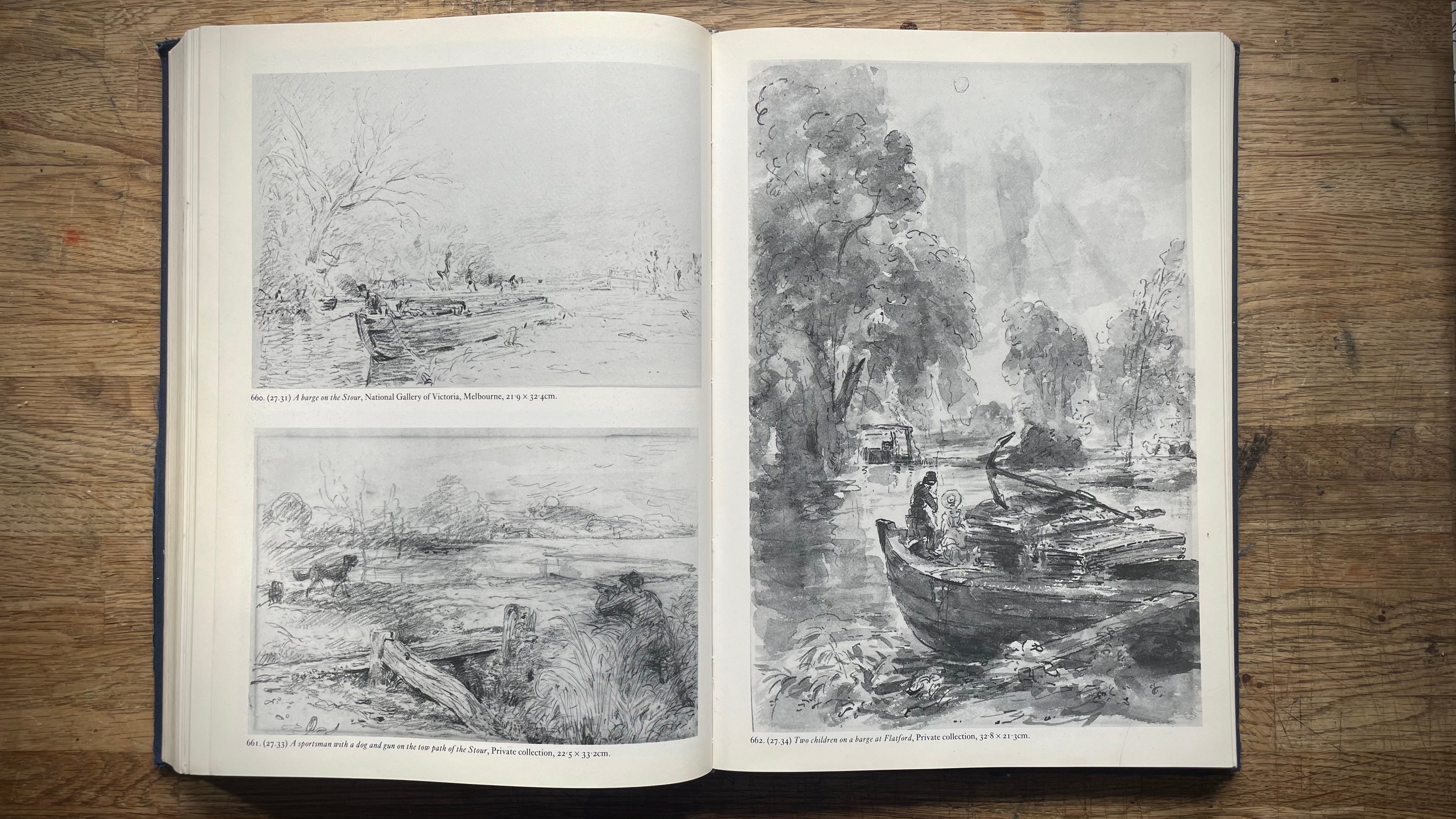
He drew them in a boat in the millpond, fishing. It is modest drawing (on the right in this image, reproduced from Graham Reynolds’s magnificent catalogue of Constable’s drawings and paintings), but filled with a sense of freedom and happiness.
On the same visit he made another drawing, showing Flatford Lock from beneath, the position from which he had first painted it three years earlier. He must have been standing, or more likely sitting in a boat to get this view.
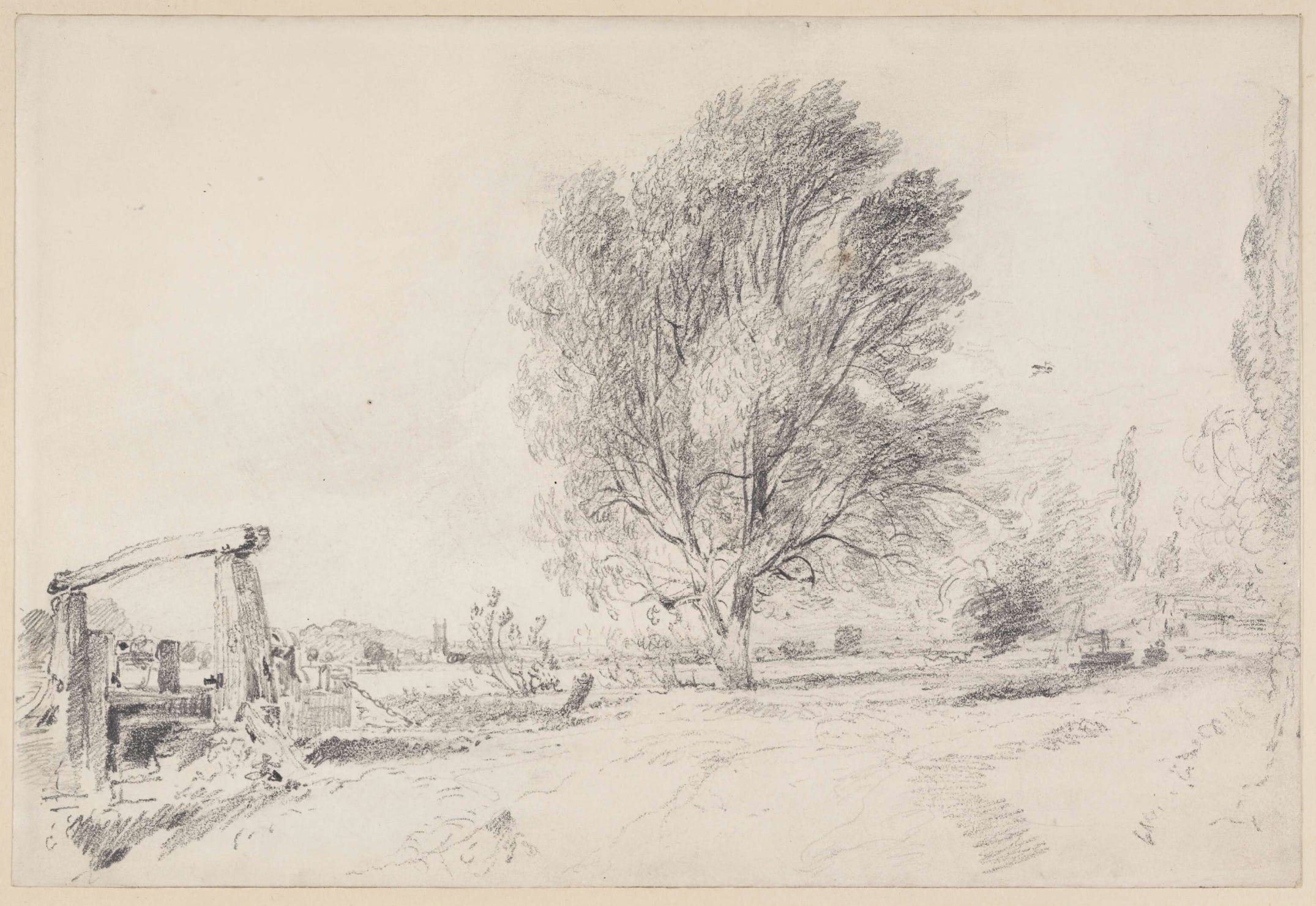
This drawing is filled with a sense of lightness and grace, a happiness that must have been in part the result of showing his children the place where the father had grown up, and recapturing through their eyes the ‘carefree boyhood ways’ that had shaped his own life as an artist.
An earlier drawing of Flatford Lock, which shaped the composition, is quite different in mood. It’s kept in the Fitzwilliam Museum in Cambridge:
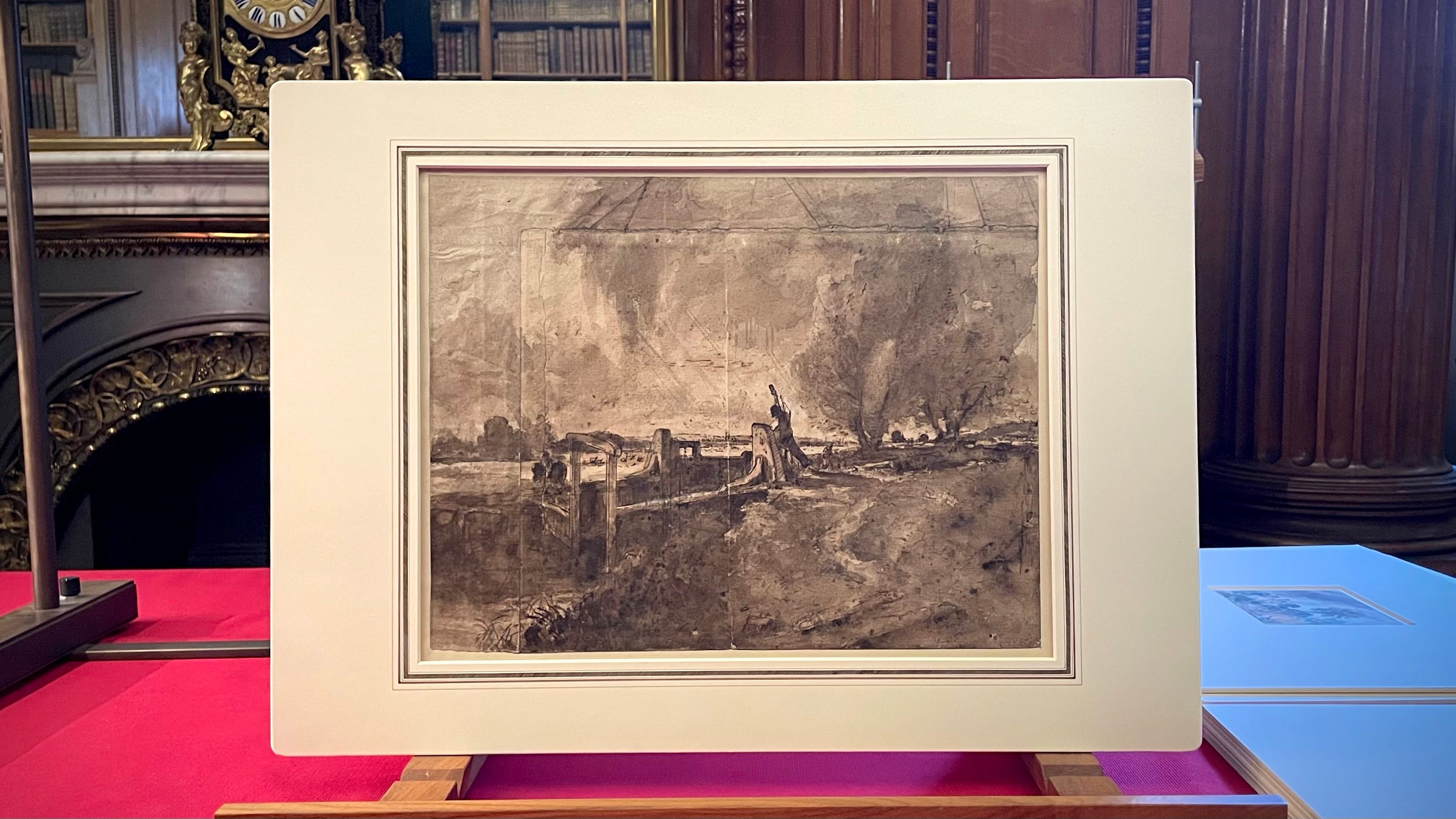
Constable drew with pen and ink on sketchbook page, adding sections of paper to the top and side to extend the scene into the landscape.
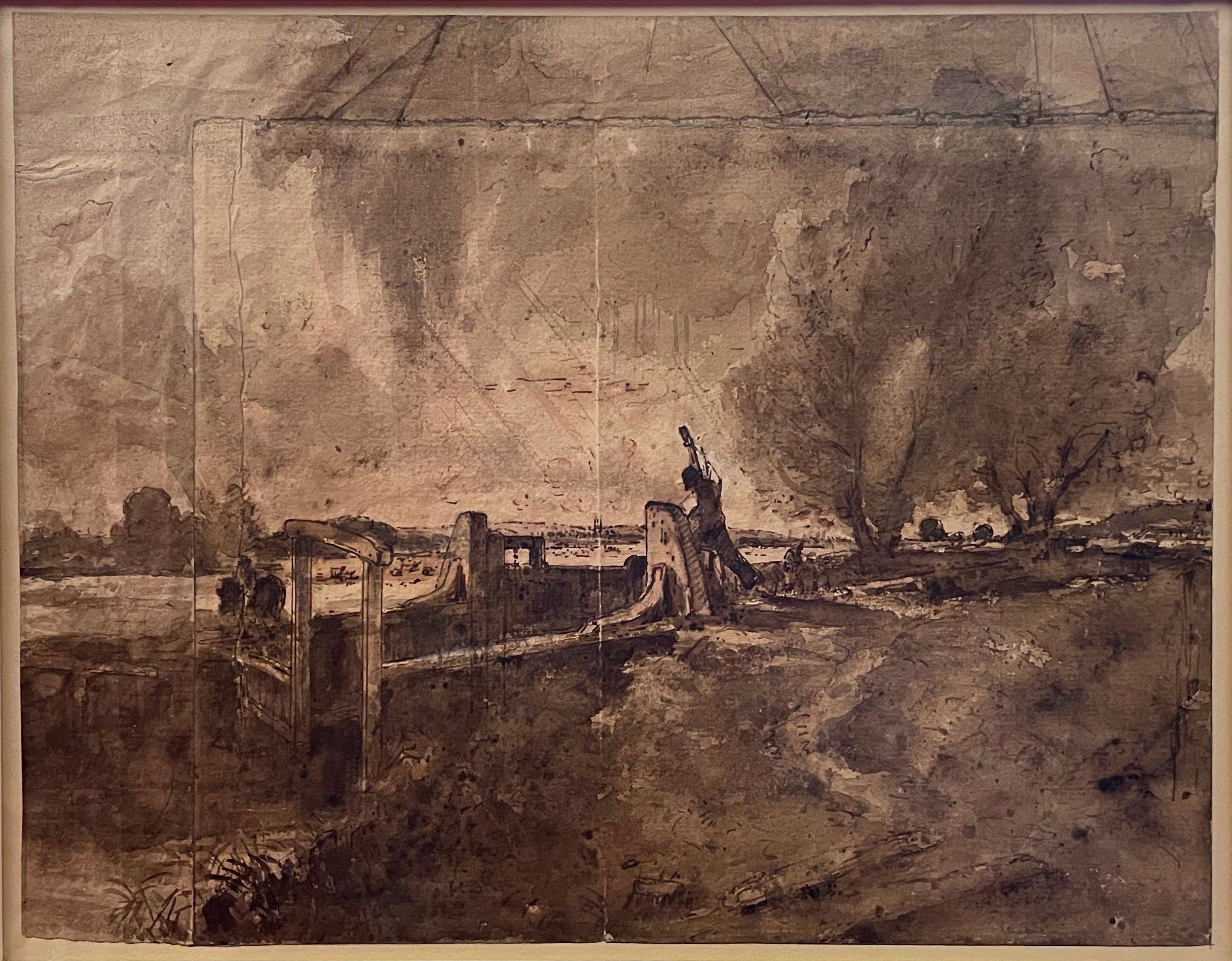
Dark clouds and streaks of rain seem to materialise on the thick wove paper, giving the chiaroscuro to the scene, the numinous and glowing light that Constable capture in his painting. It was the best piece of advice he had been given, by the painter Benjamin West: make your skies bright, not by avoiding dark or lowering skies, but rather by painting them with 'the dark of silver, not of lead or slate'.
The lock keeper is emptying the lock basin so that a barge, or lighter, might descend, continue on its journey downriver to Mistley Wharf, with a cargo perhaps of flour or Suffolk bricks, bound for London. (Incidentally one of the cargoes that the barges returned with was London sewage, ‘muck’ for spreading on the fields. See this previous post on the role of manure in Constable’s painting).
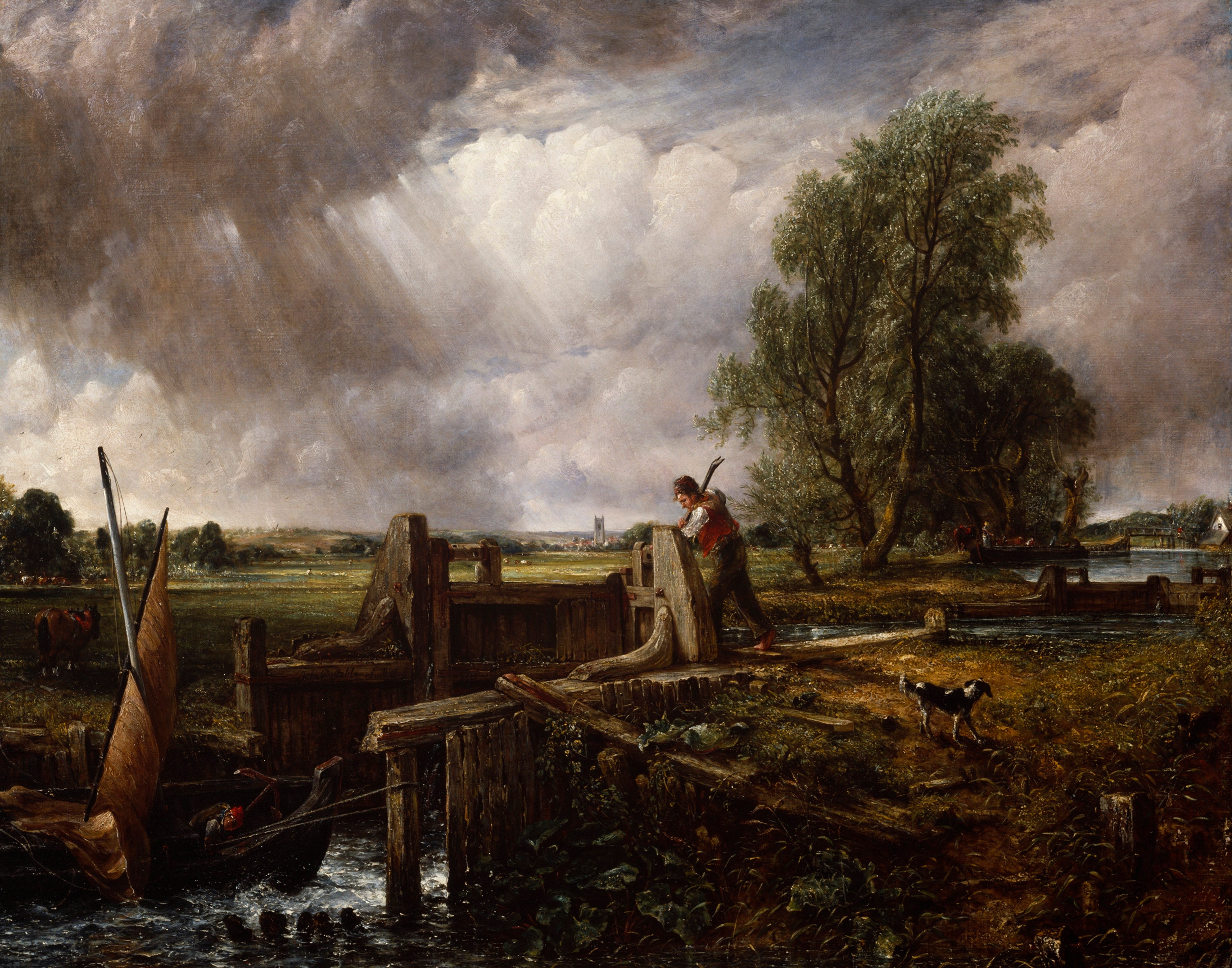
Looking back at The Lock in the light — and dark — of the Fitzwilliam drawing, it seems more than ever a landscape drama shot through with a troubling energy and a register of heroism. It is a feeling of the heroism of human agency in the world, one that reverberates in the timbers of the lock, the branches of the trees, and is magnified by the clouds and the weather, a moment of vision that stops the lock keeper’s dog in its tracks.
II
WHAT IS MORE IMPORTANT, art or life? A question, you might say, that great works of art themselves ask, by stepping out of art into life. This, it seems to me, is what Constable does, and the reason his paintings peak so urgently to us still.
The Lock, along with The Leaping Horse, was the culmination of Constable’s mission to elevate landscape painting in the eyes of the Academy. To make of it ‘high art’.
He referred to his mission as ‘natural painture’, hardly a catchy title for an art movement. But then Constable was more a self-sabotager than a self-publicist. He would have been terrible in an age of social media (as all the best people are).
Would things have been different had he, or somebody else on his behalf, coined the term ‘Realism’ to describe his paintings? A few decades later it was claimed by the French painter Gustave Courbet, in his 1855 manifesto, Le Manifest de Réalisme.
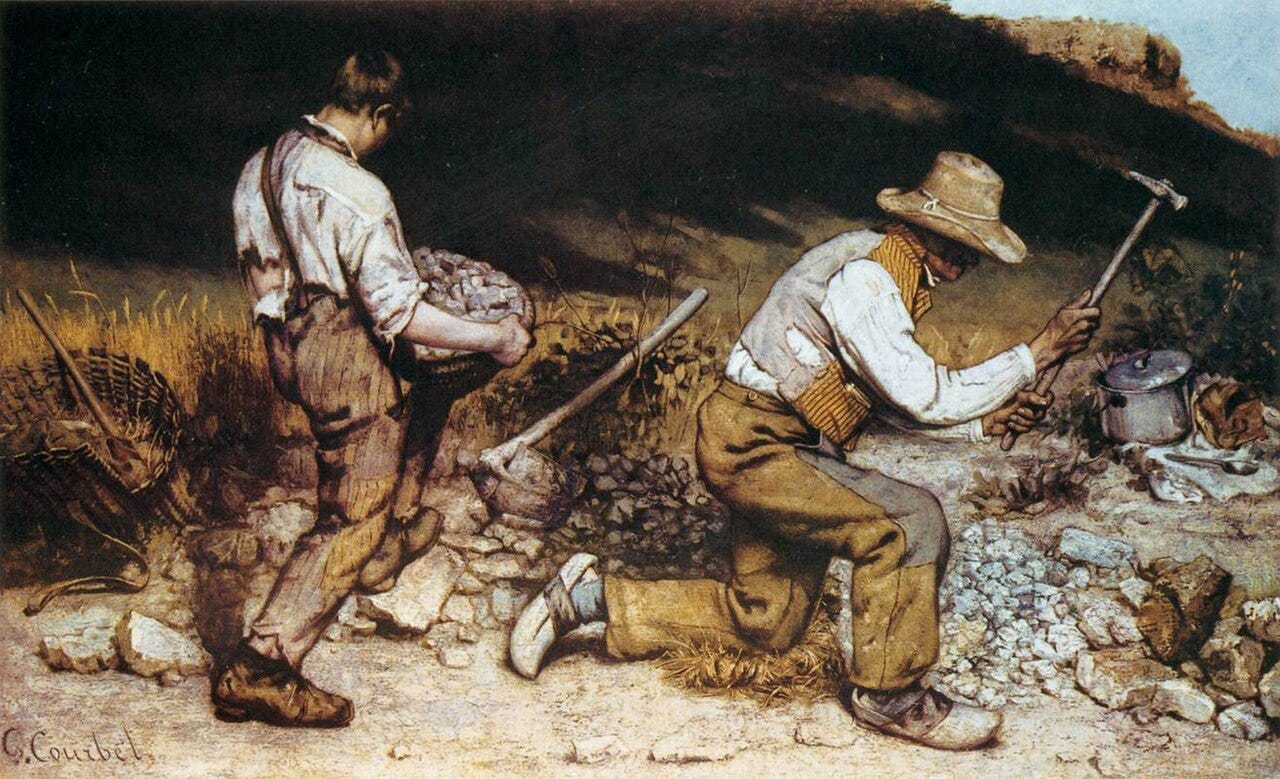
Probably not much, in truth, although the comparison with Courbet is telling. For all the weight of reality around his paintings, of men breaking stones on a rural road, of waves breaking on the coast of Normandy, of a trout flapping on the kitchen table (gasping for air like Madame Bovary was gasping for love, as Flaubert wrote), or of his great self-portrait in the studio, hanging in the Musée d’Orsay (below) Courbet remained (as the title of this painting suggests), an allegorical painter.
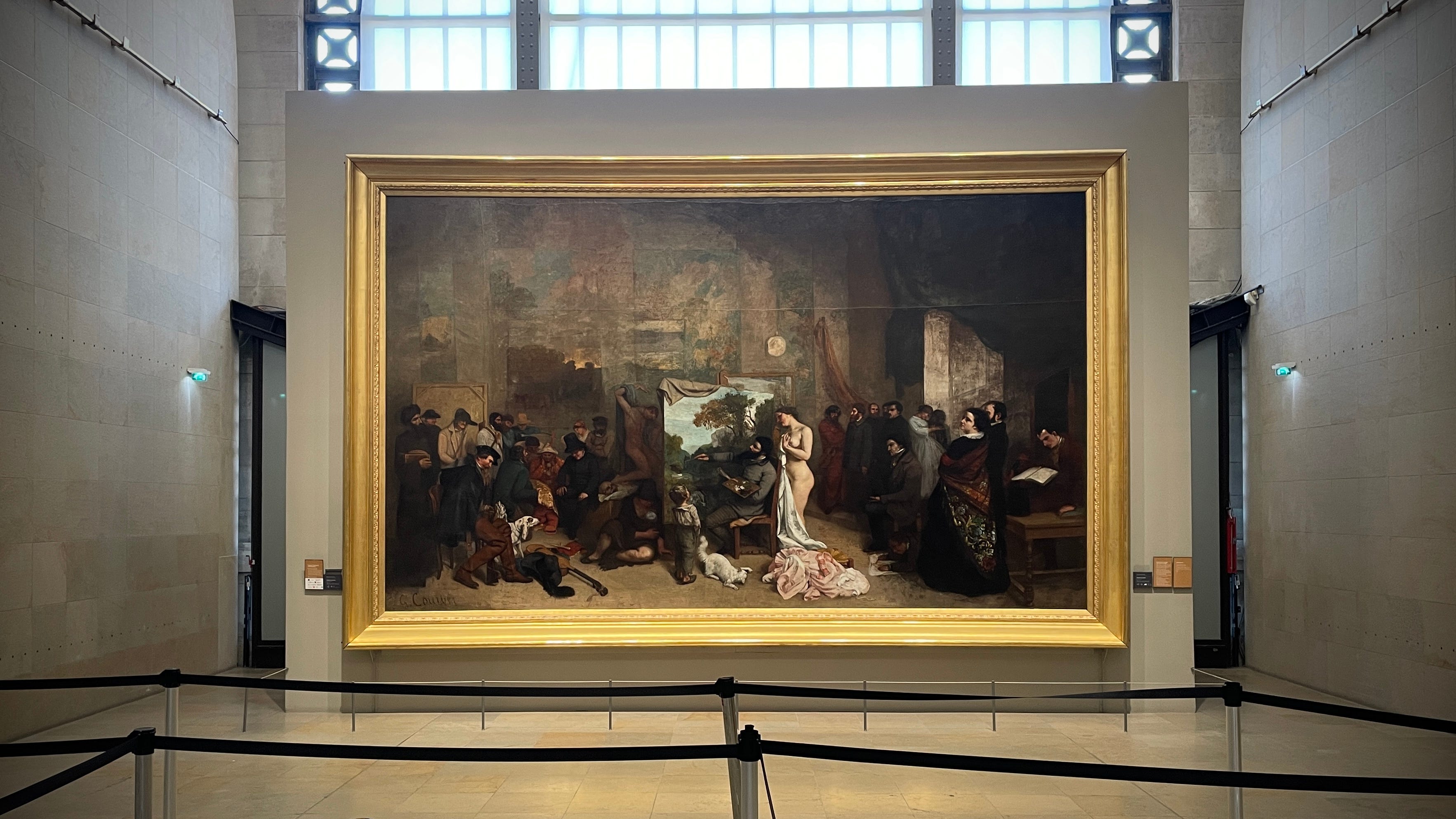
Although it is not stated anywhere, Courbet must have known of Constable’s paintings and their success in Paris in 1824 (when Courbet was however still a boy), and in particular Constable’s highly creative use of the palette knife. In The Painter’s Studio Courbet holds just such a knife ready for action, and is painting the river valley of his boyhood home, near Ornans in the Franch-Comté.
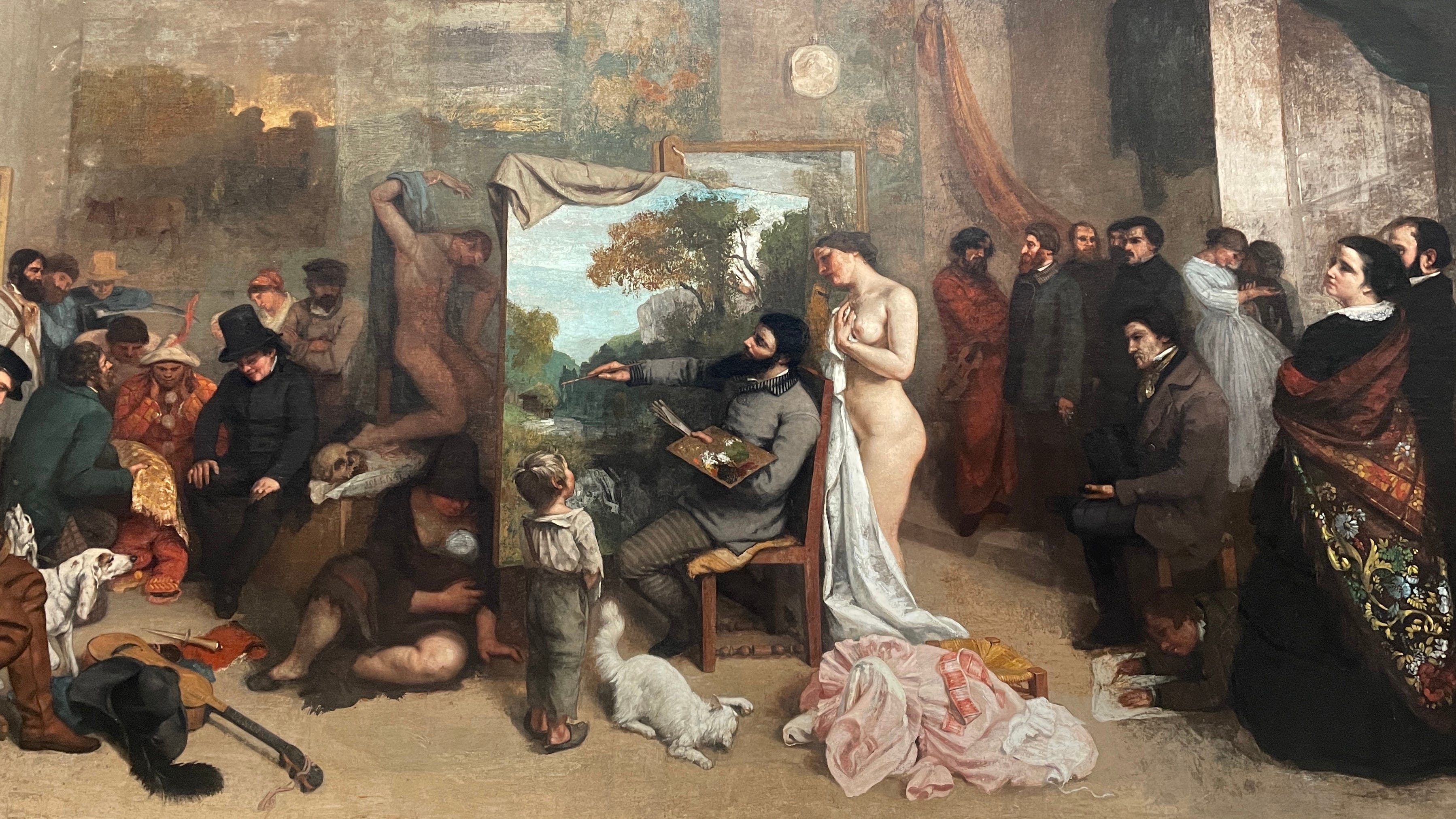
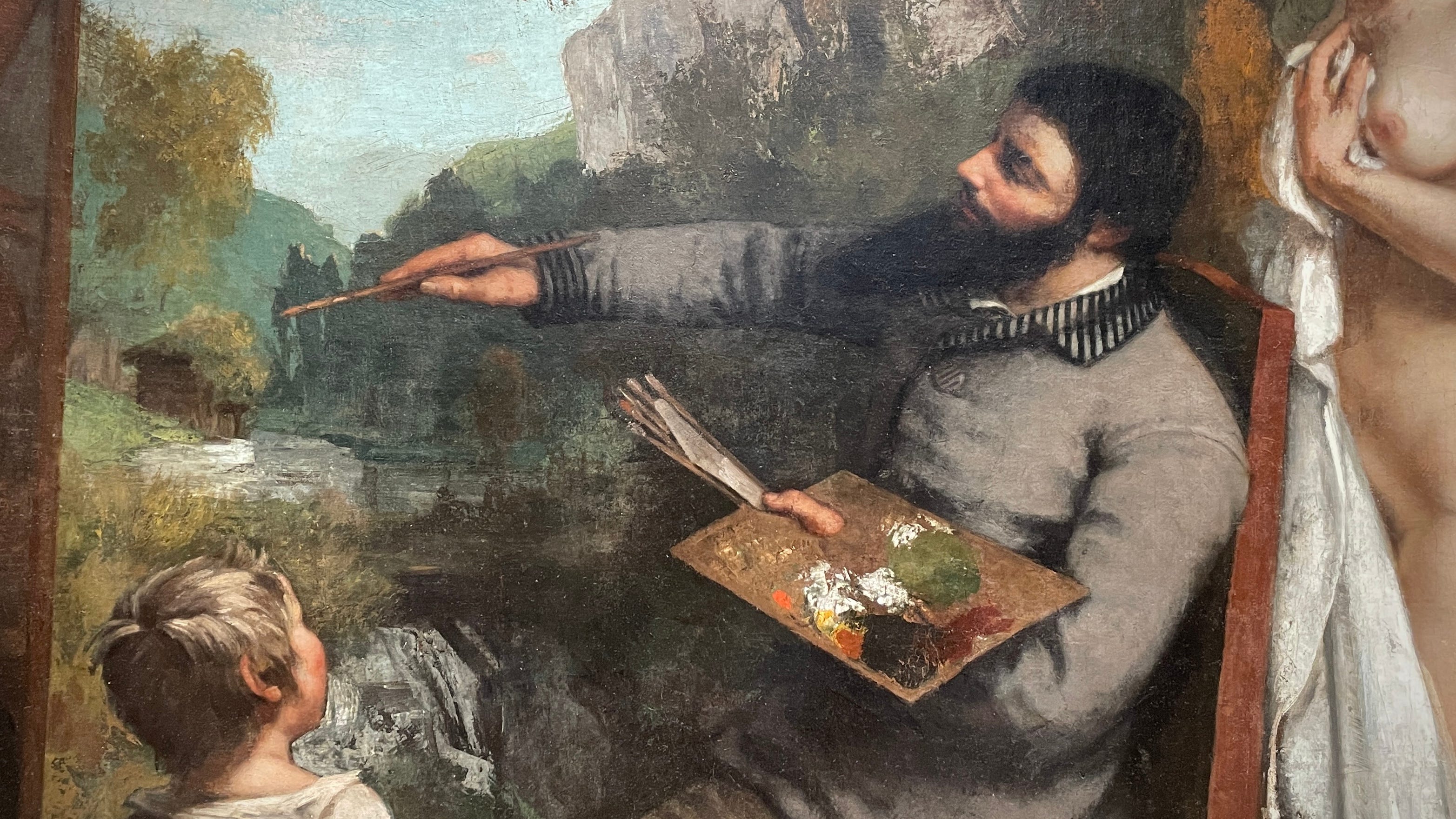
He is doing a Constable, but not.
Constable was the opposite of an allegorist. His own views on allegorical painting are well-expressed in a commentary he made, in his lectures on landscape painting, on Jacob van Ruysdael’s painting The Jewish Cemetery, which the artist referred to as ‘An Allegory of the Life of Man’. By intending his ‘ruins to indicate old age, a stream to signify the course of life, and rocks and precipices to shadow forth its dangers’, Ruysdael had, in Constable’s eyes, ‘attempted to tell that which is outside the reach of art’. Ruysdael may have intended these things — but ‘how are we to discover this?’, Constable asks.4 Quite.
Constable was a one of the greatest literalists in the history of painting.
So that rather than Constable & Courbet, a more revealing pairing (to talk in such terms), would be with another nineteenth-century painter who caught the echo of Constable’s paintings more directly, another great literalist, Adolph Menzel.
Although not primarily a landscape painter, much more an observer of urban scenes, Menzel’s paintings and drawings have the same feeling of reaching out and touching the world in the present as do those of Constable. This is one definition of what ‘literalism’ might mean.
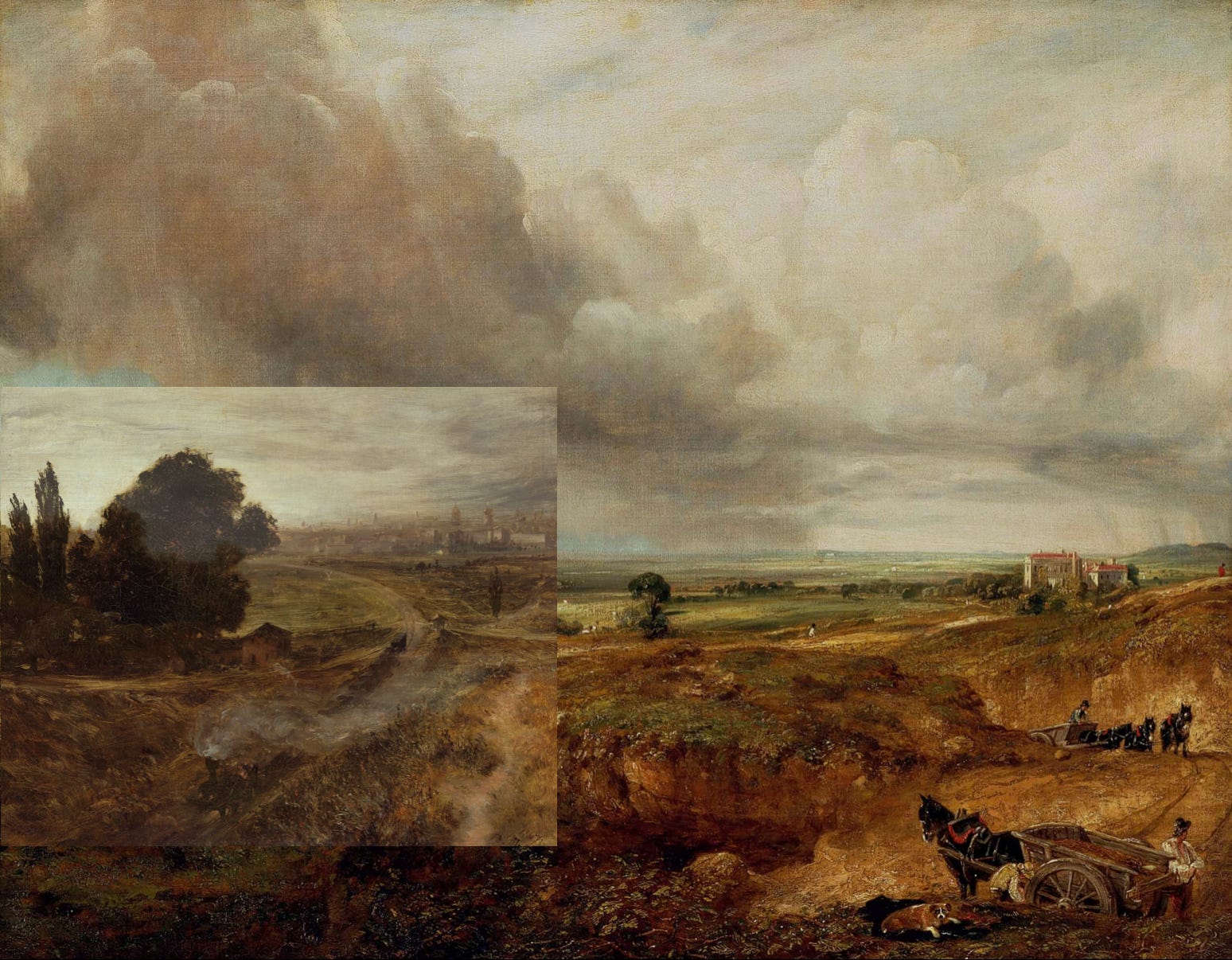
Here is Menzel’s well-known image of the Berlin-Potsdam Railway, the first passenger train in Prussia, curving its path through the scrubland outside of Berlin.
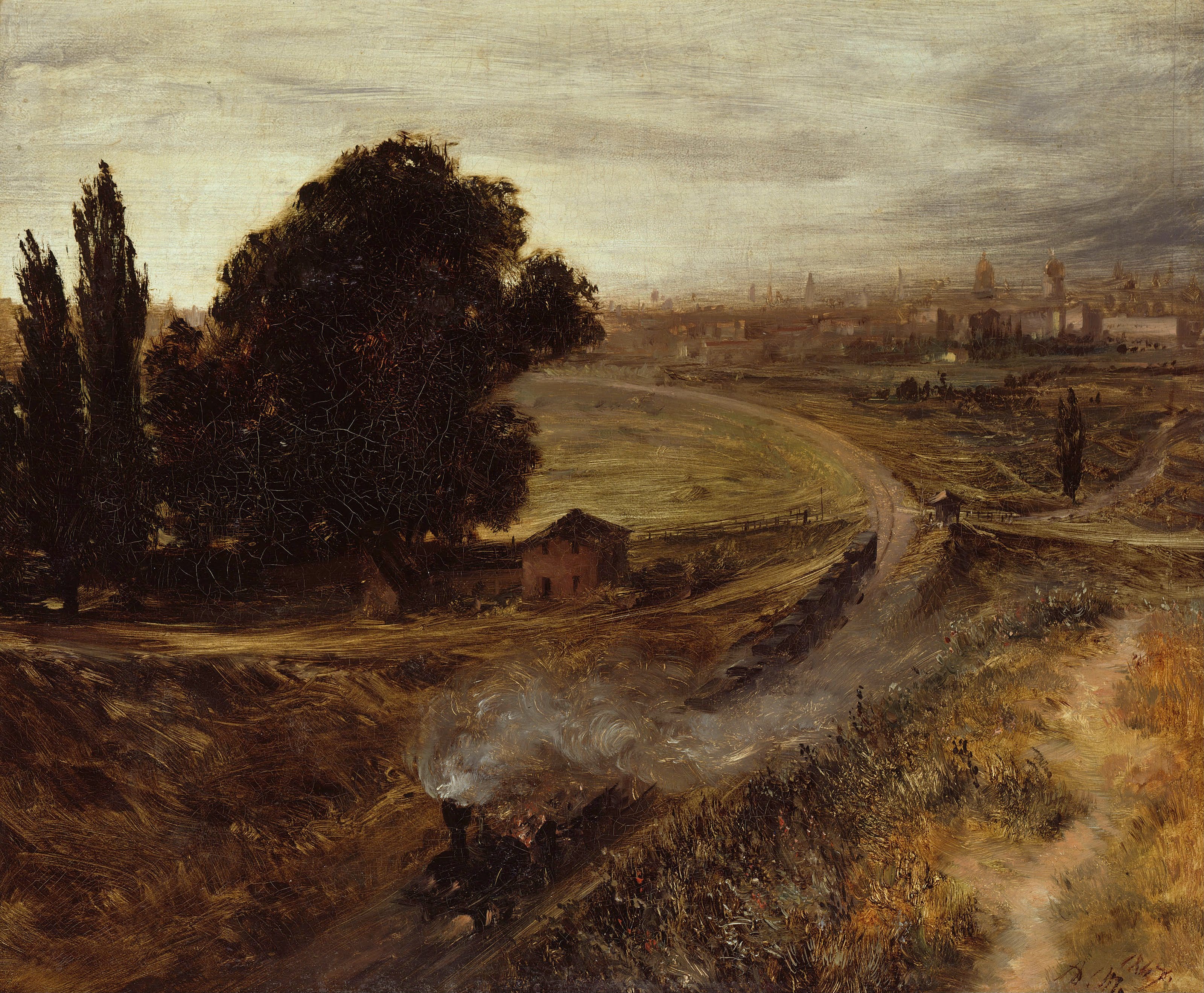
Here is the painting hanging in the Alte Nationalgalerie, on Berlin’s Museum Insel:
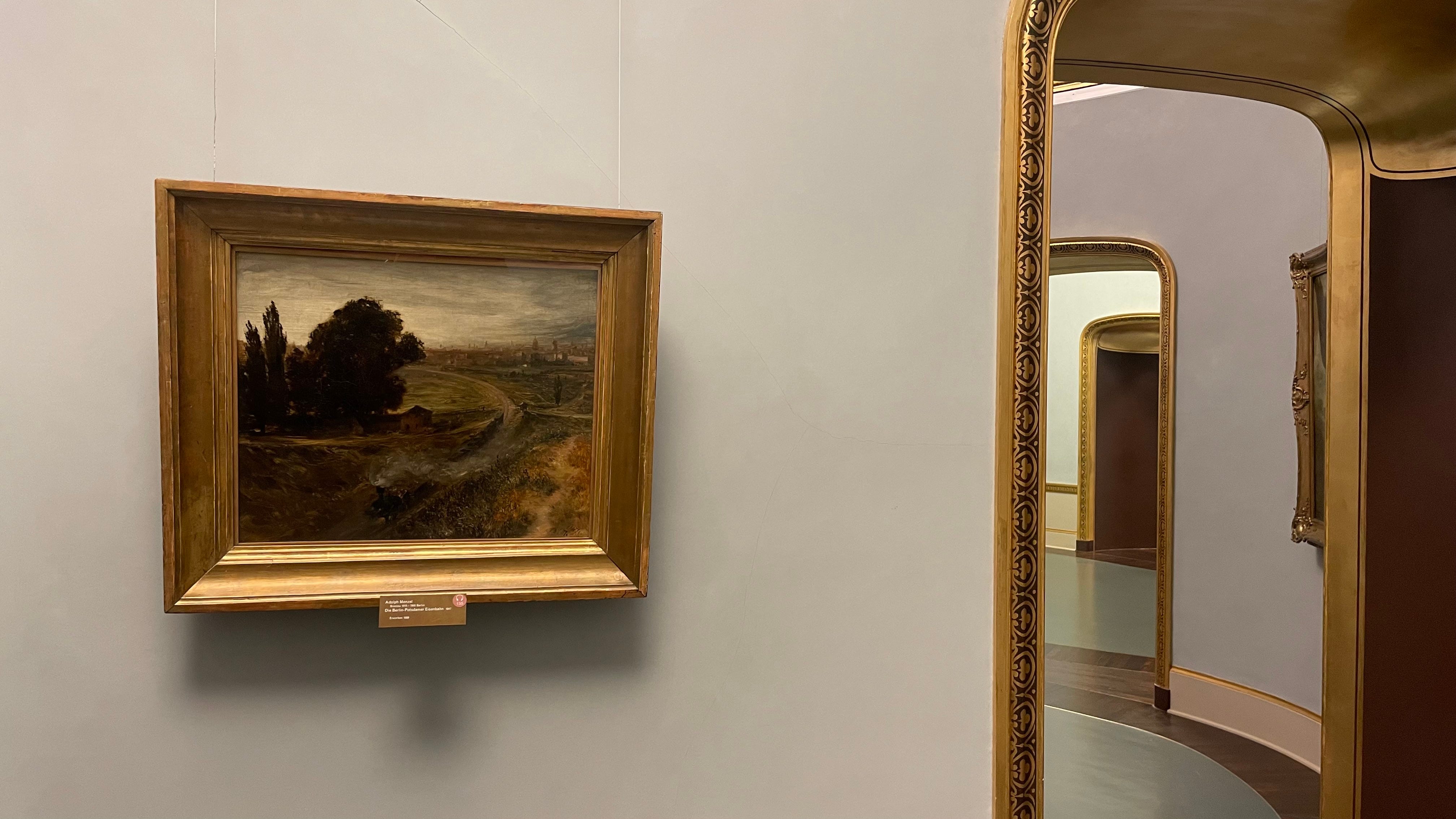
We seem to be looking back to a moment, almost two hundred years ago, with the same sense of astonishment as Menzel himself, and the same unwillingness to read into the painting any other than the idea that this was the world as it was.
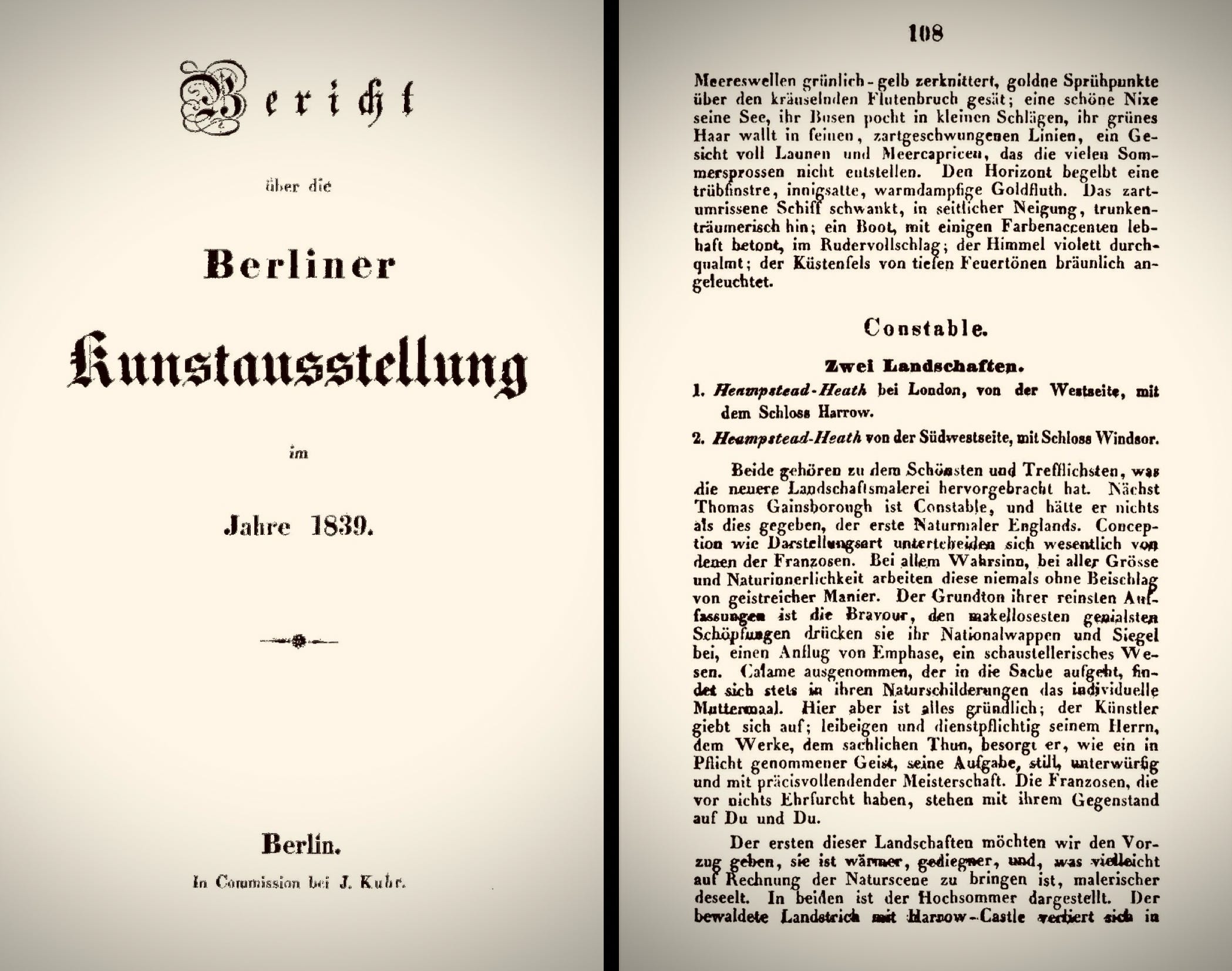
The story is often repeated how the twenty-four-year-old Menzel saw paintings by Constable in an exhibition in Berlin in 1839, and that this was a formative experience.
It has not before been known which paintings these were (niche art historical research discovery coming up), but they are listed in an obscure publication, the Bericht über die Berliner kunstausstellung im Jahre 1893, as two landscape views of Hampstead Heath:
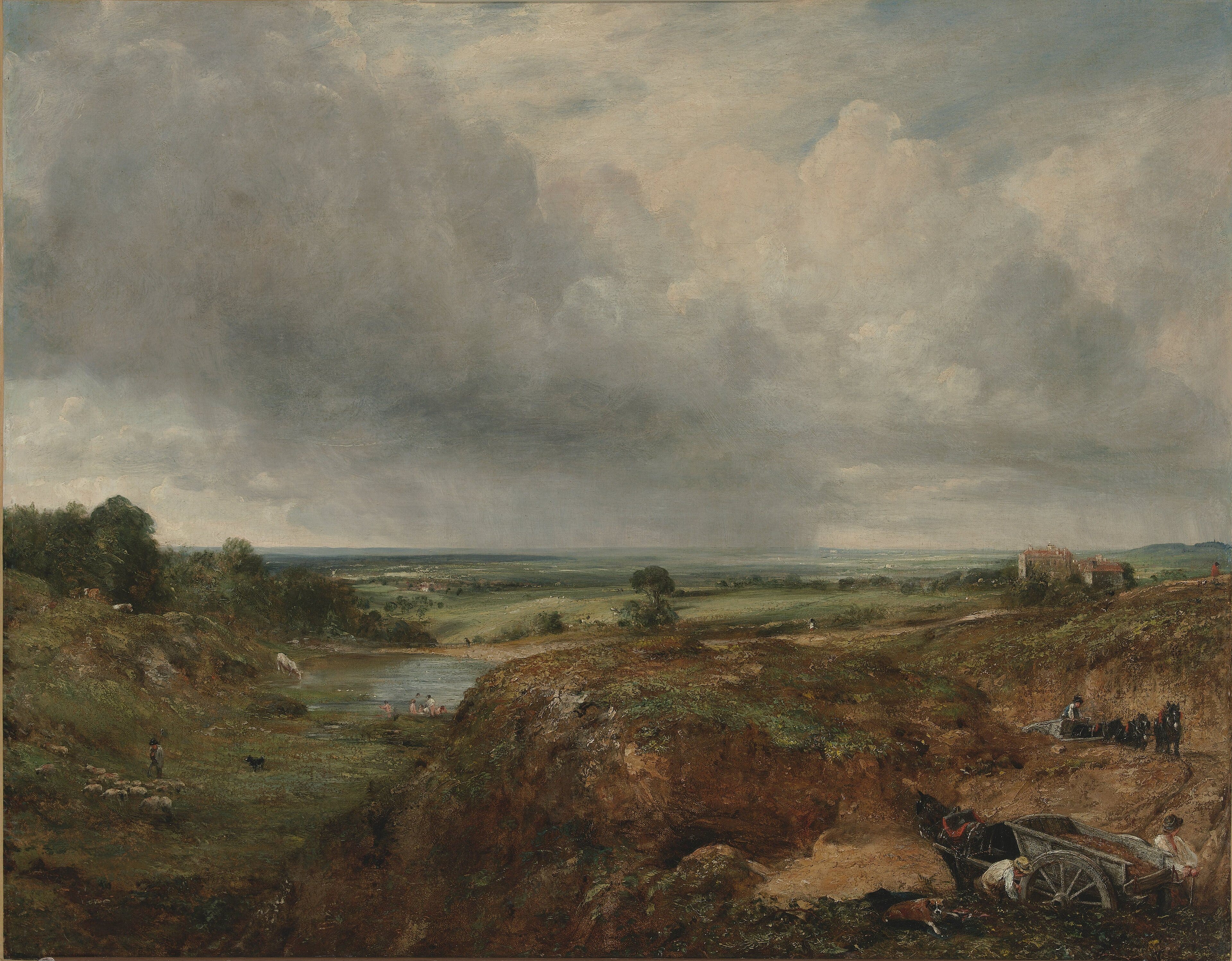
One of these paintings may well be the one below, a view of Hampstead Heath and Branch Hill Pond, with a view into the distance over the villages of Hendon and Kilburn, to the distant realms of Berkshire where a raincloud darkens the horizon. The painting is now in the Virginia Museum of Fine Art in Richmond.
It is the view of Windsor Castle (‘Schloss Windsor’ in the German catalogue) - a tiny smudge of white — that creates the link; Constable mentions this in a letter to the first purchaser of the painting, Francis Darby, of Coalbrookdale, identifying the castle ‘just to the right of the rain cloud’.
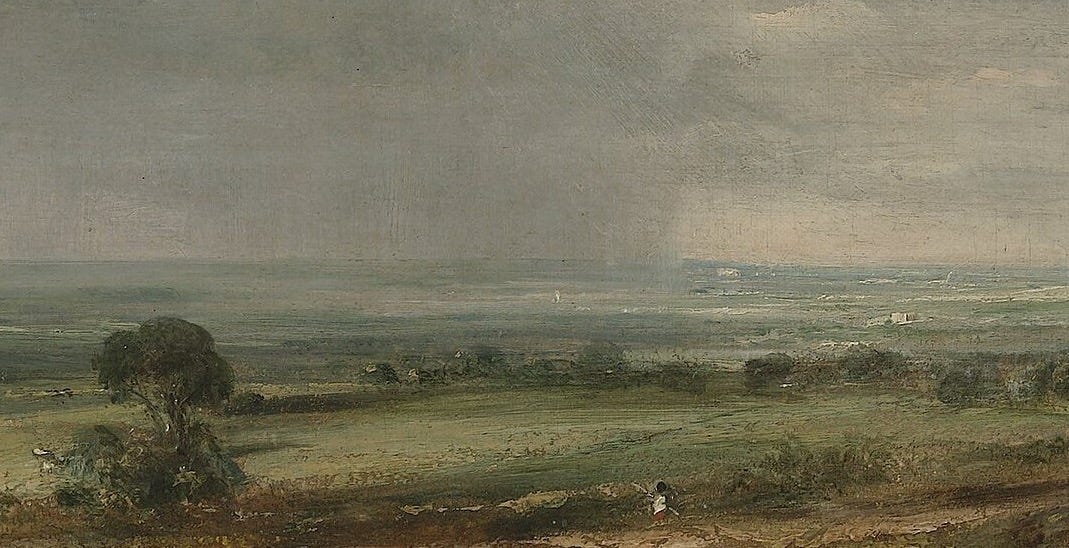
There is another version of the painting, now in the Oskar Reinhardt Foundation in Winterthur, also with the tiny white blot of Windsor, that might also be a candidate.
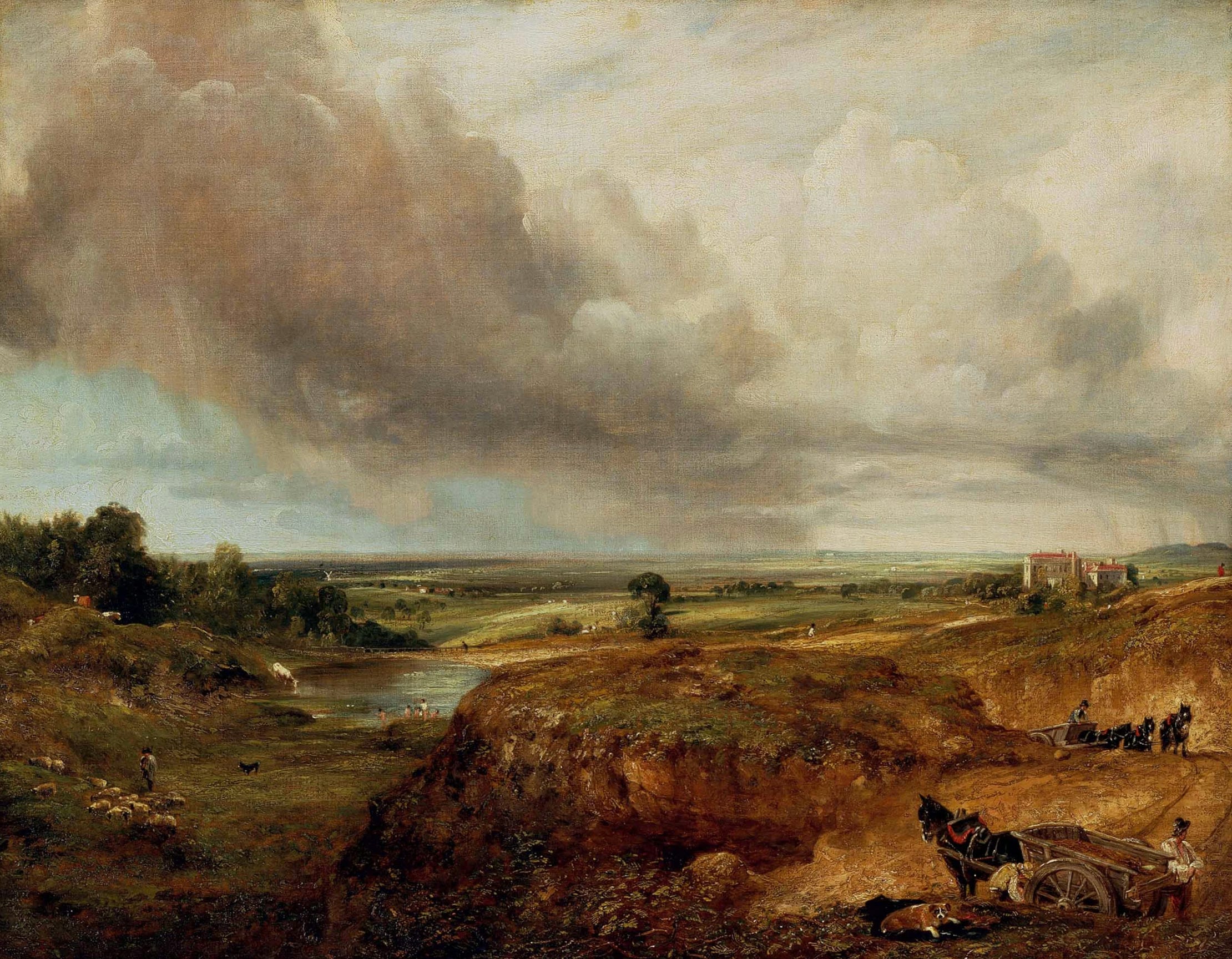
There are no other records of how the paintings might have got to Berlin, although you can see how it might have formed Menzel’s own painting-mind, in his famous image of the Berlin-Potsdam Railway, which seems to be carving a line through Constable’s Hampstead Heath:
THE OTHER GREAT LITERALIST of ninenteeth-century painting was Paul Cézanne. Constable, Menzel, Cézanne — that would be an exhibition.
Cézanne’s literalism was not a matter of realism ala Menzel, more of an almost painfully honesty of transcription and transformation, evolving a style that appeared to show the play of light and colour, the sensation and vibrations of light in the air, as every writer on Cézanne points out.
I like to think of his boy in a red waistcoat, in the National Gallery in Washington, as the jaded son of Constable’s Lock Keeper.
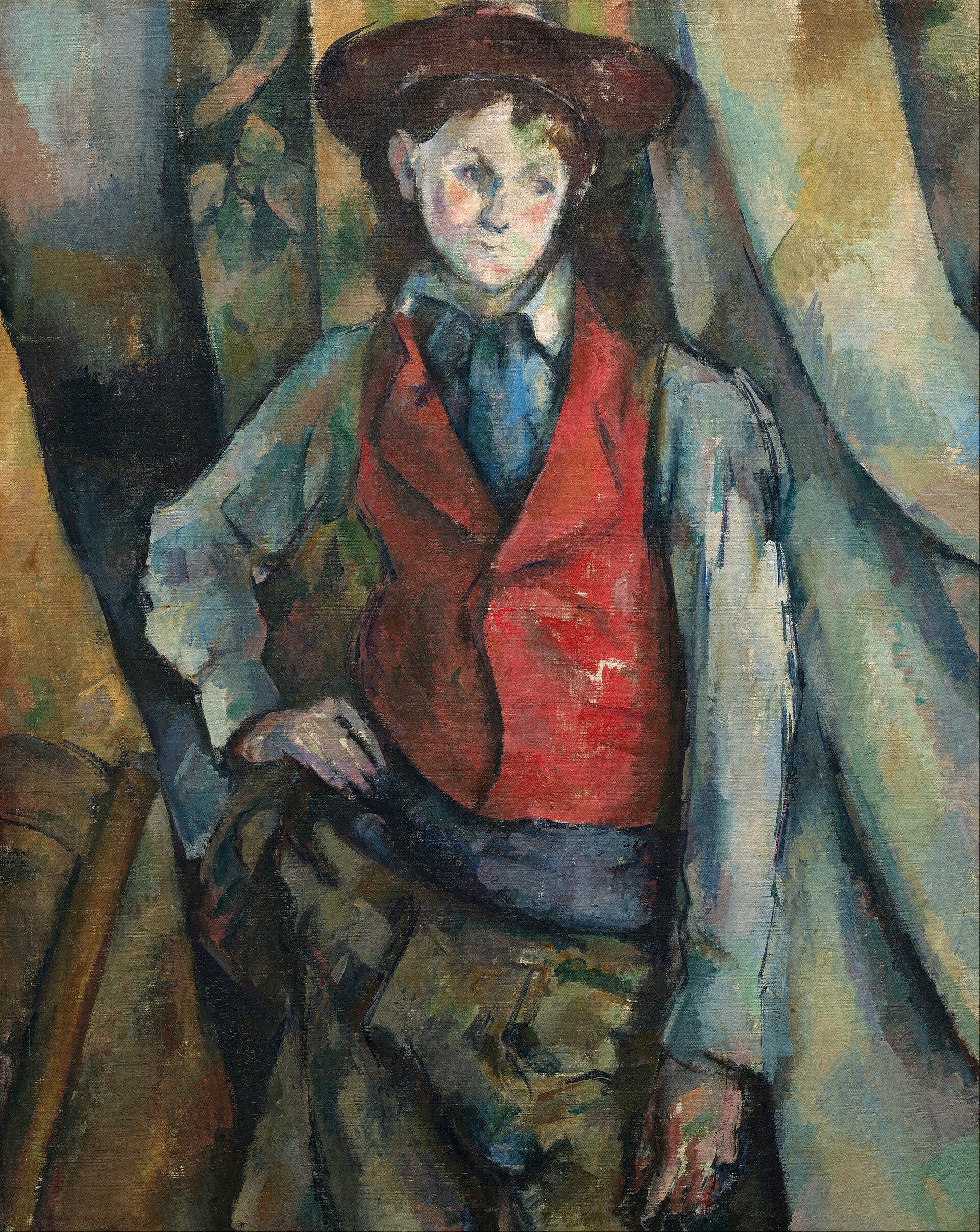
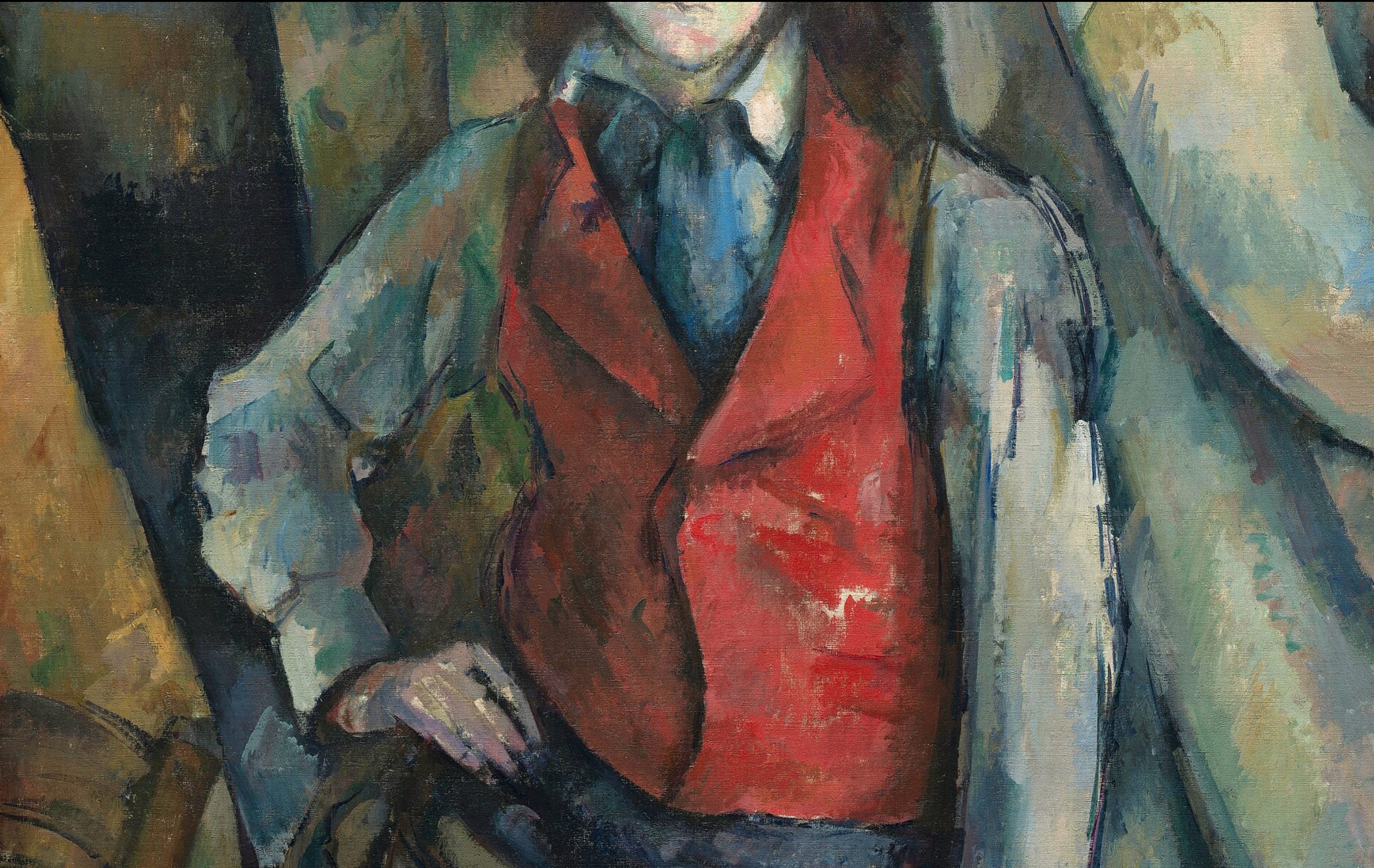
In truth it is not the subject that links them, but rather the technique, the unsmooth surface of paint that Cézanne made his own, and which Constable described as the ‘broken ruggedness’ of his style.
And moreover Cézanne as the painter of a circumscribed landscape, a painter thoroughly rooted in place. What Dedham Vale was to Constable, the environs of Mont Sainte-Victoire in Provence were to Cézanne (more on the painting below here).
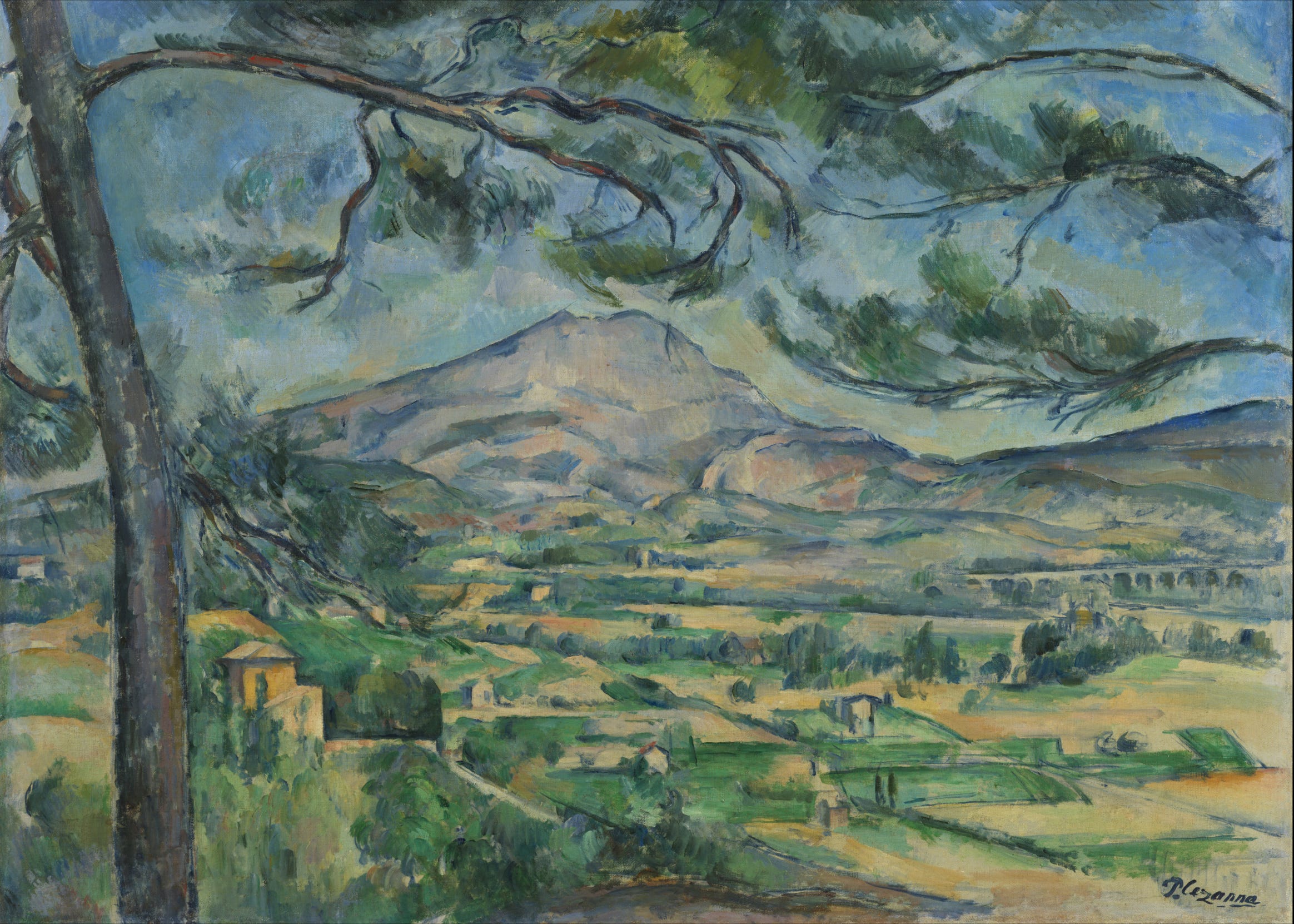
Perhaps the comparison with Cézanne is pushing it a little. And yet the connections are there, beneath the surface of the earth. There are no symbols, no allegory, no riddles to unlock. The Mont Sainte-Victoire with Large Pine is a literalist painting, precisely because, like Menzel and Constable, it shows a corner of the world as a microcosm. It is precisely because it is not speaking of elsewhere, in an allegorical register, that it is allowed to speak for everywhere.
And this is what Constable does too, efface all sense of ‘elsewhere’ to create images that are microcosms, and to make of Dedham Vale itself a microcosm of the world at large, and thus an image of the sheer astonishment at being alive, the never-ending strangeness of the world in which we find ourselves.
In a quite remarkable way, his paintings can be combined to form such a microcosm — a panoramic view of the Stour Valley that, while having no basis in Constable’s intentions, still appears a moving vision of the great breadth of his vision, of his ambition for painting literally to encompass the world:
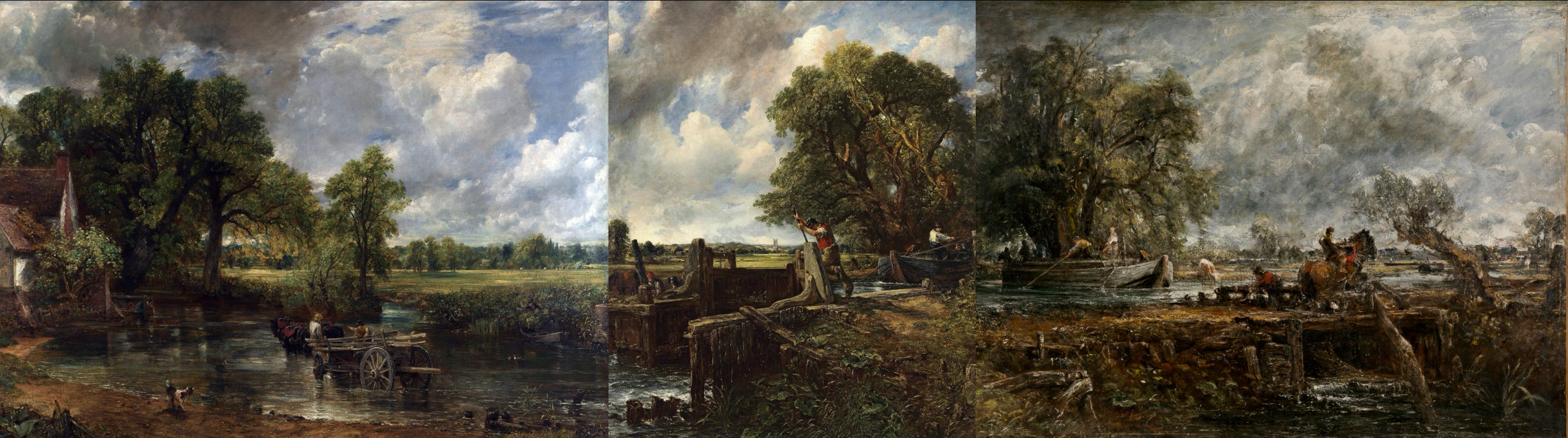
‘We are no doubt placed in a paradise here if we choose to make it such’, Constable stated in one of his great lectures on landscape painting, a lecture he concluded with lines from Milton:
Ye hills and Dales, ye Rivers, Woods, and Plains,
And ye that live and move, fair Creatures, tell,
Tell if ye saw, how came I thus, how here?
This text is taken from ‘The Lock’, a lecture given in the Britten Studio at Snape Maltings, Suffolk, on the 16th March 2026. It was the fourth in a series of six lectures on the painter John Constable.
With thanks to the artist for providing the image, reproduced here for the first time (my title) as What is more important, life or art?; 2022, Anonymous.
Eric Hobsbawm and George Rudé, Captain Swing, London 1969, pp.15-16
Michael Rosenthal, Constable. The Painter and his Landscape, 1983, p. 211.
R.B. Beckett, John Constable’s Discourses, Ipswich 1970, p. 64.
A wonderful read!
This is an amazing article, one which manages to offer a tour de force of Constable’s own work while also seeing it in the context of today and back then. Thank you for writing!